Jing Xu, Xinqi Luo, Hanxiao Chen, Bin Guo, Zhenlong Wang, Fu Wang
{"title":"Machine Learning-Aided Intelligent Monitoring of Multivariate miRNA Biomarkers Using Bipolar Self-powered Sensors","authors":"Jing Xu, Xinqi Luo, Hanxiao Chen, Bin Guo, Zhenlong Wang, Fu Wang","doi":"10.1021/acsnano.4c16423","DOIUrl":null,"url":null,"abstract":"Breast cancer has become the most prevalent form of cancer among women on a global scale. The early and timely diagnosis of breast cancer is of the utmost importance for improving the survival rate of patients with this disease. The occurrence of breast cancer is typically accompanied by the dysregulation of multiple microRNA (miRNA) expression profiles. Consequently, simultaneous detection of multiple miRNAs is vital for the early and accurate diagnosis of breast cancer. In this study, a bipolar self-powered sensor was developed for the simultaneous detection of miRNA-451 and miRNA-145 breast cancer biomarkers based on the specific catalytic properties of enzymes. Selenides with a microporous hollow cubic structure were designed and prepared, which can markedly enhance the enzyme load and activity, as well as detection sensitivity, due to their extensive surface area and three-dimensional porous channel. The designed bipolar self-powered sensor platform is integrated into the commercial chip, and the signal is presented in the smartphone interface, thereby enabling real-time and continuous monitoring. Furthermore, machine learning was utilized to predict miRNA detection, which encompasses numerous stages, including data collection, feature extraction, model training, and validation. In comparison to the limited sensing efficiency of self-powered biosensors driven by enzyme biofuel cells, our bipolar self-powered sensor achieved simultaneous quantitative analysis of multiple miRNA targets, thereby providing a robust tool for a more comprehensive understanding of miRNA function and its association with cancers.","PeriodicalId":21,"journal":{"name":"ACS Nano","volume":"51 1","pages":""},"PeriodicalIF":16.0000,"publicationDate":"2025-02-26","publicationTypes":"Journal Article","fieldsOfStudy":null,"isOpenAccess":false,"openAccessPdf":"","citationCount":"0","resultStr":null,"platform":"Semanticscholar","paperid":null,"PeriodicalName":"ACS Nano","FirstCategoryId":"88","ListUrlMain":"https://doi.org/10.1021/acsnano.4c16423","RegionNum":1,"RegionCategory":"材料科学","ArticlePicture":[],"TitleCN":null,"AbstractTextCN":null,"PMCID":null,"EPubDate":"","PubModel":"","JCR":"Q1","JCRName":"CHEMISTRY, MULTIDISCIPLINARY","Score":null,"Total":0}
引用次数: 0
Abstract
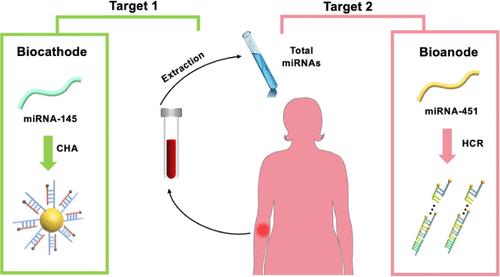
Breast cancer has become the most prevalent form of cancer among women on a global scale. The early and timely diagnosis of breast cancer is of the utmost importance for improving the survival rate of patients with this disease. The occurrence of breast cancer is typically accompanied by the dysregulation of multiple microRNA (miRNA) expression profiles. Consequently, simultaneous detection of multiple miRNAs is vital for the early and accurate diagnosis of breast cancer. In this study, a bipolar self-powered sensor was developed for the simultaneous detection of miRNA-451 and miRNA-145 breast cancer biomarkers based on the specific catalytic properties of enzymes. Selenides with a microporous hollow cubic structure were designed and prepared, which can markedly enhance the enzyme load and activity, as well as detection sensitivity, due to their extensive surface area and three-dimensional porous channel. The designed bipolar self-powered sensor platform is integrated into the commercial chip, and the signal is presented in the smartphone interface, thereby enabling real-time and continuous monitoring. Furthermore, machine learning was utilized to predict miRNA detection, which encompasses numerous stages, including data collection, feature extraction, model training, and validation. In comparison to the limited sensing efficiency of self-powered biosensors driven by enzyme biofuel cells, our bipolar self-powered sensor achieved simultaneous quantitative analysis of multiple miRNA targets, thereby providing a robust tool for a more comprehensive understanding of miRNA function and its association with cancers.
期刊介绍:
ACS Nano, published monthly, serves as an international forum for comprehensive articles on nanoscience and nanotechnology research at the intersections of chemistry, biology, materials science, physics, and engineering. The journal fosters communication among scientists in these communities, facilitating collaboration, new research opportunities, and advancements through discoveries. ACS Nano covers synthesis, assembly, characterization, theory, and simulation of nanostructures, nanobiotechnology, nanofabrication, methods and tools for nanoscience and nanotechnology, and self- and directed-assembly. Alongside original research articles, it offers thorough reviews, perspectives on cutting-edge research, and discussions envisioning the future of nanoscience and nanotechnology.



 京公网安备 11010802042870号
京ICP备2023020795号-1
京公网安备 11010802042870号
京ICP备2023020795号-1

 分享
分享
 求助内容:
求助内容: 应助结果提醒方式:
 扫码关注我们
