Dasol Kim, Sungwon Kim, Jisu Jung, Jaeseung Kim, Sungwook Choi, Carl-Friedrich Schön, Changwoo Lee, Hyeonwook Lim, Jaehun Jeong, Sanghyuck Yu, Yeonsu Jeong, Hanjoo Lee, Sangsoo Kim, Daewoong Nam, Intae Eom, Dogeun Jang, Kyung Sook Kim, Seongil Im, Seungwu Han, Hyunjung Kim, Mann-Ho Cho
{"title":"Nonmelting Disordering Facilitated by Electron Delocalization","authors":"Dasol Kim, Sungwon Kim, Jisu Jung, Jaeseung Kim, Sungwook Choi, Carl-Friedrich Schön, Changwoo Lee, Hyeonwook Lim, Jaehun Jeong, Sanghyuck Yu, Yeonsu Jeong, Hanjoo Lee, Sangsoo Kim, Daewoong Nam, Intae Eom, Dogeun Jang, Kyung Sook Kim, Seongil Im, Seungwu Han, Hyunjung Kim, Mann-Ho Cho","doi":"10.1021/acsnano.5c00755","DOIUrl":null,"url":null,"abstract":"Disordering atomic structures offers a functionality hardly expected in ordered states, including phase-change memory and photonic computing, offering the potential to renovate von Neumann architecture for neuromorphic engineering with low latency. However, significant energy consumption during the disordering compromises the data reliability and integration efficiency, which is traditionally regarded to take place after melting. Here, we investigate time for disordering in isochronal and isochoric manners, challenging the conventional melt-quenching theory. The disordering times of pure Sb, Ag–In–Sb–Te, and In surpass that of InSb by over 50 times, despite a higher melting point and a lower laser absorption rate of Sb compared to InSb. This nontrivial contrast is elucidated by theoretical calculation that delocalized electrons enable flexible modification of bond lengths even below the melting points where undermined bond directionality provides room for atoms to depart from their original positions. Facilitated by delocalized electrons, specifically through metavalent and metallic bonding rather than covalent bonding, atoms can be disordered without undergoing melting, which aligns with the rapid disordering of Sb compared to that of InSb. The results bridge the unaddressed gap between chemical interaction and kinetic behaviors during the disordering and suggest design rules highlighting electron-delocalization rather than solely relying on melting points to improve energy efficiency.","PeriodicalId":21,"journal":{"name":"ACS Nano","volume":"1 1","pages":""},"PeriodicalIF":16.0000,"publicationDate":"2025-02-26","publicationTypes":"Journal Article","fieldsOfStudy":null,"isOpenAccess":false,"openAccessPdf":"","citationCount":"0","resultStr":null,"platform":"Semanticscholar","paperid":null,"PeriodicalName":"ACS Nano","FirstCategoryId":"88","ListUrlMain":"https://doi.org/10.1021/acsnano.5c00755","RegionNum":1,"RegionCategory":"材料科学","ArticlePicture":[],"TitleCN":null,"AbstractTextCN":null,"PMCID":null,"EPubDate":"","PubModel":"","JCR":"Q1","JCRName":"CHEMISTRY, MULTIDISCIPLINARY","Score":null,"Total":0}
引用次数: 0
Abstract
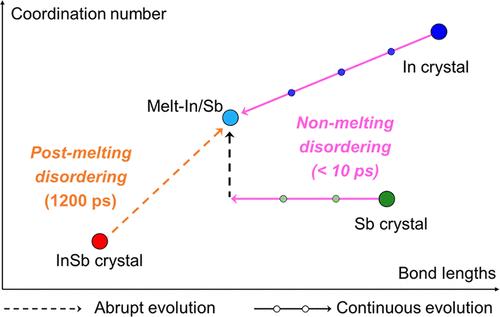
Disordering atomic structures offers a functionality hardly expected in ordered states, including phase-change memory and photonic computing, offering the potential to renovate von Neumann architecture for neuromorphic engineering with low latency. However, significant energy consumption during the disordering compromises the data reliability and integration efficiency, which is traditionally regarded to take place after melting. Here, we investigate time for disordering in isochronal and isochoric manners, challenging the conventional melt-quenching theory. The disordering times of pure Sb, Ag–In–Sb–Te, and In surpass that of InSb by over 50 times, despite a higher melting point and a lower laser absorption rate of Sb compared to InSb. This nontrivial contrast is elucidated by theoretical calculation that delocalized electrons enable flexible modification of bond lengths even below the melting points where undermined bond directionality provides room for atoms to depart from their original positions. Facilitated by delocalized electrons, specifically through metavalent and metallic bonding rather than covalent bonding, atoms can be disordered without undergoing melting, which aligns with the rapid disordering of Sb compared to that of InSb. The results bridge the unaddressed gap between chemical interaction and kinetic behaviors during the disordering and suggest design rules highlighting electron-delocalization rather than solely relying on melting points to improve energy efficiency.
期刊介绍:
ACS Nano, published monthly, serves as an international forum for comprehensive articles on nanoscience and nanotechnology research at the intersections of chemistry, biology, materials science, physics, and engineering. The journal fosters communication among scientists in these communities, facilitating collaboration, new research opportunities, and advancements through discoveries. ACS Nano covers synthesis, assembly, characterization, theory, and simulation of nanostructures, nanobiotechnology, nanofabrication, methods and tools for nanoscience and nanotechnology, and self- and directed-assembly. Alongside original research articles, it offers thorough reviews, perspectives on cutting-edge research, and discussions envisioning the future of nanoscience and nanotechnology.



 京公网安备 11010802042870号
京ICP备2023020795号-1
京公网安备 11010802042870号
京ICP备2023020795号-1

 分享
分享
 求助内容:
求助内容: 应助结果提醒方式:
 扫码关注我们
