Pengrui Zhu, Xiaowei Zhao, Xuanhe Chen, Ran Liu, Han Ouyang, Yiran Hu, Bojing Shi, Yubo Fan
{"title":"Detection of Arterial Stenosis Based on Synchronized Signals from Wearable Pulse and Blood Flow Velocity Sensors","authors":"Pengrui Zhu, Xiaowei Zhao, Xuanhe Chen, Ran Liu, Han Ouyang, Yiran Hu, Bojing Shi, Yubo Fan","doi":"10.1021/acssensors.4c03537","DOIUrl":null,"url":null,"abstract":"Atherosclerosis is the main cause of ischemic stroke. It occurs as a condition that leads to thickening of the arterial blood vessel walls and narrowing of the blood vessels, which can seriously affect the normal flow of blood. Currently, the detection of arterial stenosis relies on large-scale hospital equipment like computed tomography (CT) and magnetic resonance imaging (MRI), which require specialized technicians to operate and are not convenient for daily use. In addition, stenosis affects multiple parameters of hemodynamics in the blood flow field, and relying on a single physical quantity is not sufficient to understand the blood flow field localized in the stenotic vessel. Here, we demonstrated combined sensors of pulse wave and blood flow velocity (CSPB) based on photoelectric plethysmography and an ultrasonic Doppler device. We found that when the stenosis rate increased by 30%, the amplitude difference of the pulse wave curve between the two sides of the stenosis increased by over 11%, the amplitude of the blood flow curve decreased by 8%, and the blood flow resistance increased by 11%. We also prepared silicone-based models of blood stenosis vessels to build in vitro blood flow systems and achieve more accurate simulation of vascular stenosis diseases. Based on this, we studied the pulse wave and blood flow velocity curves of CSPB under different stenosis parameters. Meanwhile, we used the finite element analysis method of fluid–structure interactions to study the pulse wave and blood flow velocity changes under different arterial stenosis conditions. This study is expected to provide theoretical and technical references for achieving noninvasive detection of cardiovascular and cerebrovascular diseases based on multisensor fusion.","PeriodicalId":24,"journal":{"name":"ACS Sensors","volume":"42 1","pages":""},"PeriodicalIF":9.1000,"publicationDate":"2025-02-25","publicationTypes":"Journal Article","fieldsOfStudy":null,"isOpenAccess":false,"openAccessPdf":"","citationCount":"0","resultStr":null,"platform":"Semanticscholar","paperid":null,"PeriodicalName":"ACS Sensors","FirstCategoryId":"92","ListUrlMain":"https://doi.org/10.1021/acssensors.4c03537","RegionNum":1,"RegionCategory":"化学","ArticlePicture":[],"TitleCN":null,"AbstractTextCN":null,"PMCID":null,"EPubDate":"","PubModel":"","JCR":"Q1","JCRName":"CHEMISTRY, ANALYTICAL","Score":null,"Total":0}
引用次数: 0
Abstract
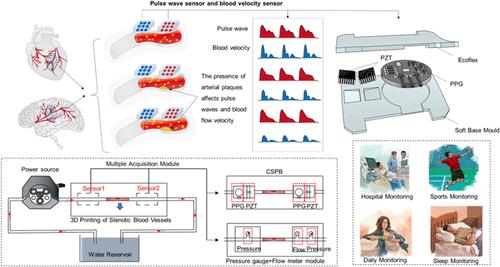
Atherosclerosis is the main cause of ischemic stroke. It occurs as a condition that leads to thickening of the arterial blood vessel walls and narrowing of the blood vessels, which can seriously affect the normal flow of blood. Currently, the detection of arterial stenosis relies on large-scale hospital equipment like computed tomography (CT) and magnetic resonance imaging (MRI), which require specialized technicians to operate and are not convenient for daily use. In addition, stenosis affects multiple parameters of hemodynamics in the blood flow field, and relying on a single physical quantity is not sufficient to understand the blood flow field localized in the stenotic vessel. Here, we demonstrated combined sensors of pulse wave and blood flow velocity (CSPB) based on photoelectric plethysmography and an ultrasonic Doppler device. We found that when the stenosis rate increased by 30%, the amplitude difference of the pulse wave curve between the two sides of the stenosis increased by over 11%, the amplitude of the blood flow curve decreased by 8%, and the blood flow resistance increased by 11%. We also prepared silicone-based models of blood stenosis vessels to build in vitro blood flow systems and achieve more accurate simulation of vascular stenosis diseases. Based on this, we studied the pulse wave and blood flow velocity curves of CSPB under different stenosis parameters. Meanwhile, we used the finite element analysis method of fluid–structure interactions to study the pulse wave and blood flow velocity changes under different arterial stenosis conditions. This study is expected to provide theoretical and technical references for achieving noninvasive detection of cardiovascular and cerebrovascular diseases based on multisensor fusion.
期刊介绍:
ACS Sensors is a peer-reviewed research journal that focuses on the dissemination of new and original knowledge in the field of sensor science, particularly those that selectively sense chemical or biological species or processes. The journal covers a broad range of topics, including but not limited to biosensors, chemical sensors, gas sensors, intracellular sensors, single molecule sensors, cell chips, and microfluidic devices. It aims to publish articles that address conceptual advances in sensing technology applicable to various types of analytes or application papers that report on the use of existing sensing concepts in new ways or for new analytes.



 京公网安备 11010802042870号
京ICP备2023020795号-1
京公网安备 11010802042870号
京ICP备2023020795号-1

 分享
分享
 求助内容:
求助内容: 应助结果提醒方式:
 扫码关注我们
