Aline Yen Ling Wang, Ana Elena Aviña, Yen-Yu Liu, Yun-Ching Chang, Huang-Kai Kao
{"title":"Transcription Factor Blimp-1: A Central Regulator of Oxidative Stress and Metabolic Reprogramming in Chronic Inflammatory Diseases.","authors":"Aline Yen Ling Wang, Ana Elena Aviña, Yen-Yu Liu, Yun-Ching Chang, Huang-Kai Kao","doi":"10.3390/antiox14020183","DOIUrl":null,"url":null,"abstract":"<p><p>B-lymphocyte-induced maturation protein 1 (Blimp-1) is a transcription factor that, among other functions, modulates metabolism and helps to regulate antioxidant pathways, which is important in the context of chronic inflammatory diseases like diabetes, cardiovascular disease, and autoimmune disease. In immune cell function, Blimp-1 has a modulatory role in the orchestration of metabolic reprogramming and as a promoter of anti-inflammatory cytokines, including IL-10, responsible for modulating oxidative stress and immune homeostasis. Moreover, Blimp-1 also modulates key metabolic aspects, such as glycolysis and fatty acid oxidation, which regulate reactive oxygen species levels, as well as tissue protection. This review depicts Blimp-1 as an important regulator of antioxidant defenses and anti-inflammation and suggests that the protein could serve as a therapeutic target in chronic inflammatory and metabolic dysregulation conditions. The modulation of Blimp-1 in diseases such as diabetic coronary heart disease and atherosclerosis could alleviate oxidative stress, augment the protection of tissues, and improve disease outcomes. The therapeutic potential for the development of new treatments for these chronic conditions lies in the synergy between the regulation of Blimp-1 and antioxidant therapies, which are future directions that may be pursued. This review emphasizes Blimp-1's emerging importance as a novel regulator in the pathogenesis of inflammatory diseases, providing new opportunities for therapeutic intervention.</p>","PeriodicalId":7984,"journal":{"name":"Antioxidants","volume":"14 2","pages":""},"PeriodicalIF":6.6000,"publicationDate":"2025-02-04","publicationTypes":"Journal Article","fieldsOfStudy":null,"isOpenAccess":false,"openAccessPdf":"https://www.ncbi.nlm.nih.gov/pmc/articles/PMC11851694/pdf/","citationCount":"0","resultStr":null,"platform":"Semanticscholar","paperid":null,"PeriodicalName":"Antioxidants","FirstCategoryId":"3","ListUrlMain":"https://doi.org/10.3390/antiox14020183","RegionNum":2,"RegionCategory":"医学","ArticlePicture":[],"TitleCN":null,"AbstractTextCN":null,"PMCID":null,"EPubDate":"","PubModel":"","JCR":"Q1","JCRName":"BIOCHEMISTRY & MOLECULAR BIOLOGY","Score":null,"Total":0}
引用次数: 0
Abstract
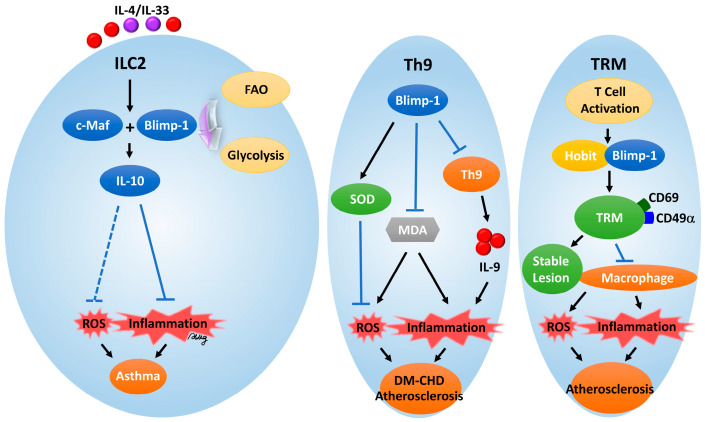
B-lymphocyte-induced maturation protein 1 (Blimp-1) is a transcription factor that, among other functions, modulates metabolism and helps to regulate antioxidant pathways, which is important in the context of chronic inflammatory diseases like diabetes, cardiovascular disease, and autoimmune disease. In immune cell function, Blimp-1 has a modulatory role in the orchestration of metabolic reprogramming and as a promoter of anti-inflammatory cytokines, including IL-10, responsible for modulating oxidative stress and immune homeostasis. Moreover, Blimp-1 also modulates key metabolic aspects, such as glycolysis and fatty acid oxidation, which regulate reactive oxygen species levels, as well as tissue protection. This review depicts Blimp-1 as an important regulator of antioxidant defenses and anti-inflammation and suggests that the protein could serve as a therapeutic target in chronic inflammatory and metabolic dysregulation conditions. The modulation of Blimp-1 in diseases such as diabetic coronary heart disease and atherosclerosis could alleviate oxidative stress, augment the protection of tissues, and improve disease outcomes. The therapeutic potential for the development of new treatments for these chronic conditions lies in the synergy between the regulation of Blimp-1 and antioxidant therapies, which are future directions that may be pursued. This review emphasizes Blimp-1's emerging importance as a novel regulator in the pathogenesis of inflammatory diseases, providing new opportunities for therapeutic intervention.
AntioxidantsBiochemistry, Genetics and Molecular Biology-Physiology
CiteScore
10.60
自引率
11.40%
发文量
2123
审稿时长
16.3 days
期刊介绍:
Antioxidants (ISSN 2076-3921), provides an advanced forum for studies related to the science and technology of antioxidants. It publishes research papers, reviews and communications. Our aim is to encourage scientists to publish their experimental and theoretical results in as much detail as possible. There is no restriction on the length of the papers. The full experimental details must be provided so that the results can be reproduced. Electronic files and software regarding the full details of the calculation or experimental procedure, if unable to be published in a normal way, can be deposited as supplementary electronic material.





 京公网安备 11010802042870号
京ICP备2023020795号-1
京公网安备 11010802042870号
京ICP备2023020795号-1

 分享
分享
 求助内容:
求助内容: 应助结果提醒方式:
 扫码关注我们
