Brooklyn E Taylor, Scott J Howell, Chieh Lee, Zakary Taylor, Katherine Barber, Patricia R Taylor
{"title":"Diabetes-Mediated STEAP4 Enhances Retinal Oxidative Stress and Impacts the Development of Diabetic Retinopathy.","authors":"Brooklyn E Taylor, Scott J Howell, Chieh Lee, Zakary Taylor, Katherine Barber, Patricia R Taylor","doi":"10.3390/antiox14020205","DOIUrl":null,"url":null,"abstract":"<p><p>Diabetic retinopathy is the most common diabetic complication of the microvasculature and one of the leading causes of acquired vision loss worldwide. Yet, the current treatments for this blinding disease are futile to many diabetics. Accordingly, new biomarkers and therapeutics for diabetic retinopathy are needed. We discovered that <i>STEAP4</i> (Six-Transmembrane Epithelial Antigen of the Prostate 4) is significantly increased in peripheral blood mononuclear cells of diabetics. <i>STEAP4</i> expression was gradiently increased from low levels in diabetics without retinopathy to successively higher levels in diabetics with more severe disease. Although the role of STEAP4 in the diabetic retina is unclear, these results provide strong evidence that this metabolic enzyme could be a potential biomarker for diabetic retinopathy progression. Thus, the central goal of this study was to evaluate if this potential biomarker impacts the intrinsic pathologies that lead to the development of diabetic retinopathy. In diabetic mice, STEAP4 was significantly increased and co-localized with 4-Hydroxy-2-nonenal in the Müller glia and photoreceptor layers of the retina. STEAP4 inhibition significantly decreased reactive oxygen species in murine photoreceptor cells, human Müller glia, and retinas of diabetic mice. Administering an intravitreal injection of anti-STEAP4 to diabetic mice halted Occludin degradation in the retinal vasculature. Similarly, anti-STEAP4 treatment of human retina endothelial cells halted cell death mediated by diabetic donor sera. Collectively, our findings provide strong evidence that STEAP4 impacts the intrinsic pathologies that initiate the development of diabetic retinopathy. Suggesting that STEAP4 could be a novel biomarker and clinically relevant therapeutic target for this diabetic complication and blinding disease.</p>","PeriodicalId":7984,"journal":{"name":"Antioxidants","volume":"14 2","pages":""},"PeriodicalIF":6.6000,"publicationDate":"2025-02-11","publicationTypes":"Journal Article","fieldsOfStudy":null,"isOpenAccess":false,"openAccessPdf":"https://www.ncbi.nlm.nih.gov/pmc/articles/PMC11851923/pdf/","citationCount":"0","resultStr":null,"platform":"Semanticscholar","paperid":null,"PeriodicalName":"Antioxidants","FirstCategoryId":"3","ListUrlMain":"https://doi.org/10.3390/antiox14020205","RegionNum":2,"RegionCategory":"医学","ArticlePicture":[],"TitleCN":null,"AbstractTextCN":null,"PMCID":null,"EPubDate":"","PubModel":"","JCR":"Q1","JCRName":"BIOCHEMISTRY & MOLECULAR BIOLOGY","Score":null,"Total":0}
引用次数: 0
Abstract
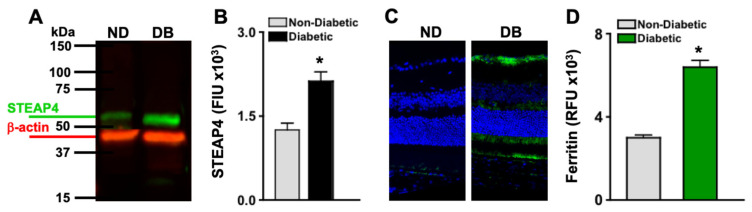
Diabetic retinopathy is the most common diabetic complication of the microvasculature and one of the leading causes of acquired vision loss worldwide. Yet, the current treatments for this blinding disease are futile to many diabetics. Accordingly, new biomarkers and therapeutics for diabetic retinopathy are needed. We discovered that STEAP4 (Six-Transmembrane Epithelial Antigen of the Prostate 4) is significantly increased in peripheral blood mononuclear cells of diabetics. STEAP4 expression was gradiently increased from low levels in diabetics without retinopathy to successively higher levels in diabetics with more severe disease. Although the role of STEAP4 in the diabetic retina is unclear, these results provide strong evidence that this metabolic enzyme could be a potential biomarker for diabetic retinopathy progression. Thus, the central goal of this study was to evaluate if this potential biomarker impacts the intrinsic pathologies that lead to the development of diabetic retinopathy. In diabetic mice, STEAP4 was significantly increased and co-localized with 4-Hydroxy-2-nonenal in the Müller glia and photoreceptor layers of the retina. STEAP4 inhibition significantly decreased reactive oxygen species in murine photoreceptor cells, human Müller glia, and retinas of diabetic mice. Administering an intravitreal injection of anti-STEAP4 to diabetic mice halted Occludin degradation in the retinal vasculature. Similarly, anti-STEAP4 treatment of human retina endothelial cells halted cell death mediated by diabetic donor sera. Collectively, our findings provide strong evidence that STEAP4 impacts the intrinsic pathologies that initiate the development of diabetic retinopathy. Suggesting that STEAP4 could be a novel biomarker and clinically relevant therapeutic target for this diabetic complication and blinding disease.
AntioxidantsBiochemistry, Genetics and Molecular Biology-Physiology
CiteScore
10.60
自引率
11.40%
发文量
2123
审稿时长
16.3 days
期刊介绍:
Antioxidants (ISSN 2076-3921), provides an advanced forum for studies related to the science and technology of antioxidants. It publishes research papers, reviews and communications. Our aim is to encourage scientists to publish their experimental and theoretical results in as much detail as possible. There is no restriction on the length of the papers. The full experimental details must be provided so that the results can be reproduced. Electronic files and software regarding the full details of the calculation or experimental procedure, if unable to be published in a normal way, can be deposited as supplementary electronic material.





 京公网安备 11010802042870号
京ICP备2023020795号-1
京公网安备 11010802042870号
京ICP备2023020795号-1

 分享
分享
 求助内容:
求助内容: 应助结果提醒方式:
 扫码关注我们
