Is High-Dose Ubiquinone Therapy Before Cardiac Surgery Enough to Reduce the Incidence of Cardiac Surgery-Associated Acute Kidney Injury? A Randomized Controlled Trial.
Hrvoje Vučemilović, Ruben Kovač, Lada Stanišić, Ana Sanader Vučemilović, Dina Mrčela, Benjamin Benzon, Mladen Carev
{"title":"Is High-Dose Ubiquinone Therapy Before Cardiac Surgery Enough to Reduce the Incidence of Cardiac Surgery-Associated Acute Kidney Injury? A Randomized Controlled Trial.","authors":"Hrvoje Vučemilović, Ruben Kovač, Lada Stanišić, Ana Sanader Vučemilović, Dina Mrčela, Benjamin Benzon, Mladen Carev","doi":"10.3390/antiox14020243","DOIUrl":null,"url":null,"abstract":"<p><p>Cardiac surgery-related acute kidney injury (CS-AKI) is a decrease in kidney function after open-heart surgery, affecting up to 50% of patients. The pathophysiology of CS-AKI involves ischemia-reperfusion injury, inflammation, and oxidative stress. Ubiquinone is a potent antioxidant, and we hypothesized that it could decrease both the incidence and severity of CS-AKI. The intervention group received ubiquinone (8 mg/kg/day) divided into three daily doses, while the control group received a placebo. The primary outcome was the incidence of CS-AKI, which was manifested as an increase in creatinine ≥26.5 µmol/L or a urine output below 0.5 mL/kg/h for 6 h. Out of 73 patients, 39.7% (N = 29) developed CS-AKI, including 35.3% of the ubiquinone group and 43.6% of the placebo group (<i>X</i><sup>2</sup>(1,N = 73) = 0.4931, <i>p</i> = 0.4825). The secondary outcomes revealed that the ubiquinone group experienced reduced postoperative bleeding, with a median (IQR) drainage of 320 mL (230-415) compared to the drainage of 420 mL (242.5-747.5) in the placebo group (t(35.84) = 2.055, <i>p</i> = 0.047). The median hs-TnI level in the ubiquinone group was 239.5 ng/mL (113.25-382.75) after surgery compared to a level of 366 (234.5-672.5) ng/mL in the placebo group (<i>p</i> = 0.024). In conclusion, there was no significant difference in the incidence of CS-AKI between groups. Postoperative hs-TnI and bleeding were significantly reduced among patients receiving ubiquinone.</p>","PeriodicalId":7984,"journal":{"name":"Antioxidants","volume":"14 2","pages":""},"PeriodicalIF":6.6000,"publicationDate":"2025-02-19","publicationTypes":"Journal Article","fieldsOfStudy":null,"isOpenAccess":false,"openAccessPdf":"https://www.ncbi.nlm.nih.gov/pmc/articles/PMC11852363/pdf/","citationCount":"0","resultStr":null,"platform":"Semanticscholar","paperid":null,"PeriodicalName":"Antioxidants","FirstCategoryId":"3","ListUrlMain":"https://doi.org/10.3390/antiox14020243","RegionNum":2,"RegionCategory":"医学","ArticlePicture":[],"TitleCN":null,"AbstractTextCN":null,"PMCID":null,"EPubDate":"","PubModel":"","JCR":"Q1","JCRName":"BIOCHEMISTRY & MOLECULAR BIOLOGY","Score":null,"Total":0}
引用次数: 0
Abstract
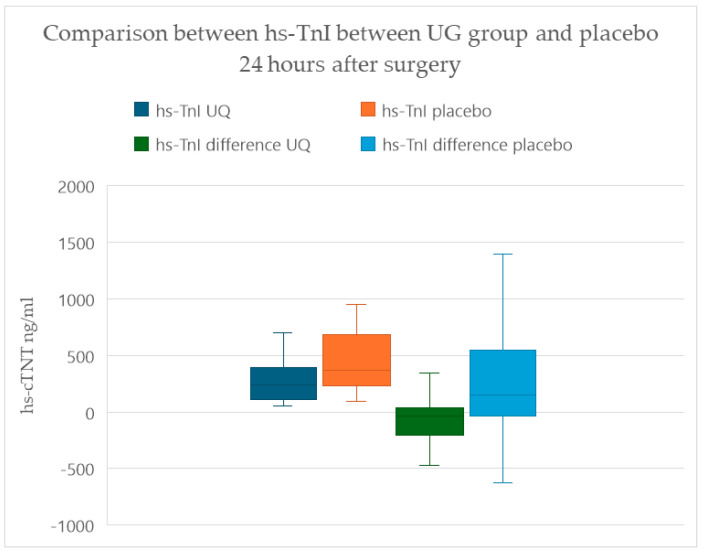
Cardiac surgery-related acute kidney injury (CS-AKI) is a decrease in kidney function after open-heart surgery, affecting up to 50% of patients. The pathophysiology of CS-AKI involves ischemia-reperfusion injury, inflammation, and oxidative stress. Ubiquinone is a potent antioxidant, and we hypothesized that it could decrease both the incidence and severity of CS-AKI. The intervention group received ubiquinone (8 mg/kg/day) divided into three daily doses, while the control group received a placebo. The primary outcome was the incidence of CS-AKI, which was manifested as an increase in creatinine ≥26.5 µmol/L or a urine output below 0.5 mL/kg/h for 6 h. Out of 73 patients, 39.7% (N = 29) developed CS-AKI, including 35.3% of the ubiquinone group and 43.6% of the placebo group (X2(1,N = 73) = 0.4931, p = 0.4825). The secondary outcomes revealed that the ubiquinone group experienced reduced postoperative bleeding, with a median (IQR) drainage of 320 mL (230-415) compared to the drainage of 420 mL (242.5-747.5) in the placebo group (t(35.84) = 2.055, p = 0.047). The median hs-TnI level in the ubiquinone group was 239.5 ng/mL (113.25-382.75) after surgery compared to a level of 366 (234.5-672.5) ng/mL in the placebo group (p = 0.024). In conclusion, there was no significant difference in the incidence of CS-AKI between groups. Postoperative hs-TnI and bleeding were significantly reduced among patients receiving ubiquinone.
AntioxidantsBiochemistry, Genetics and Molecular Biology-Physiology
CiteScore
10.60
自引率
11.40%
发文量
2123
审稿时长
16.3 days
期刊介绍:
Antioxidants (ISSN 2076-3921), provides an advanced forum for studies related to the science and technology of antioxidants. It publishes research papers, reviews and communications. Our aim is to encourage scientists to publish their experimental and theoretical results in as much detail as possible. There is no restriction on the length of the papers. The full experimental details must be provided so that the results can be reproduced. Electronic files and software regarding the full details of the calculation or experimental procedure, if unable to be published in a normal way, can be deposited as supplementary electronic material.






 京公网安备 11010802042870号
京ICP备2023020795号-1
京公网安备 11010802042870号
京ICP备2023020795号-1

 分享
分享
 求助内容:
求助内容: 应助结果提醒方式:
 扫码关注我们
