Siqi Li, Hang Yuan, Liang Li, Qin Li, Ping Lin, Kai Li
{"title":"Oxidative Stress and Reprogramming of Lipid Metabolism in Cancers.","authors":"Siqi Li, Hang Yuan, Liang Li, Qin Li, Ping Lin, Kai Li","doi":"10.3390/antiox14020201","DOIUrl":null,"url":null,"abstract":"<p><p>Oxidative stress is a common event involved in cancer pathophysiology, frequently accompanied by unique lipid metabolic reprogramming phenomena. Oxidative stress is caused mainly by an imbalance between the production of reactive oxygen species (ROS) and the antioxidant system in cancer cells. Emerging evidence has reported that oxidative stress regulates the expression and activity of lipid metabolism-related enzymes, leading to the alteration of cellular lipid metabolism; this involves a significant increase in fatty acid synthesis and a shift in the way in which lipids are taken up and utilized. The dysregulation of lipid metabolism provides abundant intermediates to synthesize biological macromolecules for the rapid proliferation of cancer cells; moreover, it contributes to the maintenance of intracellular redox homeostasis by producing a variety of reducing agents. Moreover, lipid derivatives and metabolites play critical roles in signal transduction within cancer cells and in the tumor microenvironment that evades immune destruction and facilitates tumor invasion and metastasis. These findings suggest a close relationship between oxidative stress and lipid metabolism during the malignant progression of cancers. This review focuses on the crosstalk between the redox system and lipid metabolic reprogramming, which provides an in-depth insight into the modulation of ROS on lipid metabolic reprogramming in cancers and discusses potential strategies for targeting lipid metabolism for cancer therapy.</p>","PeriodicalId":7984,"journal":{"name":"Antioxidants","volume":"14 2","pages":""},"PeriodicalIF":6.6000,"publicationDate":"2025-02-10","publicationTypes":"Journal Article","fieldsOfStudy":null,"isOpenAccess":false,"openAccessPdf":"https://www.ncbi.nlm.nih.gov/pmc/articles/PMC11851681/pdf/","citationCount":"0","resultStr":null,"platform":"Semanticscholar","paperid":null,"PeriodicalName":"Antioxidants","FirstCategoryId":"3","ListUrlMain":"https://doi.org/10.3390/antiox14020201","RegionNum":2,"RegionCategory":"医学","ArticlePicture":[],"TitleCN":null,"AbstractTextCN":null,"PMCID":null,"EPubDate":"","PubModel":"","JCR":"Q1","JCRName":"BIOCHEMISTRY & MOLECULAR BIOLOGY","Score":null,"Total":0}
引用次数: 0
Abstract
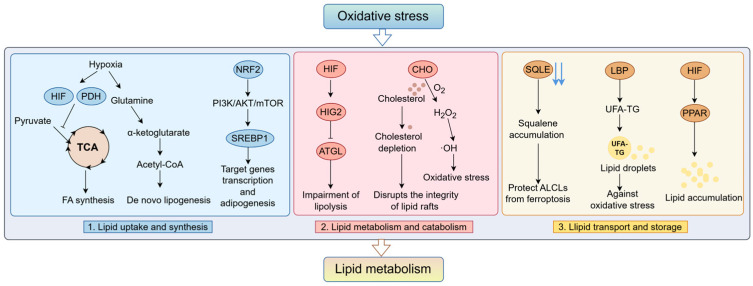
Oxidative stress is a common event involved in cancer pathophysiology, frequently accompanied by unique lipid metabolic reprogramming phenomena. Oxidative stress is caused mainly by an imbalance between the production of reactive oxygen species (ROS) and the antioxidant system in cancer cells. Emerging evidence has reported that oxidative stress regulates the expression and activity of lipid metabolism-related enzymes, leading to the alteration of cellular lipid metabolism; this involves a significant increase in fatty acid synthesis and a shift in the way in which lipids are taken up and utilized. The dysregulation of lipid metabolism provides abundant intermediates to synthesize biological macromolecules for the rapid proliferation of cancer cells; moreover, it contributes to the maintenance of intracellular redox homeostasis by producing a variety of reducing agents. Moreover, lipid derivatives and metabolites play critical roles in signal transduction within cancer cells and in the tumor microenvironment that evades immune destruction and facilitates tumor invasion and metastasis. These findings suggest a close relationship between oxidative stress and lipid metabolism during the malignant progression of cancers. This review focuses on the crosstalk between the redox system and lipid metabolic reprogramming, which provides an in-depth insight into the modulation of ROS on lipid metabolic reprogramming in cancers and discusses potential strategies for targeting lipid metabolism for cancer therapy.
AntioxidantsBiochemistry, Genetics and Molecular Biology-Physiology
CiteScore
10.60
自引率
11.40%
发文量
2123
审稿时长
16.3 days
期刊介绍:
Antioxidants (ISSN 2076-3921), provides an advanced forum for studies related to the science and technology of antioxidants. It publishes research papers, reviews and communications. Our aim is to encourage scientists to publish their experimental and theoretical results in as much detail as possible. There is no restriction on the length of the papers. The full experimental details must be provided so that the results can be reproduced. Electronic files and software regarding the full details of the calculation or experimental procedure, if unable to be published in a normal way, can be deposited as supplementary electronic material.





 京公网安备 11010802042870号
京ICP备2023020795号-1
京公网安备 11010802042870号
京ICP备2023020795号-1

 分享
分享
 求助内容:
求助内容: 应助结果提醒方式:
 扫码关注我们
