{"title":"Gen Z Tourism Employees' Adaptive Performance During a Major Cultural Shift: The Impact of Leadership and Employee Voice Behavior.","authors":"Kleanthis K Katsaros","doi":"10.3390/bs15020171","DOIUrl":null,"url":null,"abstract":"<p><p>Based on social exchange theory and the norm of reciprocity, the current study proposes a mediation model to assess the role of employee voice behavior (promotive and prohibitive) on the relationship between leadership (i.e., transformational, inclusive, and adaptive) and Gen Z employees' adaptive performance (AP). Research data were obtained from 195 Gen Z employees and their supervisors from a group of luxury hotels located in Greece that had experienced a major cultural shift. The research model was examined using the structural equation modeling technique (SEM) with maximum likelihood estimation using the analysis of moment structures program (AMOS version 24). The research findings indicate that (a) all three leadership approaches positively influence Gen Z employees' AP, (b) promotive voice behavior mediates the relationship between all leadership approaches and Gen Z employees' AP, and (c) prohibitive voice behavior mediates the relationship between inclusive leadership and Gen Z employees' AP. The results suggest that by implementing human-centered practices and procedures to positively influence Gen Z employees' voice behavior, tourism leaders/managers can increase their AP.</p>","PeriodicalId":8742,"journal":{"name":"Behavioral Sciences","volume":"15 2","pages":""},"PeriodicalIF":2.5000,"publicationDate":"2025-02-05","publicationTypes":"Journal Article","fieldsOfStudy":null,"isOpenAccess":false,"openAccessPdf":"https://www.ncbi.nlm.nih.gov/pmc/articles/PMC11851938/pdf/","citationCount":"0","resultStr":null,"platform":"Semanticscholar","paperid":null,"PeriodicalName":"Behavioral Sciences","FirstCategoryId":"102","ListUrlMain":"https://doi.org/10.3390/bs15020171","RegionNum":3,"RegionCategory":"心理学","ArticlePicture":[],"TitleCN":null,"AbstractTextCN":null,"PMCID":null,"EPubDate":"","PubModel":"","JCR":"Q2","JCRName":"PSYCHOLOGY, MULTIDISCIPLINARY","Score":null,"Total":0}
引用次数: 0
Abstract
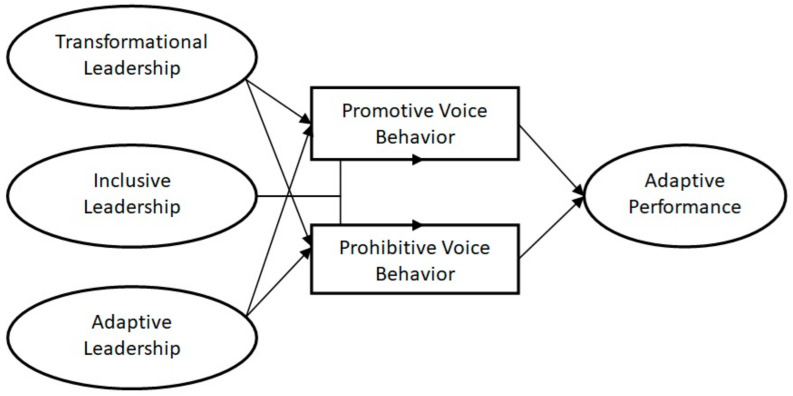
Based on social exchange theory and the norm of reciprocity, the current study proposes a mediation model to assess the role of employee voice behavior (promotive and prohibitive) on the relationship between leadership (i.e., transformational, inclusive, and adaptive) and Gen Z employees' adaptive performance (AP). Research data were obtained from 195 Gen Z employees and their supervisors from a group of luxury hotels located in Greece that had experienced a major cultural shift. The research model was examined using the structural equation modeling technique (SEM) with maximum likelihood estimation using the analysis of moment structures program (AMOS version 24). The research findings indicate that (a) all three leadership approaches positively influence Gen Z employees' AP, (b) promotive voice behavior mediates the relationship between all leadership approaches and Gen Z employees' AP, and (c) prohibitive voice behavior mediates the relationship between inclusive leadership and Gen Z employees' AP. The results suggest that by implementing human-centered practices and procedures to positively influence Gen Z employees' voice behavior, tourism leaders/managers can increase their AP.
基于社会交换理论和互惠准则,本研究提出了一个中介模型来评估员工建言(促进型和禁止型)在领导(转型型、包容型和适应性型)与Z世代员工适应性绩效(AP)之间的关系。研究数据来自195名Z世代员工和他们的主管,他们来自希腊的一组豪华酒店,这些酒店经历了重大的文化转变。采用结构方程建模技术(SEM)和最大似然估计,利用力矩结构分析程序(AMOS version 24)对研究模型进行检验。研究结果表明:(a)三种领导方式均对Z世代员工的AP产生正向影响,(b)促进性建言在所有领导方式与Z世代员工AP之间起中介作用,(c)禁止性建言在包容性领导与Z世代员工AP之间起中介作用。研究结果表明,通过实施以人为本的实践和程序,对Z世代员工建言产生正向影响。旅游领导者/管理者可以增加他们的AP。





 京公网安备 11010802042870号
京ICP备2023020795号-1
京公网安备 11010802042870号
京ICP备2023020795号-1

 分享
分享
 求助内容:
求助内容: 应助结果提醒方式:
 扫码关注我们
