Mark F A Bierhuizen, Jorik H Amesz, Sanne J J Langmuur, Bobby Lam, Paul Knops, Kevin M Veen, Olivier C Manintveld, Jolanda Kluin, Natasja M S de Groot, Yannick J H J Taverne
{"title":"Acute Biomechanical Effects of Cardiac Contractility Modulation in Living Myocardial Slices from End-Stage Heart Failure Patients.","authors":"Mark F A Bierhuizen, Jorik H Amesz, Sanne J J Langmuur, Bobby Lam, Paul Knops, Kevin M Veen, Olivier C Manintveld, Jolanda Kluin, Natasja M S de Groot, Yannick J H J Taverne","doi":"10.3390/bioengineering12020174","DOIUrl":null,"url":null,"abstract":"<p><p>Proof-of-concept to determine the direct biomechanical effects of cardiac contractility modulation (CCM) on living myocardial slices (LMS) from patients with end-stage heart failure (HF). Left ventricular LMS from patients with end-stage HF were produced and cultured in a biomimetic system with mechanical loading and electrical stimulation. CCM stimulation (80 mA, 40 ms delay, 21 ms duration) enhanced maximum contractile force (CCM: 1229 µN (587-2658) vs. baseline: 1066 µN (529-2128), <i>p</i> = 0.05) and area under the contractile curve (CCM: 297 (151-562) vs. baseline: 243 (129-464), <i>p</i> = 0.05) but did not significantly impact contractile duration, time to peak, or time to relaxation. Increasing CCM stimulation delay, duration, and amplitude resulted in a higher fraction of LMS with a positive inotropic response. Furthermore, CCM attenuated the negative force-frequency relationship in HF-LMS. CCM stimulation enhanced contractile force in HF-LMS. The fraction of LMS exerting a positive inotropic response to CCM increased with increasing delay, duration, and amplitude settings, suggesting that personalizing stimulation parameters could optimize the beneficial effects of CCM. CCM is a novel device-based therapy that may improve contractile function, ejection fraction, functional outcomes, and quality of life in patients with heart failure. However, continuous efforts are needed to identify true responders to CCM therapy, understand the exact mechanisms, and optimize the contractile response to CCM stimulation. The present study revealed that CCM enhanced the contractile force of HF-LMS in a stimulation setting-dependent manner, reaching a larger fraction of the myocardium while increasing delay, duration, and amplitude. This understanding may contribute to the individualization of CCM stimulation settings.</p>","PeriodicalId":8874,"journal":{"name":"Bioengineering","volume":"12 2","pages":""},"PeriodicalIF":3.7000,"publicationDate":"2025-02-12","publicationTypes":"Journal Article","fieldsOfStudy":null,"isOpenAccess":false,"openAccessPdf":"https://www.ncbi.nlm.nih.gov/pmc/articles/PMC11851609/pdf/","citationCount":"0","resultStr":null,"platform":"Semanticscholar","paperid":null,"PeriodicalName":"Bioengineering","FirstCategoryId":"5","ListUrlMain":"https://doi.org/10.3390/bioengineering12020174","RegionNum":3,"RegionCategory":"医学","ArticlePicture":[],"TitleCN":null,"AbstractTextCN":null,"PMCID":null,"EPubDate":"","PubModel":"","JCR":"Q2","JCRName":"ENGINEERING, BIOMEDICAL","Score":null,"Total":0}
引用次数: 0
Abstract
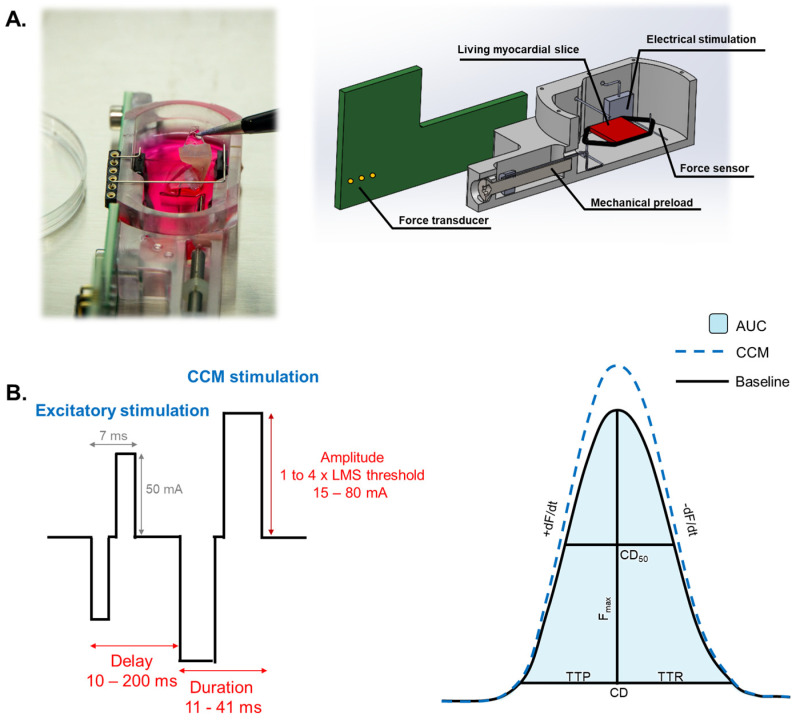
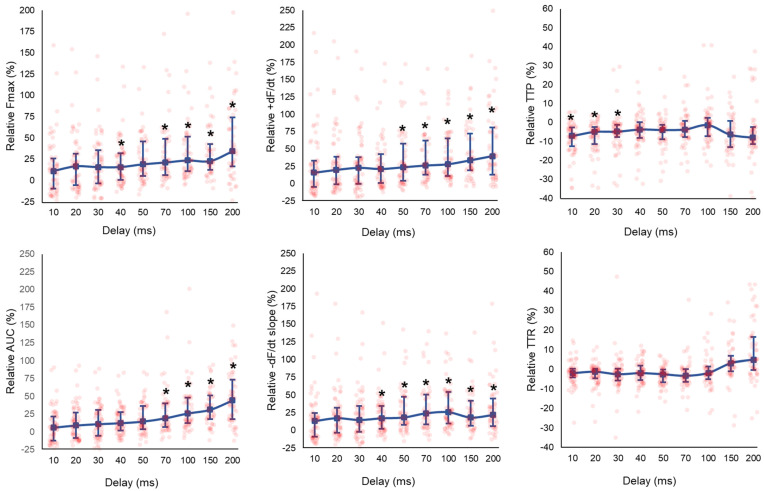
Proof-of-concept to determine the direct biomechanical effects of cardiac contractility modulation (CCM) on living myocardial slices (LMS) from patients with end-stage heart failure (HF). Left ventricular LMS from patients with end-stage HF were produced and cultured in a biomimetic system with mechanical loading and electrical stimulation. CCM stimulation (80 mA, 40 ms delay, 21 ms duration) enhanced maximum contractile force (CCM: 1229 µN (587-2658) vs. baseline: 1066 µN (529-2128), p = 0.05) and area under the contractile curve (CCM: 297 (151-562) vs. baseline: 243 (129-464), p = 0.05) but did not significantly impact contractile duration, time to peak, or time to relaxation. Increasing CCM stimulation delay, duration, and amplitude resulted in a higher fraction of LMS with a positive inotropic response. Furthermore, CCM attenuated the negative force-frequency relationship in HF-LMS. CCM stimulation enhanced contractile force in HF-LMS. The fraction of LMS exerting a positive inotropic response to CCM increased with increasing delay, duration, and amplitude settings, suggesting that personalizing stimulation parameters could optimize the beneficial effects of CCM. CCM is a novel device-based therapy that may improve contractile function, ejection fraction, functional outcomes, and quality of life in patients with heart failure. However, continuous efforts are needed to identify true responders to CCM therapy, understand the exact mechanisms, and optimize the contractile response to CCM stimulation. The present study revealed that CCM enhanced the contractile force of HF-LMS in a stimulation setting-dependent manner, reaching a larger fraction of the myocardium while increasing delay, duration, and amplitude. This understanding may contribute to the individualization of CCM stimulation settings.
期刊介绍:
Aims
Bioengineering (ISSN 2306-5354) provides an advanced forum for the science and technology of bioengineering. It publishes original research papers, comprehensive reviews, communications and case reports. Our aim is to encourage scientists to publish their experimental and theoretical results in as much detail as possible. All aspects of bioengineering are welcomed from theoretical concepts to education and applications. There is no restriction on the length of the papers. The full experimental details must be provided so that the results can be reproduced. There are, in addition, four key features of this Journal:
● We are introducing a new concept in scientific and technical publications “The Translational Case Report in Bioengineering”. It is a descriptive explanatory analysis of a transformative or translational event. Understanding that the goal of bioengineering scholarship is to advance towards a transformative or clinical solution to an identified transformative/clinical need, the translational case report is used to explore causation in order to find underlying principles that may guide other similar transformative/translational undertakings.
● Manuscripts regarding research proposals and research ideas will be particularly welcomed.
● Electronic files and software regarding the full details of the calculation and experimental procedure, if unable to be published in a normal way, can be deposited as supplementary material.
● We also accept manuscripts communicating to a broader audience with regard to research projects financed with public funds.
Scope
● Bionics and biological cybernetics: implantology; bio–abio interfaces
● Bioelectronics: wearable electronics; implantable electronics; “more than Moore” electronics; bioelectronics devices
● Bioprocess and biosystems engineering and applications: bioprocess design; biocatalysis; bioseparation and bioreactors; bioinformatics; bioenergy; etc.
● Biomolecular, cellular and tissue engineering and applications: tissue engineering; chromosome engineering; embryo engineering; cellular, molecular and synthetic biology; metabolic engineering; bio-nanotechnology; micro/nano technologies; genetic engineering; transgenic technology
● Biomedical engineering and applications: biomechatronics; biomedical electronics; biomechanics; biomaterials; biomimetics; biomedical diagnostics; biomedical therapy; biomedical devices; sensors and circuits; biomedical imaging and medical information systems; implants and regenerative medicine; neurotechnology; clinical engineering; rehabilitation engineering
● Biochemical engineering and applications: metabolic pathway engineering; modeling and simulation
● Translational bioengineering





 京公网安备 11010802042870号
京ICP备2023020795号-1
京公网安备 11010802042870号
京ICP备2023020795号-1

 分享
分享
 求助内容:
求助内容: 应助结果提醒方式:
 扫码关注我们
