Ivan Vogt, Martin Volk, Emma-Luise Kulzer, Janis Seibt, Maciej Pech, Georg Rose, Oliver S Grosser
{"title":"Microwave-Assisted Optimization of Polyvinyl Alcohol Cryogel (PVA-C) Manufacturing for MRI Phantom Production.","authors":"Ivan Vogt, Martin Volk, Emma-Luise Kulzer, Janis Seibt, Maciej Pech, Georg Rose, Oliver S Grosser","doi":"10.3390/bioengineering12020171","DOIUrl":null,"url":null,"abstract":"<p><strong>Objectives: </strong>Anthropomorphic phantoms offer a promising solution to minimize animal testing, enable medical training, and support the efficient development of medical devices. The adjustable mechanical, biochemical, and imaging properties of the polyvinyl alcohol cryogel (PVA-C) make it an appropriate phantom material for mimicking soft tissues. Conventional manufacturing (CM) of aqueous solutions requires constant stirring, using a heated water bath, and monitoring.</p><p><strong>Methods: </strong>To explore potential improvements in the dissolution of PVA crystals in water, a microwave-based manufacturing method (MWM) was employed. Samples created using CM and MWM (<i>n</i> = 14 each) were compared. Because PVA-C is a multifunctional phantom material (e.g., in magnetic resonance imaging (MRI)), its MRI properties (T1/T2 relaxation times) and elasticity were determined.</p><p><strong>Results: </strong>T1 relaxation times did not significantly differ between the two methods (<i>p</i> = 0.3577), whereas T2 and elasticity for the MWM were significantly higher than those for the CM (<i>p</i> < 0.001). The MWM reduced the production time by 11% and decreased active user involvement by 93%.</p><p><strong>Conclusions: </strong>The MWM offers a promising, easily implementable, and time-efficient method for manufacturing PVA-C-based phantoms. Nevertheless, manufacturing-related microstructural properties and sample molding require further study.</p>","PeriodicalId":8874,"journal":{"name":"Bioengineering","volume":"12 2","pages":""},"PeriodicalIF":3.7000,"publicationDate":"2025-02-10","publicationTypes":"Journal Article","fieldsOfStudy":null,"isOpenAccess":false,"openAccessPdf":"https://www.ncbi.nlm.nih.gov/pmc/articles/PMC11851462/pdf/","citationCount":"0","resultStr":null,"platform":"Semanticscholar","paperid":null,"PeriodicalName":"Bioengineering","FirstCategoryId":"5","ListUrlMain":"https://doi.org/10.3390/bioengineering12020171","RegionNum":3,"RegionCategory":"医学","ArticlePicture":[],"TitleCN":null,"AbstractTextCN":null,"PMCID":null,"EPubDate":"","PubModel":"","JCR":"Q2","JCRName":"ENGINEERING, BIOMEDICAL","Score":null,"Total":0}
引用次数: 0
Abstract
Objectives: Anthropomorphic phantoms offer a promising solution to minimize animal testing, enable medical training, and support the efficient development of medical devices. The adjustable mechanical, biochemical, and imaging properties of the polyvinyl alcohol cryogel (PVA-C) make it an appropriate phantom material for mimicking soft tissues. Conventional manufacturing (CM) of aqueous solutions requires constant stirring, using a heated water bath, and monitoring.
Methods: To explore potential improvements in the dissolution of PVA crystals in water, a microwave-based manufacturing method (MWM) was employed. Samples created using CM and MWM (n = 14 each) were compared. Because PVA-C is a multifunctional phantom material (e.g., in magnetic resonance imaging (MRI)), its MRI properties (T1/T2 relaxation times) and elasticity were determined.
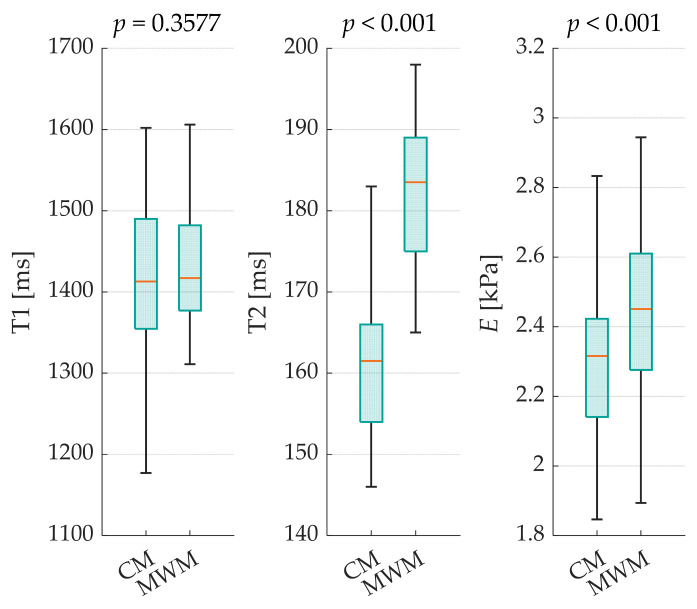
Results: T1 relaxation times did not significantly differ between the two methods (p = 0.3577), whereas T2 and elasticity for the MWM were significantly higher than those for the CM (p < 0.001). The MWM reduced the production time by 11% and decreased active user involvement by 93%.
Conclusions: The MWM offers a promising, easily implementable, and time-efficient method for manufacturing PVA-C-based phantoms. Nevertheless, manufacturing-related microstructural properties and sample molding require further study.
期刊介绍:
Aims
Bioengineering (ISSN 2306-5354) provides an advanced forum for the science and technology of bioengineering. It publishes original research papers, comprehensive reviews, communications and case reports. Our aim is to encourage scientists to publish their experimental and theoretical results in as much detail as possible. All aspects of bioengineering are welcomed from theoretical concepts to education and applications. There is no restriction on the length of the papers. The full experimental details must be provided so that the results can be reproduced. There are, in addition, four key features of this Journal:
● We are introducing a new concept in scientific and technical publications “The Translational Case Report in Bioengineering”. It is a descriptive explanatory analysis of a transformative or translational event. Understanding that the goal of bioengineering scholarship is to advance towards a transformative or clinical solution to an identified transformative/clinical need, the translational case report is used to explore causation in order to find underlying principles that may guide other similar transformative/translational undertakings.
● Manuscripts regarding research proposals and research ideas will be particularly welcomed.
● Electronic files and software regarding the full details of the calculation and experimental procedure, if unable to be published in a normal way, can be deposited as supplementary material.
● We also accept manuscripts communicating to a broader audience with regard to research projects financed with public funds.
Scope
● Bionics and biological cybernetics: implantology; bio–abio interfaces
● Bioelectronics: wearable electronics; implantable electronics; “more than Moore” electronics; bioelectronics devices
● Bioprocess and biosystems engineering and applications: bioprocess design; biocatalysis; bioseparation and bioreactors; bioinformatics; bioenergy; etc.
● Biomolecular, cellular and tissue engineering and applications: tissue engineering; chromosome engineering; embryo engineering; cellular, molecular and synthetic biology; metabolic engineering; bio-nanotechnology; micro/nano technologies; genetic engineering; transgenic technology
● Biomedical engineering and applications: biomechatronics; biomedical electronics; biomechanics; biomaterials; biomimetics; biomedical diagnostics; biomedical therapy; biomedical devices; sensors and circuits; biomedical imaging and medical information systems; implants and regenerative medicine; neurotechnology; clinical engineering; rehabilitation engineering
● Biochemical engineering and applications: metabolic pathway engineering; modeling and simulation
● Translational bioengineering





 京公网安备 11010802042870号
京ICP备2023020795号-1
京公网安备 11010802042870号
京ICP备2023020795号-1

 分享
分享
 求助内容:
求助内容: 应助结果提醒方式:
 扫码关注我们
