{"title":"Predicting Health-Related Quality of Life Using Social Determinants of Health: A Machine Learning Approach with the All of Us Cohort.","authors":"Tadesse M Abegaz, Muktar Ahmed, Askal Ayalew Ali, Akshaya Srikanth Bhagavathula","doi":"10.3390/bioengineering12020166","DOIUrl":null,"url":null,"abstract":"<p><p>This study applied machine learning (ML) algorithms to predict health-related quality of life (HRQOL) using comprehensive social determinants of health (SDOH) features. Data from the All of Us dataset, comprising participants with complete HRQOL and SDOH records, were analyzed. The primary outcome was HRQOL, which encompassed physical and mental health components, while SDOH features included social, educational, economic, environmental, and healthcare access factors. Three ML algorithms, namely logistic regression, XGBoost, and Random Forest, were tested. The models achieved accuracy ranges of 0.73-0.77 for HRQOL, 0.70-0.71 for physical health, and 0.72-0.77 for mental health, with corresponding area under the curve ranges of 0.81-0.84, 0.74-0.76, and 0.83-0.85, respectively. Emotional stability, activity management, spiritual beliefs, and comorbidity were identified as key predictors. These findings underscore the critical role of SDOH in predicting HRQOL and suggests future research to focus on applying such models to diverse patient populations and specific clinical conditions.</p>","PeriodicalId":8874,"journal":{"name":"Bioengineering","volume":"12 2","pages":""},"PeriodicalIF":3.7000,"publicationDate":"2025-02-09","publicationTypes":"Journal Article","fieldsOfStudy":null,"isOpenAccess":false,"openAccessPdf":"https://www.ncbi.nlm.nih.gov/pmc/articles/PMC11851811/pdf/","citationCount":"0","resultStr":null,"platform":"Semanticscholar","paperid":null,"PeriodicalName":"Bioengineering","FirstCategoryId":"5","ListUrlMain":"https://doi.org/10.3390/bioengineering12020166","RegionNum":3,"RegionCategory":"医学","ArticlePicture":[],"TitleCN":null,"AbstractTextCN":null,"PMCID":null,"EPubDate":"","PubModel":"","JCR":"Q2","JCRName":"ENGINEERING, BIOMEDICAL","Score":null,"Total":0}
引用次数: 0
Abstract
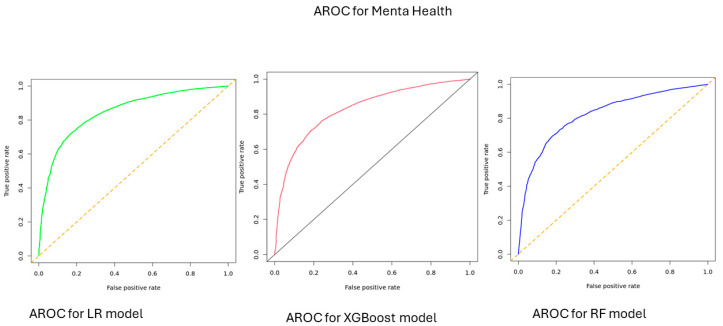
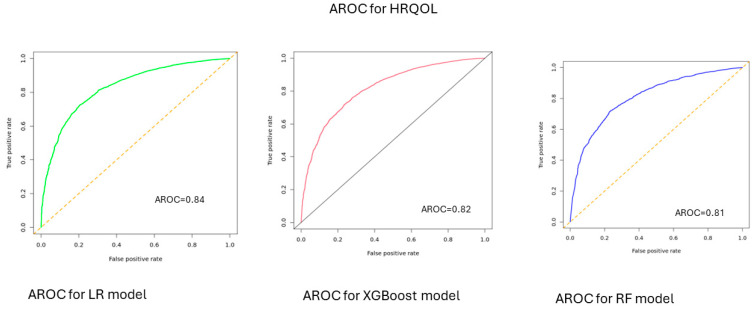
This study applied machine learning (ML) algorithms to predict health-related quality of life (HRQOL) using comprehensive social determinants of health (SDOH) features. Data from the All of Us dataset, comprising participants with complete HRQOL and SDOH records, were analyzed. The primary outcome was HRQOL, which encompassed physical and mental health components, while SDOH features included social, educational, economic, environmental, and healthcare access factors. Three ML algorithms, namely logistic regression, XGBoost, and Random Forest, were tested. The models achieved accuracy ranges of 0.73-0.77 for HRQOL, 0.70-0.71 for physical health, and 0.72-0.77 for mental health, with corresponding area under the curve ranges of 0.81-0.84, 0.74-0.76, and 0.83-0.85, respectively. Emotional stability, activity management, spiritual beliefs, and comorbidity were identified as key predictors. These findings underscore the critical role of SDOH in predicting HRQOL and suggests future research to focus on applying such models to diverse patient populations and specific clinical conditions.
本研究应用机器学习(ML)算法,利用综合健康社会决定因素(SDOH)特征预测健康相关生活质量(HRQOL)。来自All of Us数据集的数据,包括完整的HRQOL和SDOH记录的参与者,被分析。主要结局是HRQOL,包括身体和心理健康成分,而SDOH特征包括社会、教育、经济、环境和医疗保健获取因素。测试了三种机器学习算法,即逻辑回归、XGBoost和随机森林。模型对HRQOL的准确度范围为0.73-0.77,对身体健康的准确度范围为0.70-0.71,对心理健康的准确度范围为0.72-0.77,对应的曲线下面积范围分别为0.81-0.84,0.74-0.76和0.83-0.85。情绪稳定性、活动管理、精神信仰和合并症被认为是关键的预测因素。这些发现强调了SDOH在预测HRQOL中的关键作用,并建议未来的研究将重点放在将这些模型应用于不同的患者群体和特定的临床条件上。
期刊介绍:
Aims
Bioengineering (ISSN 2306-5354) provides an advanced forum for the science and technology of bioengineering. It publishes original research papers, comprehensive reviews, communications and case reports. Our aim is to encourage scientists to publish their experimental and theoretical results in as much detail as possible. All aspects of bioengineering are welcomed from theoretical concepts to education and applications. There is no restriction on the length of the papers. The full experimental details must be provided so that the results can be reproduced. There are, in addition, four key features of this Journal:
● We are introducing a new concept in scientific and technical publications “The Translational Case Report in Bioengineering”. It is a descriptive explanatory analysis of a transformative or translational event. Understanding that the goal of bioengineering scholarship is to advance towards a transformative or clinical solution to an identified transformative/clinical need, the translational case report is used to explore causation in order to find underlying principles that may guide other similar transformative/translational undertakings.
● Manuscripts regarding research proposals and research ideas will be particularly welcomed.
● Electronic files and software regarding the full details of the calculation and experimental procedure, if unable to be published in a normal way, can be deposited as supplementary material.
● We also accept manuscripts communicating to a broader audience with regard to research projects financed with public funds.
Scope
● Bionics and biological cybernetics: implantology; bio–abio interfaces
● Bioelectronics: wearable electronics; implantable electronics; “more than Moore” electronics; bioelectronics devices
● Bioprocess and biosystems engineering and applications: bioprocess design; biocatalysis; bioseparation and bioreactors; bioinformatics; bioenergy; etc.
● Biomolecular, cellular and tissue engineering and applications: tissue engineering; chromosome engineering; embryo engineering; cellular, molecular and synthetic biology; metabolic engineering; bio-nanotechnology; micro/nano technologies; genetic engineering; transgenic technology
● Biomedical engineering and applications: biomechatronics; biomedical electronics; biomechanics; biomaterials; biomimetics; biomedical diagnostics; biomedical therapy; biomedical devices; sensors and circuits; biomedical imaging and medical information systems; implants and regenerative medicine; neurotechnology; clinical engineering; rehabilitation engineering
● Biochemical engineering and applications: metabolic pathway engineering; modeling and simulation
● Translational bioengineering





 京公网安备 11010802042870号
京ICP备2023020795号-1
京公网安备 11010802042870号
京ICP备2023020795号-1

 分享
分享
 求助内容:
求助内容: 应助结果提醒方式:
 扫码关注我们
