Charles J Ley, Emma M Strage, Sarah M Stadig, Claudia von Brömssen, Ulf Olsson, Anna Bergh, Cecilia Ley
{"title":"Associations between body composition, metabolic mediators and osteoarthritis in cats.","authors":"Charles J Ley, Emma M Strage, Sarah M Stadig, Claudia von Brömssen, Ulf Olsson, Anna Bergh, Cecilia Ley","doi":"10.1186/s12917-025-04536-y","DOIUrl":null,"url":null,"abstract":"<p><strong>Background: </strong>Osteoarthritis (OA) is a common, age-related joint disease in cats. The common finding of bilateral symmetric joint involvement may suggest influence from systemic factors, and could imply that body parameters such as excess body fat and cat size are important for OA development. We aimed to investigate associations between body composition and whole-body OA scores in 72 cats, using whole-body computed tomography (CT), and if serum concentrations of the metabolic mediators leptin, adiponectin and insulin-like growth factor-1 (IGF-1) reflected the total OA load. In addition, associations between body composition and metabolic mediators were determined. For data analyses, cats were grouped as smaller or larger according to the median value of the total body bone volume (body size), and as leaner or fatter cats according to the median of the total body fat volumes normalized for body size (nBFV).</p><p><strong>Results: </strong>Computed tomography-detected OA changes were present in 94% of cats. In appendicular joints, OA was most commonly detected in hip joints followed by elbow, stifle, carpal, tarsal and shoulder joints, whereas in axial joints, OA was most commonly detected in the thoracic region. Groupwise comparisons showed that whole-body OA scores were higher for fatter compared to leaner cats (p = 0.012), and larger fatter cats had higher whole-body OA scores compared to smaller leaner cats (p = 0.021). Whole-body OA scores were associated with IGF-1 concentrations (p = 0.0051). Leptin concentrations were strongly associated with nBFV (p < 0.0001), whereas IGF-1 concentrations were weakly associated with total body bone volumes (p = 0.0134). Individual joint region OA scores were higher in carpal, elbow, stifle and hip joints in fatter cats, in carpal joints in larger and larger fatter cats, in elbow joints in larger leaner cats, and in stifle joints in smaller fatter cats.</p><p><strong>Conclusions: </strong>In cats, increased body fat is a risk factor for having a higher load of OA, particularly in carpal, elbow, stifle and hip joints. Increased body size is additionally a risk factor for having carpal OA. The total OA load is reflected in serum IGF-1 concentrations, but underlying mechanisms for this association are unclear.</p>","PeriodicalId":9041,"journal":{"name":"BMC Veterinary Research","volume":"21 1","pages":"103"},"PeriodicalIF":2.6000,"publicationDate":"2025-02-25","publicationTypes":"Journal Article","fieldsOfStudy":null,"isOpenAccess":false,"openAccessPdf":"https://www.ncbi.nlm.nih.gov/pmc/articles/PMC11853884/pdf/","citationCount":"0","resultStr":null,"platform":"Semanticscholar","paperid":null,"PeriodicalName":"BMC Veterinary Research","FirstCategoryId":"97","ListUrlMain":"https://doi.org/10.1186/s12917-025-04536-y","RegionNum":2,"RegionCategory":"农林科学","ArticlePicture":[],"TitleCN":null,"AbstractTextCN":null,"PMCID":null,"EPubDate":"","PubModel":"","JCR":"Q1","JCRName":"VETERINARY SCIENCES","Score":null,"Total":0}
引用次数: 0
Abstract
Background: Osteoarthritis (OA) is a common, age-related joint disease in cats. The common finding of bilateral symmetric joint involvement may suggest influence from systemic factors, and could imply that body parameters such as excess body fat and cat size are important for OA development. We aimed to investigate associations between body composition and whole-body OA scores in 72 cats, using whole-body computed tomography (CT), and if serum concentrations of the metabolic mediators leptin, adiponectin and insulin-like growth factor-1 (IGF-1) reflected the total OA load. In addition, associations between body composition and metabolic mediators were determined. For data analyses, cats were grouped as smaller or larger according to the median value of the total body bone volume (body size), and as leaner or fatter cats according to the median of the total body fat volumes normalized for body size (nBFV).
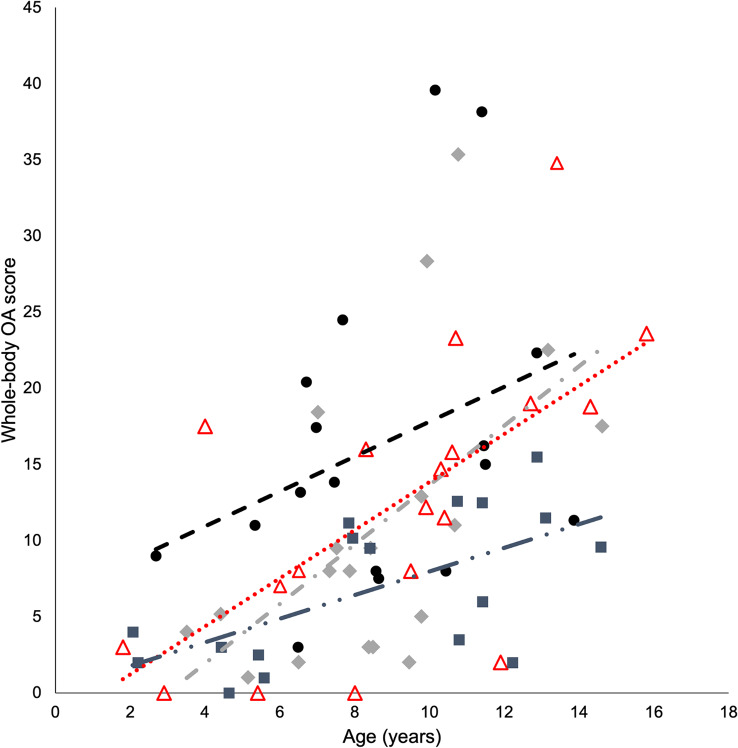
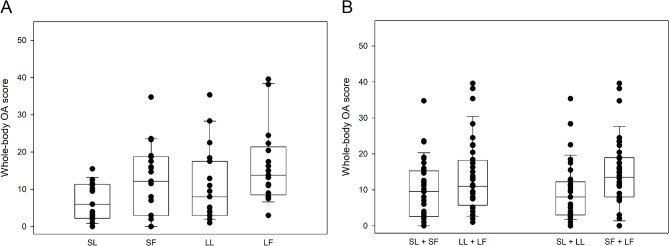
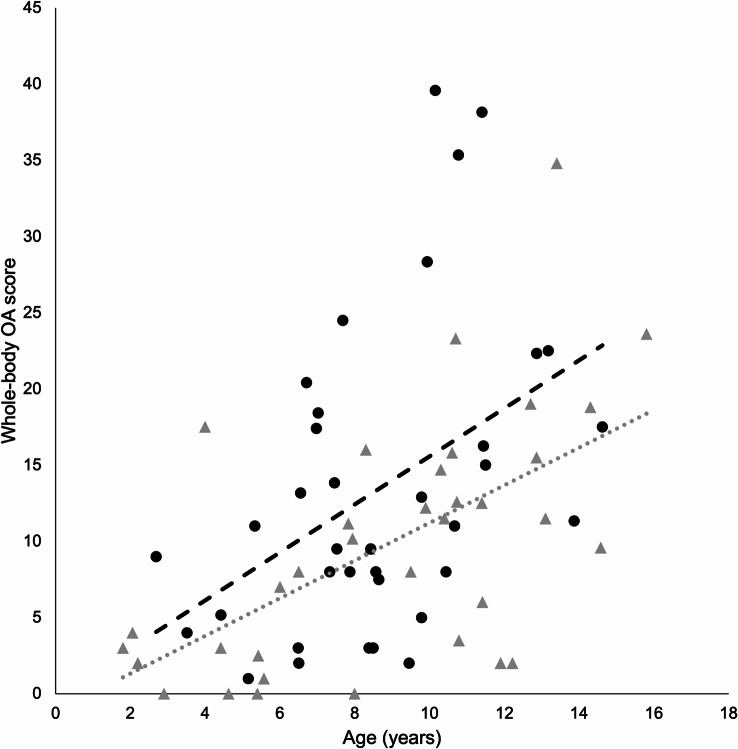
Results: Computed tomography-detected OA changes were present in 94% of cats. In appendicular joints, OA was most commonly detected in hip joints followed by elbow, stifle, carpal, tarsal and shoulder joints, whereas in axial joints, OA was most commonly detected in the thoracic region. Groupwise comparisons showed that whole-body OA scores were higher for fatter compared to leaner cats (p = 0.012), and larger fatter cats had higher whole-body OA scores compared to smaller leaner cats (p = 0.021). Whole-body OA scores were associated with IGF-1 concentrations (p = 0.0051). Leptin concentrations were strongly associated with nBFV (p < 0.0001), whereas IGF-1 concentrations were weakly associated with total body bone volumes (p = 0.0134). Individual joint region OA scores were higher in carpal, elbow, stifle and hip joints in fatter cats, in carpal joints in larger and larger fatter cats, in elbow joints in larger leaner cats, and in stifle joints in smaller fatter cats.
Conclusions: In cats, increased body fat is a risk factor for having a higher load of OA, particularly in carpal, elbow, stifle and hip joints. Increased body size is additionally a risk factor for having carpal OA. The total OA load is reflected in serum IGF-1 concentrations, but underlying mechanisms for this association are unclear.
期刊介绍:
BMC Veterinary Research is an open access, peer-reviewed journal that considers articles on all aspects of veterinary science and medicine, including the epidemiology, diagnosis, prevention and treatment of medical conditions of domestic, companion, farm and wild animals, as well as the biomedical processes that underlie their health.



 京公网安备 11010802042870号
京ICP备2023020795号-1
京公网安备 11010802042870号
京ICP备2023020795号-1

 分享
分享
 求助内容:
求助内容: 应助结果提醒方式:
 扫码关注我们
