Vanessa Pachón Olmos, Marina Pollán, Nerea Fernández de Larrea-Baz, Julia Fernández-Morata, Emma Ruiz-Moreno, Javier García-Pérez, Adela Castelló, María Ángeles Sierra, Pilar Lucas, Isabel Alonso-Ledesma, Agostina Stradella, Blanca Cantos, Teresa Ramón Y Cajal, Marta Santisteban, Miguel Ángel Seguí, Ana Santaballa Bertrán, Mónica Granja, Julia Camps-Herrero, Sabela Recalde, Miriam Mendez, Nuria Calvo Verges, Beatriz Pérez-Gómez, Roberto Pastor-Barriuso, Virginia Lope
{"title":"Determinants of Adherence to World Cancer Research Fund/American Institute for Cancer Research Recommendations in Women with Breast Cancer.","authors":"Vanessa Pachón Olmos, Marina Pollán, Nerea Fernández de Larrea-Baz, Julia Fernández-Morata, Emma Ruiz-Moreno, Javier García-Pérez, Adela Castelló, María Ángeles Sierra, Pilar Lucas, Isabel Alonso-Ledesma, Agostina Stradella, Blanca Cantos, Teresa Ramón Y Cajal, Marta Santisteban, Miguel Ángel Seguí, Ana Santaballa Bertrán, Mónica Granja, Julia Camps-Herrero, Sabela Recalde, Miriam Mendez, Nuria Calvo Verges, Beatriz Pérez-Gómez, Roberto Pastor-Barriuso, Virginia Lope","doi":"10.3390/cancers17040708","DOIUrl":null,"url":null,"abstract":"<p><strong>Background/objectives: </strong>The 2018 World Cancer Research Fund/American Institute for Cancer Research (WCRF/AICR) cancer prevention recommendations benefit primary prevention and survivor outcomes. This study evaluated the adherence to these recommendations during the year prior to breast cancer diagnosis and identified related clinical and sociodemographic factors.</p><p><strong>Methods: </strong>A total of 915 patients with breast cancer were recruited from eight hospitals in four regions of Spain. The participants completed an epidemiologic questionnaire and a food frequency questionnaire. The compliance with the WCRF/AICR recommendations was assessed using a standardized score based on seven recommendations. Standardized prevalences and standardized prevalence ratios (SPRs) for moderate and high adherence were calculated based on participant characteristics using binary and multinomial logistic regression models.</p><p><strong>Results: </strong>The mean adherence was 3.5 points out of 7. The recommendations with the best and worst adherence were avoiding sugar-sweetened drinks (54.4% adherence) and maintaining a fiber-rich diet (4.4% consumed ≥30 g/day). The overall adherence was better in women aged ≥60 years (SPR = 1.55; 95% CI = 1.09-2.22), and worse in those with a caloric intake ≥2000 kcal/day (SPR = 0.48; 95% CI = 0.37-0.62) or ≥2 comorbidities (SPR = 0.66; 95% CI = 0.49-0.89). The adherence to maintaining a healthy weight was worse in those with ≥2 comorbidities and stage III-IV tumors. The physical activity adherence was worse in working women and those with ≥2 comorbidities. The alcohol restriction adherence was worse in smokers. Younger women, smokers and those with a low calorie intake were less adherent to the fruit/vegetable recommendation. The consumption of fiber and limited consumption of red/processed meat adherence was poor in all the subgroups. The adherence to a limited consumption of fast food and sugary drinks was worse in younger women and high-calorie-diet consumers.</p><p><strong>Conclusions: </strong>The differences in the adherence to recommendations according to patient characteristics justify the design of personalized interventions for breast cancer patients.</p>","PeriodicalId":9681,"journal":{"name":"Cancers","volume":"17 4","pages":""},"PeriodicalIF":4.4000,"publicationDate":"2025-02-19","publicationTypes":"Journal Article","fieldsOfStudy":null,"isOpenAccess":false,"openAccessPdf":"https://www.ncbi.nlm.nih.gov/pmc/articles/PMC11853811/pdf/","citationCount":"0","resultStr":null,"platform":"Semanticscholar","paperid":null,"PeriodicalName":"Cancers","FirstCategoryId":"3","ListUrlMain":"https://doi.org/10.3390/cancers17040708","RegionNum":2,"RegionCategory":"医学","ArticlePicture":[],"TitleCN":null,"AbstractTextCN":null,"PMCID":null,"EPubDate":"","PubModel":"","JCR":"Q1","JCRName":"ONCOLOGY","Score":null,"Total":0}
引用次数: 0
Abstract
Background/objectives: The 2018 World Cancer Research Fund/American Institute for Cancer Research (WCRF/AICR) cancer prevention recommendations benefit primary prevention and survivor outcomes. This study evaluated the adherence to these recommendations during the year prior to breast cancer diagnosis and identified related clinical and sociodemographic factors.
Methods: A total of 915 patients with breast cancer were recruited from eight hospitals in four regions of Spain. The participants completed an epidemiologic questionnaire and a food frequency questionnaire. The compliance with the WCRF/AICR recommendations was assessed using a standardized score based on seven recommendations. Standardized prevalences and standardized prevalence ratios (SPRs) for moderate and high adherence were calculated based on participant characteristics using binary and multinomial logistic regression models.
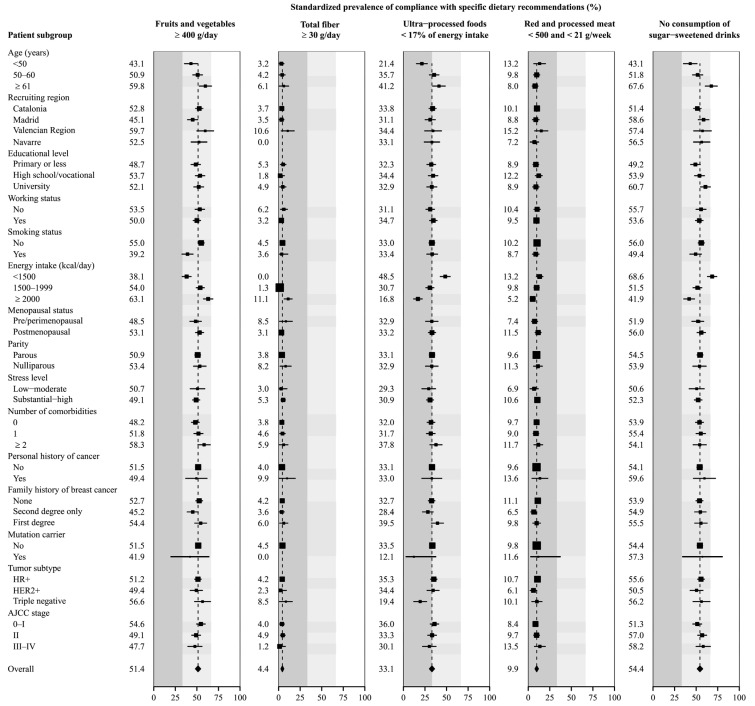
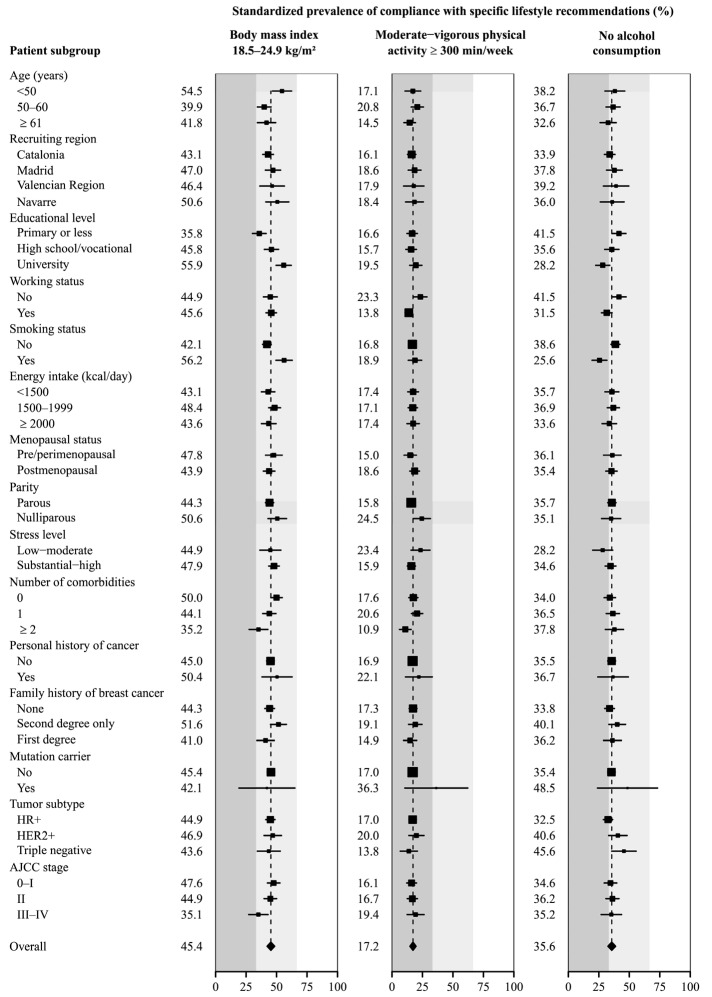
Results: The mean adherence was 3.5 points out of 7. The recommendations with the best and worst adherence were avoiding sugar-sweetened drinks (54.4% adherence) and maintaining a fiber-rich diet (4.4% consumed ≥30 g/day). The overall adherence was better in women aged ≥60 years (SPR = 1.55; 95% CI = 1.09-2.22), and worse in those with a caloric intake ≥2000 kcal/day (SPR = 0.48; 95% CI = 0.37-0.62) or ≥2 comorbidities (SPR = 0.66; 95% CI = 0.49-0.89). The adherence to maintaining a healthy weight was worse in those with ≥2 comorbidities and stage III-IV tumors. The physical activity adherence was worse in working women and those with ≥2 comorbidities. The alcohol restriction adherence was worse in smokers. Younger women, smokers and those with a low calorie intake were less adherent to the fruit/vegetable recommendation. The consumption of fiber and limited consumption of red/processed meat adherence was poor in all the subgroups. The adherence to a limited consumption of fast food and sugary drinks was worse in younger women and high-calorie-diet consumers.
Conclusions: The differences in the adherence to recommendations according to patient characteristics justify the design of personalized interventions for breast cancer patients.
期刊介绍:
Cancers (ISSN 2072-6694) is an international, peer-reviewed open access journal on oncology. It publishes reviews, regular research papers and short communications. Our aim is to encourage scientists to publish their experimental and theoretical results in as much detail as possible. There is no restriction on the length of the papers. The full experimental details must be provided so that the results can be reproduced.



 京公网安备 11010802042870号
京ICP备2023020795号-1
京公网安备 11010802042870号
京ICP备2023020795号-1

 分享
分享
 求助内容:
求助内容: 应助结果提醒方式:
 扫码关注我们
