Tianquan Chen, Yijiao Zhu, Yushuang Liu, Hongxia Li, Zhe Han, Min Liu, Xia Xu, Rong Wang
{"title":"Stress hyperglycemia ratio: a novel prognostic marker in chronic kidney disease.","authors":"Tianquan Chen, Yijiao Zhu, Yushuang Liu, Hongxia Li, Zhe Han, Min Liu, Xia Xu, Rong Wang","doi":"10.1186/s13098-025-01639-2","DOIUrl":null,"url":null,"abstract":"<p><strong>Background: </strong>The stress hyperglycemia ratio (SHR) has recently been suggested to characterize acute glycemic rise better than the admission blood glucose and to be associated with unfavorable outcomes in patients with various cardiovascular diseases. This study aimed to explore the associations between SHR and all-cause or cardiovascular disease (CVD) mortality in patients with chronic kidney disease (CKD).</p><p><strong>Methods: </strong>Adults with CKD participating in the 1999-2018 US National Health and Nutrition Examination Survey with complete SHR and follow-up data were included. SHR was calculated from fasting blood glucose and glycated hemoglobin levels. Associations between SHR and mortality were investigated by weighted multivariable Cox regression analysis.</p><p><strong>Results: </strong>Among the 3284 participants (mean age 61 years, men prevalence 44.09%) included, 1324 (487 CVD-related) deaths occurred during a median follow-up of 87 months. The restricted cubic spline curve adjusted for all covariates showed a U-shaped and J-shaped association between SHR and all-cause or CVD mortality, respectively, with discernible inflection points at 0.86 and 0.88, respectively. The hazard ratio (95% confidence interval) was 0.117 (0.034-0.404) for SHR < 0.86 and 2.065 (1.328-3.209) for SHR ≥ 0.86 for all-cause mortality, and 0.063 (0.008-0.531) for SHR < 0.88 and 1.551 (0.770-3.124) for SHR ≥ 0.88 for CVD mortality.</p><p><strong>Conclusion: </strong>We identified U-shaped and J-shaped association between SHR and all-cause or CVD mortality, respectively, in patients with CKD. This result highlights that SHR may be potentially informative for the risk stratification of CKD patients. Given the potential limitations of residual confounding, prospective studies are needed to confirm our findings.</p>","PeriodicalId":11106,"journal":{"name":"Diabetology & Metabolic Syndrome","volume":"17 1","pages":"69"},"PeriodicalIF":3.9000,"publicationDate":"2025-02-25","publicationTypes":"Journal Article","fieldsOfStudy":null,"isOpenAccess":false,"openAccessPdf":"https://www.ncbi.nlm.nih.gov/pmc/articles/PMC11854335/pdf/","citationCount":"0","resultStr":null,"platform":"Semanticscholar","paperid":null,"PeriodicalName":"Diabetology & Metabolic Syndrome","FirstCategoryId":"3","ListUrlMain":"https://doi.org/10.1186/s13098-025-01639-2","RegionNum":3,"RegionCategory":"医学","ArticlePicture":[],"TitleCN":null,"AbstractTextCN":null,"PMCID":null,"EPubDate":"","PubModel":"","JCR":"Q2","JCRName":"ENDOCRINOLOGY & METABOLISM","Score":null,"Total":0}
引用次数: 0
Abstract
Background: The stress hyperglycemia ratio (SHR) has recently been suggested to characterize acute glycemic rise better than the admission blood glucose and to be associated with unfavorable outcomes in patients with various cardiovascular diseases. This study aimed to explore the associations between SHR and all-cause or cardiovascular disease (CVD) mortality in patients with chronic kidney disease (CKD).
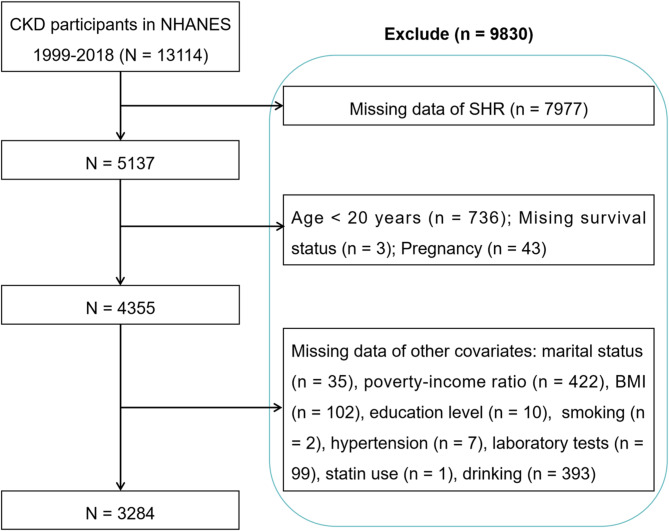
Methods: Adults with CKD participating in the 1999-2018 US National Health and Nutrition Examination Survey with complete SHR and follow-up data were included. SHR was calculated from fasting blood glucose and glycated hemoglobin levels. Associations between SHR and mortality were investigated by weighted multivariable Cox regression analysis.
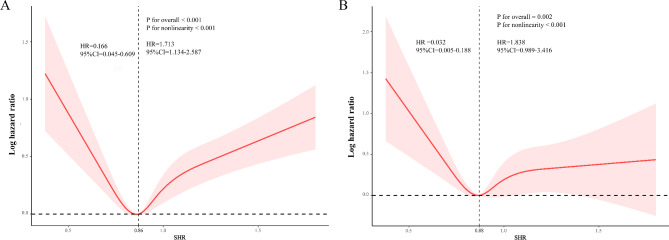
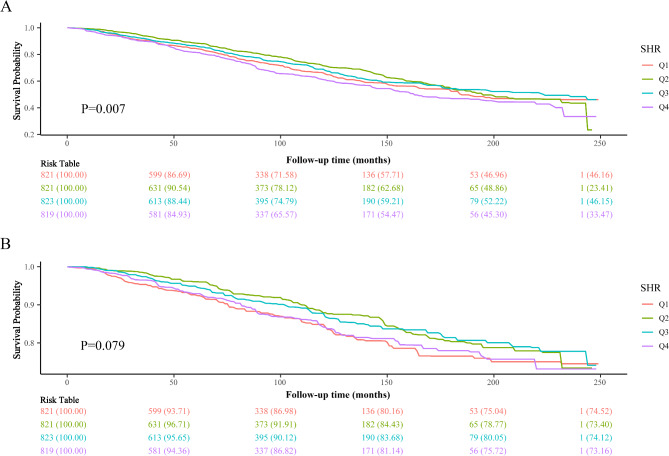
Results: Among the 3284 participants (mean age 61 years, men prevalence 44.09%) included, 1324 (487 CVD-related) deaths occurred during a median follow-up of 87 months. The restricted cubic spline curve adjusted for all covariates showed a U-shaped and J-shaped association between SHR and all-cause or CVD mortality, respectively, with discernible inflection points at 0.86 and 0.88, respectively. The hazard ratio (95% confidence interval) was 0.117 (0.034-0.404) for SHR < 0.86 and 2.065 (1.328-3.209) for SHR ≥ 0.86 for all-cause mortality, and 0.063 (0.008-0.531) for SHR < 0.88 and 1.551 (0.770-3.124) for SHR ≥ 0.88 for CVD mortality.
Conclusion: We identified U-shaped and J-shaped association between SHR and all-cause or CVD mortality, respectively, in patients with CKD. This result highlights that SHR may be potentially informative for the risk stratification of CKD patients. Given the potential limitations of residual confounding, prospective studies are needed to confirm our findings.
期刊介绍:
Diabetology & Metabolic Syndrome publishes articles on all aspects of the pathophysiology of diabetes and metabolic syndrome.
By publishing original material exploring any area of laboratory, animal or clinical research into diabetes and metabolic syndrome, the journal offers a high-visibility forum for new insights and discussions into the issues of importance to the relevant community.



 京公网安备 11010802042870号
京ICP备2023020795号-1
京公网安备 11010802042870号
京ICP备2023020795号-1

 分享
分享
 求助内容:
求助内容: 应助结果提醒方式:
 扫码关注我们
