Meaghan A. Rettele PharmD , Adham M. Mohamed PharmD , Timothy P. Berry PharmD , Sydney S. Wilson PharmD , Julie A. Welge PharmD , Shelby S. Shemanski PharmD , Rebecca L. Shriver MD , Shais S. Jallu MD , Michelle M. Haines MD , Aaron J. Douglas DO , Majdi S. Hamarshi MD, FCCM , Jonathan B. Kozinn MD
{"title":"Evaluation of Angiotensin II in Patients With Catecholamine-Resistant Vasodilatory Shock Requiring Continuous Renal Replacement Therapy (ANGEL CRRT)","authors":"Meaghan A. Rettele PharmD , Adham M. Mohamed PharmD , Timothy P. Berry PharmD , Sydney S. Wilson PharmD , Julie A. Welge PharmD , Shelby S. Shemanski PharmD , Rebecca L. Shriver MD , Shais S. Jallu MD , Michelle M. Haines MD , Aaron J. Douglas DO , Majdi S. Hamarshi MD, FCCM , Jonathan B. Kozinn MD","doi":"10.1053/j.jvca.2025.01.042","DOIUrl":null,"url":null,"abstract":"<div><h3>Objective</h3><div>To compare clinical outcomes of patients with catecholamine-resistant vasodilatory shock (CRVS) receiving continuous renal replacement therapy who receive adjunctive angiotensin II (ANGII) to those who do not.</div></div><div><h3>Design</h3><div>Retrospective cohort analysis.</div></div><div><h3>Setting</h3><div>Multicenter, single health system consisting of one academic medical center and four community hospitals.</div></div><div><h3>Participants</h3><div>Critically ill adult patients with CRVS (norepinephrine or equivalent dose ≥0.5 mcg/kg/min).</div></div><div><h3>Interventions</h3><div>Adjunctive ANGII versus standard-of-care (SOC) vasopressors alone (norepinephrine, epinephrine, vasopressin, phenylephrine, dopamine).</div></div><div><h3>Measurements and Main Results</h3><div>The primary outcome was intensive care unit mortality. Secondary outcomes included 30-day mortality, Sequential Organ Failure Assessment (SOFA) score at 72 hours, time to shock resolution, and adverse effects. A multivariate logistic regression was used for the primary analysis. The study included 265 patients, of which 70 received ANGII and 195 received SOC. Intensive care unit and 30-day mortality were lower in patients that received ANGII (61.4% <em>v</em> 75.4%, adjusted odds ratio 0.438, 95% confidence interval: 0.239-0.805, p <em>=</em> 0.008; and 67.1% <em>v</em> 78.5%, adjusted odds ratio 0.479, 95% confidence interval: 0.256-0.898, p = 0.022). Differences in time to shock reversal and SOFA score at 72 hours were not statistically significant. The adverse effects evaluated were not statistically significant, apart from an increase in fungal infections in the ANGII group (17.1% <em>v</em> 7.2%, p = 0.016).</div></div><div><h3>Conclusions</h3><div>ANGII was associated with lower mortality in patients who received renal replacement therapy compared to SOC. This evaluation reaffirms a subgroup of patients that may benefit from the addition of ANGII.</div></div>","PeriodicalId":15176,"journal":{"name":"Journal of cardiothoracic and vascular anesthesia","volume":"39 5","pages":"Pages 1250-1256"},"PeriodicalIF":2.1000,"publicationDate":"2025-05-01","publicationTypes":"Journal Article","fieldsOfStudy":null,"isOpenAccess":false,"openAccessPdf":"","citationCount":"0","resultStr":null,"platform":"Semanticscholar","paperid":null,"PeriodicalName":"Journal of cardiothoracic and vascular anesthesia","FirstCategoryId":"3","ListUrlMain":"https://www.sciencedirect.com/science/article/pii/S105307702500103X","RegionNum":4,"RegionCategory":"医学","ArticlePicture":[],"TitleCN":null,"AbstractTextCN":null,"PMCID":null,"EPubDate":"2025/1/31 0:00:00","PubModel":"Epub","JCR":"Q2","JCRName":"ANESTHESIOLOGY","Score":null,"Total":0}
引用次数: 0
Abstract
Objective
To compare clinical outcomes of patients with catecholamine-resistant vasodilatory shock (CRVS) receiving continuous renal replacement therapy who receive adjunctive angiotensin II (ANGII) to those who do not.
Design
Retrospective cohort analysis.
Setting
Multicenter, single health system consisting of one academic medical center and four community hospitals.
Participants
Critically ill adult patients with CRVS (norepinephrine or equivalent dose ≥0.5 mcg/kg/min).
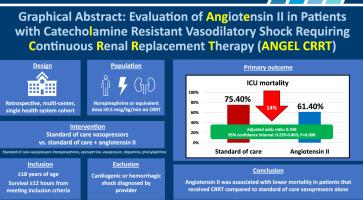
The primary outcome was intensive care unit mortality. Secondary outcomes included 30-day mortality, Sequential Organ Failure Assessment (SOFA) score at 72 hours, time to shock resolution, and adverse effects. A multivariate logistic regression was used for the primary analysis. The study included 265 patients, of which 70 received ANGII and 195 received SOC. Intensive care unit and 30-day mortality were lower in patients that received ANGII (61.4% v 75.4%, adjusted odds ratio 0.438, 95% confidence interval: 0.239-0.805, p = 0.008; and 67.1% v 78.5%, adjusted odds ratio 0.479, 95% confidence interval: 0.256-0.898, p = 0.022). Differences in time to shock reversal and SOFA score at 72 hours were not statistically significant. The adverse effects evaluated were not statistically significant, apart from an increase in fungal infections in the ANGII group (17.1% v 7.2%, p = 0.016).
Conclusions
ANGII was associated with lower mortality in patients who received renal replacement therapy compared to SOC. This evaluation reaffirms a subgroup of patients that may benefit from the addition of ANGII.
目的:比较接受持续肾替代治疗的儿茶酚胺抵抗性血管扩张性休克(CRVS)患者接受辅助血管紧张素II (ANGII)治疗与不接受辅助血管紧张素II治疗的临床结果。设计:回顾性队列分析。环境:由1个学术医疗中心和4个社区医院组成的多中心、单一卫生系统。参与者:CRVS的危重成人患者(去甲肾上腺素或等效剂量≥0.5 mcg/kg/min)。干预措施:辅助ANGII与标准护理(SOC)单抗利尿激素(去甲肾上腺素,肾上腺素,利尿加压素,苯肾上腺素,多巴胺)。测量方法和主要结果:主要结果为重症监护病房死亡率。次要结局包括30天死亡率、72小时时顺序器官衰竭评估(SOFA)评分、休克消退时间和不良反应。采用多元逻辑回归进行初步分析。该研究纳入265例患者,其中70例接受ANGII治疗,195例接受SOC治疗。重症监护病房和30天死亡率在接受ANGII治疗的患者中较低(61.4% vs 75.4%,校正优势比0.438,95%可信区间:0.239-0.805,p = 0.008;67.1% vs 78.5%,校正优势比0.479,95%可信区间:0.256 ~ 0.898,p = 0.022)。休克逆转时间和72小时SOFA评分差异无统计学意义。除了ANGII组真菌感染增加(17.1% vs 7.2%, p = 0.016)外,评估的不良反应无统计学意义。结论:与SOC相比,接受肾脏替代治疗的患者ANGII与较低的死亡率相关。这一评价再次确认了一个亚组患者可能受益于ANGII的添加。
期刊介绍:
The Journal of Cardiothoracic and Vascular Anesthesia is primarily aimed at anesthesiologists who deal with patients undergoing cardiac, thoracic or vascular surgical procedures. JCVA features a multidisciplinary approach, with contributions from cardiac, vascular and thoracic surgeons, cardiologists, and other related specialists. Emphasis is placed on rapid publication of clinically relevant material.



 京公网安备 11010802042870号
京ICP备2023020795号-1
京公网安备 11010802042870号
京ICP备2023020795号-1

 分享
分享
 求助内容:
求助内容: 应助结果提醒方式:
 扫码关注我们
