{"title":"Contactless Breathing Monitoring at Home and in the Hospital: Protocol for a Low-Cost Frequency-Modulated Continuous-Wave Radar-Based Device.","authors":"Arnav Hari, Ravishankar Kumar, Brijesh Kumbhani, Sam Darshi, Satyam Agarwal, Jyotindra Singh Sahambi, Suksham Jain, Deepak Chawla","doi":"10.2196/59532","DOIUrl":null,"url":null,"abstract":"<p><strong>Background: </strong>Contactless monitoring of vital signs, especially the breathing of children, in the hospital is performed on a priority basis because their organs and immune system are immature. Therefore, continuous monitoring of their vital signs with a sensor that is directly attached to their body is not possible, as it irritates the sensitive newborn skin and causes discomfort. A contactless frequency-modulated continuous-wave (FMCW) radar-based device can wirelessly monitor the breathing rate and pattern of a child in the hospital or at home. Signal-processing capability can be added to this device to process breathing data and analyze the apnea condition arising due to irregular breathing patterns.</p><p><strong>Objective: </strong>This study will develop a contactless FMCW radar-based system to accurately monitor the breathing rate and pattern of neonates and infants in hospitals and at home in order to provide a noninvasive, nonintrusive and contactless alternative to conventional sensor-based methods and address a critical need in neonatal care, potentially improving health outcomes for vulnerable infants.</p><p><strong>Methods: </strong>The radar transmits a signal toward the body, and the time taken by the signal received to travel from the body to the receiving antenna is analyzed. This time is proportional to the distance between the radar and the body, and the breathing pattern is recognized as a slight, periodic variation in this distance. We will use this concept with multiple antenna systems to monitor the breathing of neonates with improved sensitivity. The radar-based device will be installed, in addition to conventional breathing monitors, in the neonatal intensive care unit. The signals received at the radar and the respiration signals from conventional monitors will be recorded in a database. Signal-processing techniques will be applied to extract breathing signals from the signals received at the radar.</p><p><strong>Results: </strong>This study was funded in January 2023 by the Science and Engineering Research Board (SERB) of India. The device was designed by May 2024, and a working proof-of concept was verified in the Indian Institute of Technology (IIT) Ropar laboratory. Implementation of the proposed method for initial study began in December 2024. Results are expected to be published in the first quarter of 2025.</p><p><strong>Conclusions: </strong>The contactless FMCW radar-based system will provide reliable estimation of the breathing rate and pattern, which is close to the conventional reference device values most of the time. Our device will also provide a seamless breathing-monitoring system to be used both in hospitals and at home for newborns and premature babies until they are fully healthy and fit.</p><p><strong>International registered report identifier (irrid): </strong>PRR1-10.2196/59532.</p>","PeriodicalId":14755,"journal":{"name":"JMIR Research Protocols","volume":"14 ","pages":"e59532"},"PeriodicalIF":1.5000,"publicationDate":"2025-02-25","publicationTypes":"Journal Article","fieldsOfStudy":null,"isOpenAccess":false,"openAccessPdf":"https://www.ncbi.nlm.nih.gov/pmc/articles/PMC11897680/pdf/","citationCount":"0","resultStr":null,"platform":"Semanticscholar","paperid":null,"PeriodicalName":"JMIR Research Protocols","FirstCategoryId":"1085","ListUrlMain":"https://doi.org/10.2196/59532","RegionNum":0,"RegionCategory":null,"ArticlePicture":[],"TitleCN":null,"AbstractTextCN":null,"PMCID":null,"EPubDate":"","PubModel":"","JCR":"Q3","JCRName":"HEALTH CARE SCIENCES & SERVICES","Score":null,"Total":0}
引用次数: 0
Abstract
Background: Contactless monitoring of vital signs, especially the breathing of children, in the hospital is performed on a priority basis because their organs and immune system are immature. Therefore, continuous monitoring of their vital signs with a sensor that is directly attached to their body is not possible, as it irritates the sensitive newborn skin and causes discomfort. A contactless frequency-modulated continuous-wave (FMCW) radar-based device can wirelessly monitor the breathing rate and pattern of a child in the hospital or at home. Signal-processing capability can be added to this device to process breathing data and analyze the apnea condition arising due to irregular breathing patterns.
Objective: This study will develop a contactless FMCW radar-based system to accurately monitor the breathing rate and pattern of neonates and infants in hospitals and at home in order to provide a noninvasive, nonintrusive and contactless alternative to conventional sensor-based methods and address a critical need in neonatal care, potentially improving health outcomes for vulnerable infants.
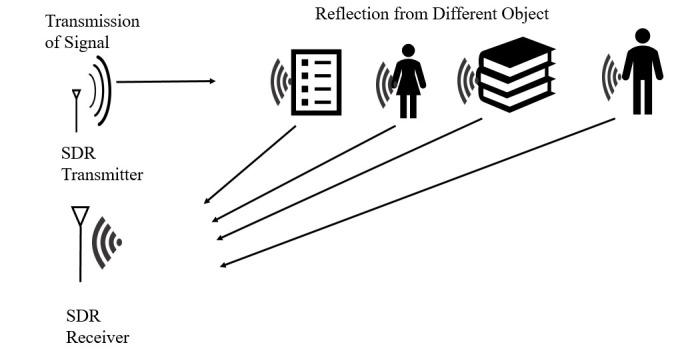
Methods: The radar transmits a signal toward the body, and the time taken by the signal received to travel from the body to the receiving antenna is analyzed. This time is proportional to the distance between the radar and the body, and the breathing pattern is recognized as a slight, periodic variation in this distance. We will use this concept with multiple antenna systems to monitor the breathing of neonates with improved sensitivity. The radar-based device will be installed, in addition to conventional breathing monitors, in the neonatal intensive care unit. The signals received at the radar and the respiration signals from conventional monitors will be recorded in a database. Signal-processing techniques will be applied to extract breathing signals from the signals received at the radar.
Results: This study was funded in January 2023 by the Science and Engineering Research Board (SERB) of India. The device was designed by May 2024, and a working proof-of concept was verified in the Indian Institute of Technology (IIT) Ropar laboratory. Implementation of the proposed method for initial study began in December 2024. Results are expected to be published in the first quarter of 2025.
Conclusions: The contactless FMCW radar-based system will provide reliable estimation of the breathing rate and pattern, which is close to the conventional reference device values most of the time. Our device will also provide a seamless breathing-monitoring system to be used both in hospitals and at home for newborns and premature babies until they are fully healthy and fit.
International registered report identifier (irrid): PRR1-10.2196/59532.





 京公网安备 11010802042870号
京ICP备2023020795号-1
京公网安备 11010802042870号
京ICP备2023020795号-1

 分享
分享
 求助内容:
求助内容: 应助结果提醒方式:
 扫码关注我们
