{"title":"Digital Therapeutics-Based Cardio-Oncology Rehabilitation for Lung Cancer Survivors: Randomized Controlled Trial.","authors":"Guangqi Li, Xueyan Zhou, Junyue Deng, Jiao Wang, Ping Ai, Jingyuan Zeng, Xuelei Ma, Hu Liao","doi":"10.2196/60115","DOIUrl":null,"url":null,"abstract":"<p><strong>Background: </strong>Lung cancer ranks as the leading cause of cancer-related deaths. For lung cancer survivors, cardiopulmonary fitness is a strong independent predictor of survival, while surgical interventions impact both cardiovascular and pulmonary function. Home-based cardiac telerehabilitation through wearable devices and mobile apps is a substitution for traditional, center-based rehabilitation with equal efficacy and a higher completion rate. However, it has not been widely used in clinical practice.</p><p><strong>Objective: </strong>The objective of this study was to broaden the use of digital health care in the cardiopulmonary rehabilitation of lung cancer survivors and to assess its impact on cardiopulmonary fitness and quality of life (QOL).</p><p><strong>Methods: </strong>Early-stage nonsmall cell lung cancer survivors aged 18-70 years were included. All the participants received surgery 1-2 months before enrollment and did not require further antitumor therapy. Participants were randomly assigned to receive cardiac telerehabilitation or usual care for 5 months. Artificial intelligence-driven exercise prescription with a video guide and real-time heart rate (HR) monitoring was generated based on cardiopulmonary exercise testing. Aerobic exercise combining elastic band-based resistance exercises were recommended with a frequency of 3-5 d/wk and a duration of 90-150 min/wk. The effective exercise duration was recorded when patients' HR reached the target zone (HR<sub>resting</sub> + [HR<sub>max</sub> - HR<sub>resting</sub>] × [≈40%-60%]), representing the duration under the target intensity. The prescription used a gradual progression in duration and action intensity based on the exercise data and feedback. Outcome measurements included cardiopulmonary fitness; lung function; cardiac function; tumor marker; safety; compliance; and scales assessing symptoms, psychology, sleep, fatigue, and QOL.</p><p><strong>Results: </strong>A total of 40 (85%) out of 47 patients finished the trial. The average prescription compliance rate of patients in the telerehabilitation group reached 101.2%, with an average exercise duration of 151.4 min/wk and an average effective exercise duration of 92.3 min/wk. The cardiac telerehabilitation was associated with higher improvement of maximal oxygen uptake peak (3.66, SD 3.23 mL/Kg/min vs 1.09, SD 3.23 mL/Kg/min; P=.02) and global health status or QOL (16.25, SD 23.02 vs 1.04, SD 13.90; P=.03) compared with usual care. Better alleviation of affective interference (-0.88, SD 1.50 vs 0.21, SD 1.22; P=.048), fatigue (-8.89, SD 15.96 vs 1.39, SD 12.09; P=.02), anxiety (-0.31, SD 0.44 vs -0.05, SD 0.29; P=.048), and daytime dysfunction (-0.55, SD 0.69 vs 0.00, SD 0.52; P=.02) was also observed in the telerehabilitation group. No exercise-related adverse events were identified during the intervention period.</p><p><strong>Conclusions: </strong>The 5-month, digital therapeutics-based telerehabilitation improved cardiorespiratory fitness in lung cancer survivors with good compliance and safety. Patients receiving telerehabilitation also reported improved QOL with reduced levels of fatigue, anxiety, and daytime dysfunction.</p><p><strong>Trial registration: </strong>Chinese Clinical Trial Registry ChiCTR2200064000; https://www.chictr.org.cn/showproj.html?proj=180594.</p>","PeriodicalId":14756,"journal":{"name":"JMIR mHealth and uHealth","volume":"13 ","pages":"e60115"},"PeriodicalIF":6.2000,"publicationDate":"2025-02-25","publicationTypes":"Journal Article","fieldsOfStudy":null,"isOpenAccess":false,"openAccessPdf":"https://www.ncbi.nlm.nih.gov/pmc/articles/PMC11897676/pdf/","citationCount":"0","resultStr":null,"platform":"Semanticscholar","paperid":null,"PeriodicalName":"JMIR mHealth and uHealth","FirstCategoryId":"3","ListUrlMain":"https://doi.org/10.2196/60115","RegionNum":2,"RegionCategory":"医学","ArticlePicture":[],"TitleCN":null,"AbstractTextCN":null,"PMCID":null,"EPubDate":"","PubModel":"","JCR":"Q1","JCRName":"HEALTH CARE SCIENCES & SERVICES","Score":null,"Total":0}
引用次数: 0
Abstract
Background: Lung cancer ranks as the leading cause of cancer-related deaths. For lung cancer survivors, cardiopulmonary fitness is a strong independent predictor of survival, while surgical interventions impact both cardiovascular and pulmonary function. Home-based cardiac telerehabilitation through wearable devices and mobile apps is a substitution for traditional, center-based rehabilitation with equal efficacy and a higher completion rate. However, it has not been widely used in clinical practice.
Objective: The objective of this study was to broaden the use of digital health care in the cardiopulmonary rehabilitation of lung cancer survivors and to assess its impact on cardiopulmonary fitness and quality of life (QOL).
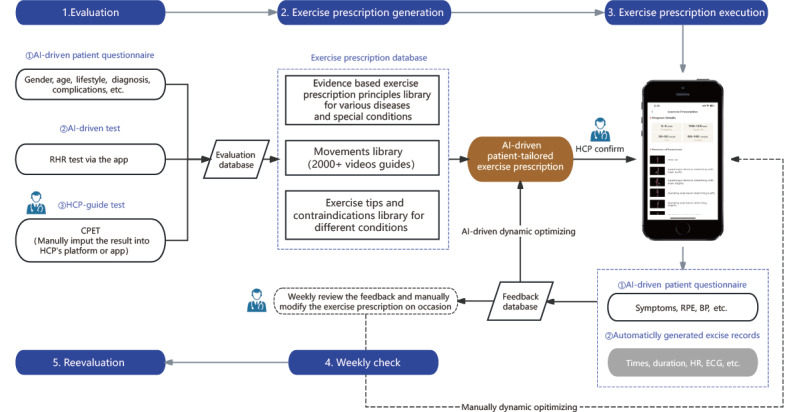
Methods: Early-stage nonsmall cell lung cancer survivors aged 18-70 years were included. All the participants received surgery 1-2 months before enrollment and did not require further antitumor therapy. Participants were randomly assigned to receive cardiac telerehabilitation or usual care for 5 months. Artificial intelligence-driven exercise prescription with a video guide and real-time heart rate (HR) monitoring was generated based on cardiopulmonary exercise testing. Aerobic exercise combining elastic band-based resistance exercises were recommended with a frequency of 3-5 d/wk and a duration of 90-150 min/wk. The effective exercise duration was recorded when patients' HR reached the target zone (HRresting + [HRmax - HRresting] × [≈40%-60%]), representing the duration under the target intensity. The prescription used a gradual progression in duration and action intensity based on the exercise data and feedback. Outcome measurements included cardiopulmonary fitness; lung function; cardiac function; tumor marker; safety; compliance; and scales assessing symptoms, psychology, sleep, fatigue, and QOL.
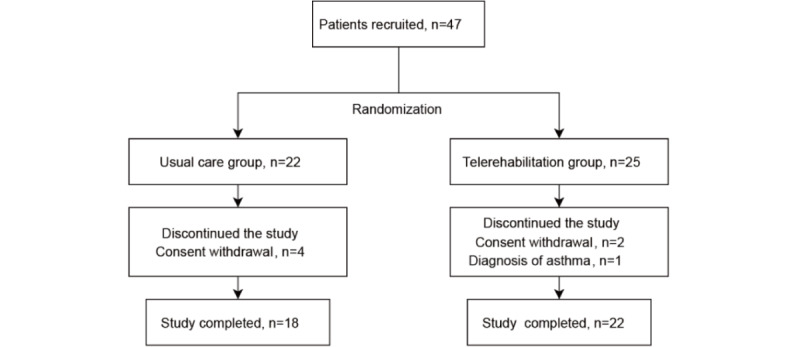
Results: A total of 40 (85%) out of 47 patients finished the trial. The average prescription compliance rate of patients in the telerehabilitation group reached 101.2%, with an average exercise duration of 151.4 min/wk and an average effective exercise duration of 92.3 min/wk. The cardiac telerehabilitation was associated with higher improvement of maximal oxygen uptake peak (3.66, SD 3.23 mL/Kg/min vs 1.09, SD 3.23 mL/Kg/min; P=.02) and global health status or QOL (16.25, SD 23.02 vs 1.04, SD 13.90; P=.03) compared with usual care. Better alleviation of affective interference (-0.88, SD 1.50 vs 0.21, SD 1.22; P=.048), fatigue (-8.89, SD 15.96 vs 1.39, SD 12.09; P=.02), anxiety (-0.31, SD 0.44 vs -0.05, SD 0.29; P=.048), and daytime dysfunction (-0.55, SD 0.69 vs 0.00, SD 0.52; P=.02) was also observed in the telerehabilitation group. No exercise-related adverse events were identified during the intervention period.
Conclusions: The 5-month, digital therapeutics-based telerehabilitation improved cardiorespiratory fitness in lung cancer survivors with good compliance and safety. Patients receiving telerehabilitation also reported improved QOL with reduced levels of fatigue, anxiety, and daytime dysfunction.
Trial registration: Chinese Clinical Trial Registry ChiCTR2200064000; https://www.chictr.org.cn/showproj.html?proj=180594.
期刊介绍:
JMIR mHealth and uHealth (JMU, ISSN 2291-5222) is a spin-off journal of JMIR, the leading eHealth journal (Impact Factor 2016: 5.175). JMIR mHealth and uHealth is indexed in PubMed, PubMed Central, and Science Citation Index Expanded (SCIE), and in June 2017 received a stunning inaugural Impact Factor of 4.636.
The journal focusses on health and biomedical applications in mobile and tablet computing, pervasive and ubiquitous computing, wearable computing and domotics.
JMIR mHealth and uHealth publishes since 2013 and was the first mhealth journal in Pubmed. It publishes even faster and has a broader scope with including papers which are more technical or more formative/developmental than what would be published in the Journal of Medical Internet Research.



 京公网安备 11010802042870号
京ICP备2023020795号-1
京公网安备 11010802042870号
京ICP备2023020795号-1

 分享
分享
 求助内容:
求助内容: 应助结果提醒方式:
 扫码关注我们
