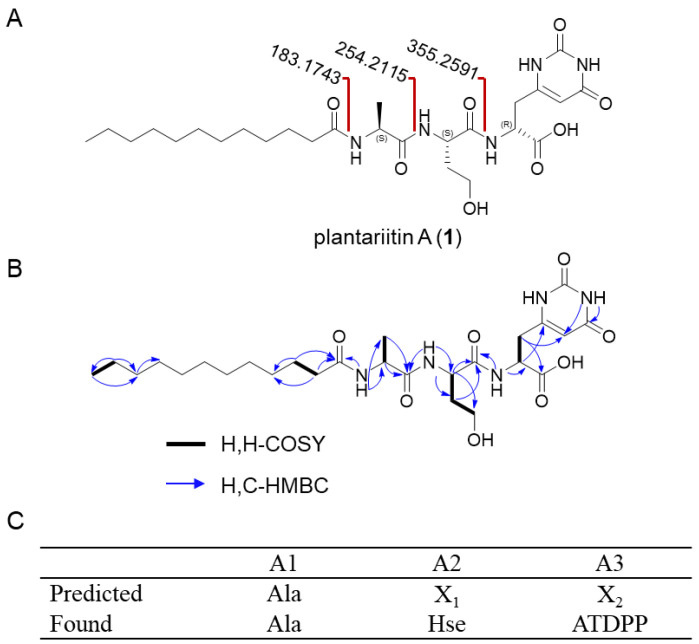
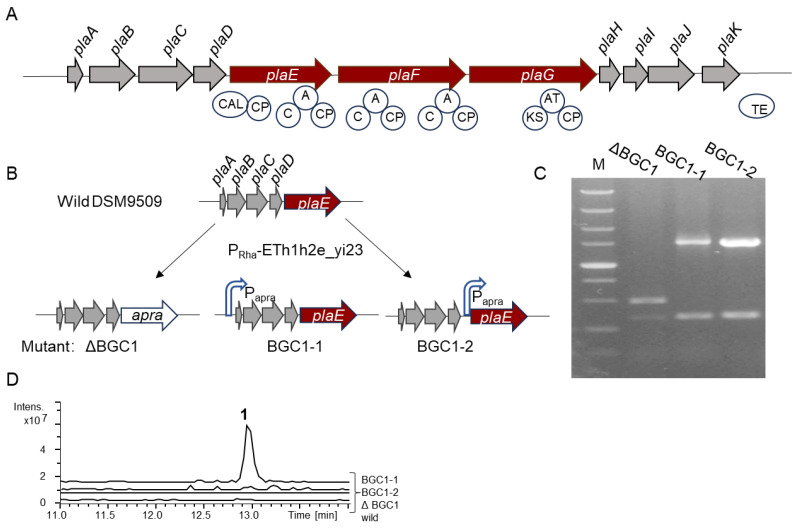
{"title":"Genomics-Driven Discovery of Plantariitin A, a New Lipopeptide in <i>Burkholderia plantarii</i> DSM9509.","authors":"Xiuling Wang, Zhuo Zhang, Jun Fu, Ruijuan Li","doi":"10.3390/molecules30040868","DOIUrl":null,"url":null,"abstract":"<p><p>A significant number of silent biosynthetic gene clusters (BGCs) within the <i>Burkholderia</i> genome remain uncharacterized, representing a valuable opportunity for the discovery of new natural products. In this research, the recombineering system ETh1h2e_yi23, which facilitates recombination in <i>Burkholderia</i> and was developed in our previous study, was used for mining the BGCs of <i>B. plantarii</i> DSM9509. By using this recombineering system, the constitutive promoter was precisely inserted into the genome, resulting in the activation of the silent <i>pla</i> BGC, which led to the production of a new lipopeptide named plantariitin A. A distinctive characteristic of this lipopeptide is the incorporation of a non-proteinogenic amino acid residue, i.e., amino-1,2,3,6-tetrahydro-2,6-dioxo-4-pyrimidinepropanoic acid (ATDPP), which has not been identified in other natural products. A biological activity assay demonstrated that plantariitin A exhibits anti-inflammatory activity. This study further substantiates the notion that the in situ activation of silent BGCs is a crucial strategy for the discovery of new natural products within the genus <i>Burkholderia</i>. With the increasing availability of genomic data and the development of bioinformatics tools, <i>Burkholderia</i> is poised to emerge as a prominent source for the development of new lipopeptides.</p>","PeriodicalId":19041,"journal":{"name":"Molecules","volume":"30 4","pages":""},"PeriodicalIF":4.6000,"publicationDate":"2025-02-14","publicationTypes":"Journal Article","fieldsOfStudy":null,"isOpenAccess":false,"openAccessPdf":"https://www.ncbi.nlm.nih.gov/pmc/articles/PMC11858073/pdf/","citationCount":"0","resultStr":null,"platform":"Semanticscholar","paperid":null,"PeriodicalName":"Molecules","FirstCategoryId":"92","ListUrlMain":"https://doi.org/10.3390/molecules30040868","RegionNum":2,"RegionCategory":"化学","ArticlePicture":[],"TitleCN":null,"AbstractTextCN":null,"PMCID":null,"EPubDate":"","PubModel":"","JCR":"Q2","JCRName":"BIOCHEMISTRY & MOLECULAR BIOLOGY","Score":null,"Total":0}
引用次数: 0
Abstract
A significant number of silent biosynthetic gene clusters (BGCs) within the Burkholderia genome remain uncharacterized, representing a valuable opportunity for the discovery of new natural products. In this research, the recombineering system ETh1h2e_yi23, which facilitates recombination in Burkholderia and was developed in our previous study, was used for mining the BGCs of B. plantarii DSM9509. By using this recombineering system, the constitutive promoter was precisely inserted into the genome, resulting in the activation of the silent pla BGC, which led to the production of a new lipopeptide named plantariitin A. A distinctive characteristic of this lipopeptide is the incorporation of a non-proteinogenic amino acid residue, i.e., amino-1,2,3,6-tetrahydro-2,6-dioxo-4-pyrimidinepropanoic acid (ATDPP), which has not been identified in other natural products. A biological activity assay demonstrated that plantariitin A exhibits anti-inflammatory activity. This study further substantiates the notion that the in situ activation of silent BGCs is a crucial strategy for the discovery of new natural products within the genus Burkholderia. With the increasing availability of genomic data and the development of bioinformatics tools, Burkholderia is poised to emerge as a prominent source for the development of new lipopeptides.
伯克霍尔德氏菌基因组中大量沉默的生物合成基因簇(bgc)仍未被表征,这为发现新的天然产物提供了宝贵的机会。本研究利用我们在前期研究中开发的重组系统ETh1h2e_yi23,对植物双歧杆菌DSM9509的bgc进行了挖掘。利用该重组系统,将本构启动子精确插入基因组,激活沉默的pgc,生成新的脂肽plantariittin a .该脂肽的显著特征是结合了非蛋白氨基酸残基,即氨基-1,2,3,6-四氢-2,6-二氧基-4-嘧啶丙酸(ATDPP),这在其他天然产物中尚未发现。生物活性试验表明,车前虫素A具有抗炎活性。这项研究进一步证实了沉默bgc的原位激活是在伯克霍尔德菌属中发现新的天然产物的关键策略。随着基因组数据的日益可用性和生物信息学工具的发展,伯克霍尔德菌有望成为开发新脂肽的重要来源。
期刊介绍:
Molecules (ISSN 1420-3049, CODEN: MOLEFW) is an open access journal of synthetic organic chemistry and natural product chemistry. All articles are peer-reviewed and published continously upon acceptance. Molecules is published by MDPI, Basel, Switzerland. Our aim is to encourage chemists to publish as much as possible their experimental detail, particularly synthetic procedures and characterization information. There is no restriction on the length of the experimental section. In addition, availability of compound samples is published and considered as important information. Authors are encouraged to register or deposit their chemical samples through the non-profit international organization Molecular Diversity Preservation International (MDPI). Molecules has been launched in 1996 to preserve and exploit molecular diversity of both, chemical information and chemical substances.




 京公网安备 11010802042870号
京ICP备2023020795号-1
京公网安备 11010802042870号
京ICP备2023020795号-1

 分享
分享
 求助内容:
求助内容: 应助结果提醒方式:
 扫码关注我们
