Xiaomeng Xiang, Chaomin Zhao, Runhe Zhang, Jing Zeng, Liangzi Wang, Shuran Zhang, Diego Cristos, Bing Liu, Siyan Xu, Xionghai Yi
{"title":"Beef Traceability Between China and Argentina Based on Various Machine Learning Models.","authors":"Xiaomeng Xiang, Chaomin Zhao, Runhe Zhang, Jing Zeng, Liangzi Wang, Shuran Zhang, Diego Cristos, Bing Liu, Siyan Xu, Xionghai Yi","doi":"10.3390/molecules30040880","DOIUrl":null,"url":null,"abstract":"<p><p>Beef, as a nutrient-rich food, is widely favored by consumers. The production region significantly influences the nutritional value and quality of beef. However, current methods for tracing the origin of beef are still under development, necessitating effective approaches to ensure food safety and meet consumer demand for high-quality beef. This study aims to establish a classification model for beef origin prediction by analyzing elemental content and stable isotopes in beef samples from two countries. The concentrations of elements in beef were analyzed using ICP-MS and ICP-OES, while the stable carbon isotope ratio was determined using EA-IRMS. Machine learning algorithms were employed to construct classification prediction models. A total of 83 beef samples were analyzed for the concentrations of 52 elements and the stable carbon isotope ratio. The classification accuracy of the PLS-DA model built on these results was 98.8%, while the prediction accuracy was 94.12% for the convolutional neural network (CNN) and 82.35% for the Random Forest algorithm. The PLS-DA model demonstrated higher classification accuracy compared to CNN and Random Forest, with an explanatory power (R<sup>2</sup>) of 0.924 and predictive ability (Q<sup>2</sup>) of 0.787. Combining the analysis of 52 elements and the stable carbon isotope ratio with machine learning algorithms enables effective tracing and origin prediction of beef from different regions. Key factors influencing beef origin were identified as Fe, Cs, As, δ<sup>13</sup>C, Co, V, Sc, Rb, and Ru.</p>","PeriodicalId":19041,"journal":{"name":"Molecules","volume":"30 4","pages":""},"PeriodicalIF":4.6000,"publicationDate":"2025-02-14","publicationTypes":"Journal Article","fieldsOfStudy":null,"isOpenAccess":false,"openAccessPdf":"https://www.ncbi.nlm.nih.gov/pmc/articles/PMC11858054/pdf/","citationCount":"0","resultStr":null,"platform":"Semanticscholar","paperid":null,"PeriodicalName":"Molecules","FirstCategoryId":"92","ListUrlMain":"https://doi.org/10.3390/molecules30040880","RegionNum":2,"RegionCategory":"化学","ArticlePicture":[],"TitleCN":null,"AbstractTextCN":null,"PMCID":null,"EPubDate":"","PubModel":"","JCR":"Q2","JCRName":"BIOCHEMISTRY & MOLECULAR BIOLOGY","Score":null,"Total":0}
引用次数: 0
Abstract
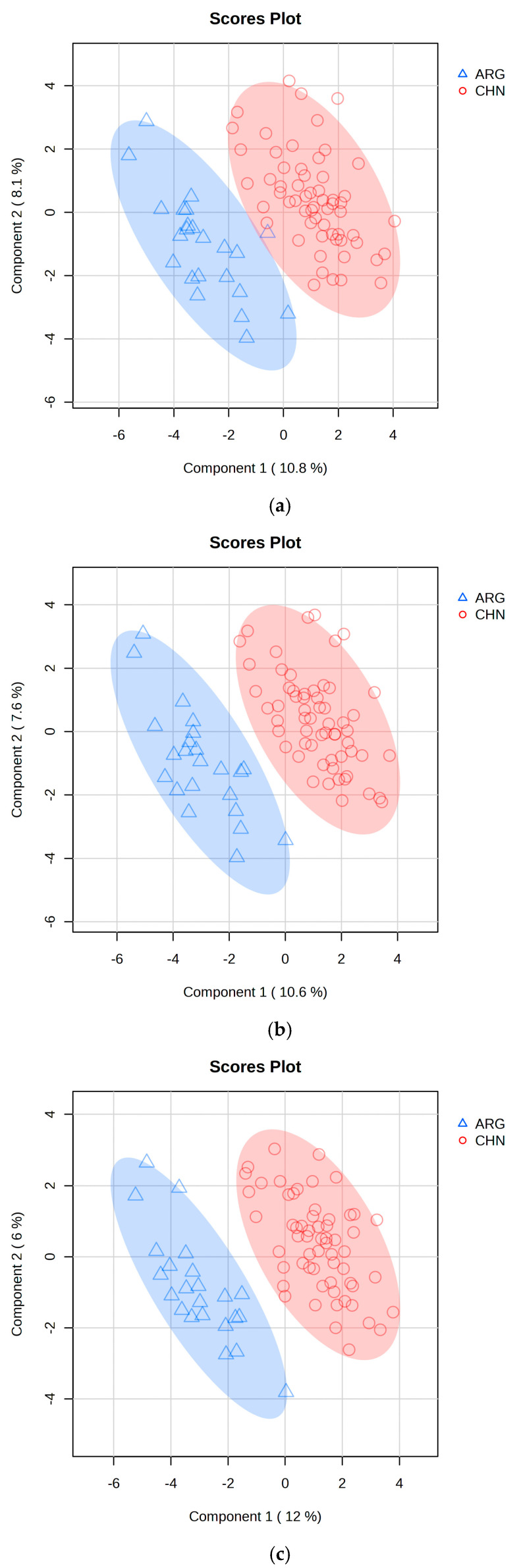
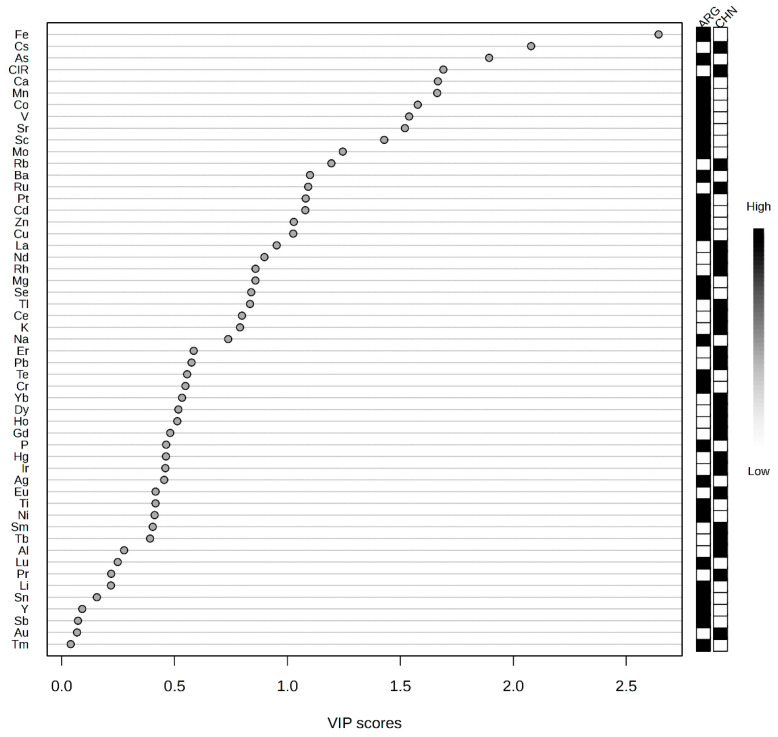
Beef, as a nutrient-rich food, is widely favored by consumers. The production region significantly influences the nutritional value and quality of beef. However, current methods for tracing the origin of beef are still under development, necessitating effective approaches to ensure food safety and meet consumer demand for high-quality beef. This study aims to establish a classification model for beef origin prediction by analyzing elemental content and stable isotopes in beef samples from two countries. The concentrations of elements in beef were analyzed using ICP-MS and ICP-OES, while the stable carbon isotope ratio was determined using EA-IRMS. Machine learning algorithms were employed to construct classification prediction models. A total of 83 beef samples were analyzed for the concentrations of 52 elements and the stable carbon isotope ratio. The classification accuracy of the PLS-DA model built on these results was 98.8%, while the prediction accuracy was 94.12% for the convolutional neural network (CNN) and 82.35% for the Random Forest algorithm. The PLS-DA model demonstrated higher classification accuracy compared to CNN and Random Forest, with an explanatory power (R2) of 0.924 and predictive ability (Q2) of 0.787. Combining the analysis of 52 elements and the stable carbon isotope ratio with machine learning algorithms enables effective tracing and origin prediction of beef from different regions. Key factors influencing beef origin were identified as Fe, Cs, As, δ13C, Co, V, Sc, Rb, and Ru.
期刊介绍:
Molecules (ISSN 1420-3049, CODEN: MOLEFW) is an open access journal of synthetic organic chemistry and natural product chemistry. All articles are peer-reviewed and published continously upon acceptance. Molecules is published by MDPI, Basel, Switzerland. Our aim is to encourage chemists to publish as much as possible their experimental detail, particularly synthetic procedures and characterization information. There is no restriction on the length of the experimental section. In addition, availability of compound samples is published and considered as important information. Authors are encouraged to register or deposit their chemical samples through the non-profit international organization Molecular Diversity Preservation International (MDPI). Molecules has been launched in 1996 to preserve and exploit molecular diversity of both, chemical information and chemical substances.





 京公网安备 11010802042870号
京ICP备2023020795号-1
京公网安备 11010802042870号
京ICP备2023020795号-1

 分享
分享
 求助内容:
求助内容: 应助结果提醒方式:
 扫码关注我们
