{"title":"Electrochemical Biosensors by Means of Molecularly Imprinted Polymers (MIPs) Cortisol Recognition.","authors":"Jindapa Nampeng, Naphatsawan Vongmanee, Chuchart Pintavirooj, Wen-Tai Chiu, Sarinporn Visitsattapongse","doi":"10.3390/polym17040545","DOIUrl":null,"url":null,"abstract":"<p><p>Depression and anxiety are two common mental health issues that require serious attention, as they have significant impacts on human well-being, with both being emotionally and physically reflected in the increasing number of suicide cases globally. The World Health Organization (WHO) estimated that about 322 million people around the world experienced mental illnesses in 2017, and this number continues to increase. Cortisol is a major stress-controlled hormone that is regulated by the hypothalamic-pituitary-adrenal (HPA) axis. The HPA axis has three main components, including the hypothalamus, pituitary gland, and adrenal gland, where cortisol, the primary stress hormone, is released. It plays crucial roles in responding to stress, energy balance, and the immune system. The cortisol level in the bloodstream usually increases when stress develops. Molecularly imprinted polymers (MIPs) have been highlighted in terms of creating artificial bioreceptors by mimicking the shape of detected biomolecules, making natural bioreceptor molecules no longer required. MIPs can overcome the limitations of chemicals and physical properties reducing over time and the short-time shelf life of natural bioreceptors. MIPs' benefits are reflected in their ease of use, high sensitivity, high specificity, reusability, durability, and the lack of requirement for complicated sample preparation before use. Moreover, MIPs incur low costs in manufacturing, giving them a favorable budget for the market with simple utilization. MIPs can be formulated by only three key steps, including formation, the polymerization of functional monomers, and the creation of three-dimensional cavities mimicking the shape and size of targeting molecules. MIPs have a high potential as biosensors, especially working as bioanalytics for protein, anti-body, antigen, or bacteria detection. Herein, this research proposes an MIP-based cortisol biosensor in which cortisol is imprinted on methyl methacrylate (MMA) and methacrylic acid (MAA) produced by UV polymerization. This MIP-based biosensor may be an alternative method with which to detect and monitor the levels of hormones in biological samples such as serum, saliva, or urine due to its rapid detection ability, which would be of benefit for diagnosing depression and anxiety and prescribing treatment. In this study, quantitative detection was performed using an electrochemical technique to measure the changes in electrical signals in different concentrations of a cortisol solution ranging from 0.1 to 1000 pg/mL. The MIP-based biosensor, as derived by calculation, achieved its best detection limit of 1.035 pg/mL with a gold electrode. Tests were also performed on molecules with a similar molecular structure, including Medroxyprogesterone acetate and drospirenone, to ensure the sensitivity and accuracy of the sensors, demonstrating a low sensitivity and low linear response.</p>","PeriodicalId":20416,"journal":{"name":"Polymers","volume":"17 4","pages":""},"PeriodicalIF":4.9000,"publicationDate":"2025-02-19","publicationTypes":"Journal Article","fieldsOfStudy":null,"isOpenAccess":false,"openAccessPdf":"https://www.ncbi.nlm.nih.gov/pmc/articles/PMC11858953/pdf/","citationCount":"0","resultStr":null,"platform":"Semanticscholar","paperid":null,"PeriodicalName":"Polymers","FirstCategoryId":"5","ListUrlMain":"https://doi.org/10.3390/polym17040545","RegionNum":3,"RegionCategory":"工程技术","ArticlePicture":[],"TitleCN":null,"AbstractTextCN":null,"PMCID":null,"EPubDate":"","PubModel":"","JCR":"Q1","JCRName":"POLYMER SCIENCE","Score":null,"Total":0}
引用次数: 0
Abstract
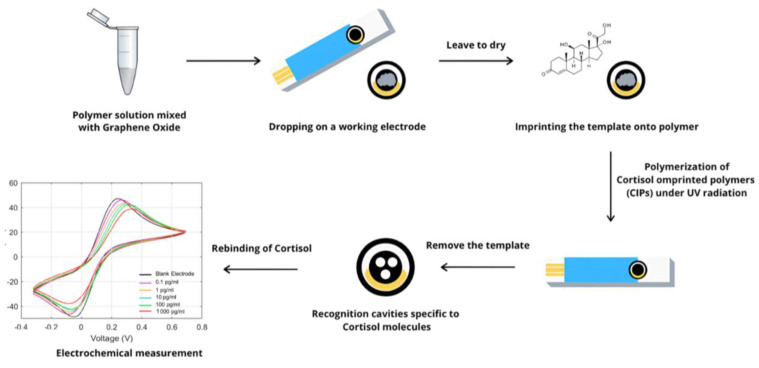
Depression and anxiety are two common mental health issues that require serious attention, as they have significant impacts on human well-being, with both being emotionally and physically reflected in the increasing number of suicide cases globally. The World Health Organization (WHO) estimated that about 322 million people around the world experienced mental illnesses in 2017, and this number continues to increase. Cortisol is a major stress-controlled hormone that is regulated by the hypothalamic-pituitary-adrenal (HPA) axis. The HPA axis has three main components, including the hypothalamus, pituitary gland, and adrenal gland, where cortisol, the primary stress hormone, is released. It plays crucial roles in responding to stress, energy balance, and the immune system. The cortisol level in the bloodstream usually increases when stress develops. Molecularly imprinted polymers (MIPs) have been highlighted in terms of creating artificial bioreceptors by mimicking the shape of detected biomolecules, making natural bioreceptor molecules no longer required. MIPs can overcome the limitations of chemicals and physical properties reducing over time and the short-time shelf life of natural bioreceptors. MIPs' benefits are reflected in their ease of use, high sensitivity, high specificity, reusability, durability, and the lack of requirement for complicated sample preparation before use. Moreover, MIPs incur low costs in manufacturing, giving them a favorable budget for the market with simple utilization. MIPs can be formulated by only three key steps, including formation, the polymerization of functional monomers, and the creation of three-dimensional cavities mimicking the shape and size of targeting molecules. MIPs have a high potential as biosensors, especially working as bioanalytics for protein, anti-body, antigen, or bacteria detection. Herein, this research proposes an MIP-based cortisol biosensor in which cortisol is imprinted on methyl methacrylate (MMA) and methacrylic acid (MAA) produced by UV polymerization. This MIP-based biosensor may be an alternative method with which to detect and monitor the levels of hormones in biological samples such as serum, saliva, or urine due to its rapid detection ability, which would be of benefit for diagnosing depression and anxiety and prescribing treatment. In this study, quantitative detection was performed using an electrochemical technique to measure the changes in electrical signals in different concentrations of a cortisol solution ranging from 0.1 to 1000 pg/mL. The MIP-based biosensor, as derived by calculation, achieved its best detection limit of 1.035 pg/mL with a gold electrode. Tests were also performed on molecules with a similar molecular structure, including Medroxyprogesterone acetate and drospirenone, to ensure the sensitivity and accuracy of the sensors, demonstrating a low sensitivity and low linear response.
期刊介绍:
Polymers (ISSN 2073-4360) is an international, open access journal of polymer science. It publishes research papers, short communications and review papers. Our aim is to encourage scientists to publish their experimental and theoretical results in as much detail as possible. Therefore, there is no restriction on the length of the papers. The full experimental details must be provided so that the results can be reproduced. Polymers provides an interdisciplinary forum for publishing papers which advance the fields of (i) polymerization methods, (ii) theory, simulation, and modeling, (iii) understanding of new physical phenomena, (iv) advances in characterization techniques, and (v) harnessing of self-assembly and biological strategies for producing complex multifunctional structures.





 京公网安备 11010802042870号
京ICP备2023020795号-1
京公网安备 11010802042870号
京ICP备2023020795号-1

 分享
分享
 求助内容:
求助内容: 应助结果提醒方式:
 扫码关注我们
