{"title":"Smooth Moves: Comparing Log Dimensionless Jerk Metrics from Body Center of Mass Trajectory and Wearable Sensor Acceleration During Walking.","authors":"Paolo Brasiliano, Gaspare Pavei, Elena Bergamini","doi":"10.3390/s25041233","DOIUrl":null,"url":null,"abstract":"<p><p>Movement smoothness is a critical metric for evaluating motor control and sensorimotor impairments, with increasing relevance in neurorehabilitation and everyday functional assessments. This study investigates the correlation between two smoothness metrics (Log Dimensionless Jerk): LDLJV, derived from body center of mass (BCoM) trajectories using a gold-standard stereophotogrammetric system, and LDLJA, calculated from acceleration data recorded via an inertial measurement unit (IMU) placed at the L1-L2 level. Ten healthy adults (six men and four women; height: 1.71 ± 0.08 m; body mass: 68.2 ± 10.2 kg; age: 34.5 ± 8.5 years) walked on a treadmill at seven different speeds, with stride-specific data analyzed to compute smoothness indices for three anatomical components (antero-posterior, medio-lateral, cranio-caudal). Concordance between the metrics was evaluated using Bland-Altman analysis, Spearman's correlation, and the mean absolute percentage error. The results revealed weak correlations and substantial biases across all components and speeds, reflecting inherent differences between IMU- and BCoM-derived data. Correcting biases improved alignment but did not eliminate discrepancies. The findings highlight that LDLJA captures only localized trunk accelerations, whereas BCoM-derived LDLJV approximates whole-body dynamics, making direct substitution infeasible. This study emphasizes the need for careful interpretation of IMU-based metrics and contributes to refining their application in real-world gait analyses.</p>","PeriodicalId":21698,"journal":{"name":"Sensors","volume":"25 4","pages":""},"PeriodicalIF":3.5000,"publicationDate":"2025-02-18","publicationTypes":"Journal Article","fieldsOfStudy":null,"isOpenAccess":false,"openAccessPdf":"https://www.ncbi.nlm.nih.gov/pmc/articles/PMC11860695/pdf/","citationCount":"0","resultStr":null,"platform":"Semanticscholar","paperid":null,"PeriodicalName":"Sensors","FirstCategoryId":"103","ListUrlMain":"https://doi.org/10.3390/s25041233","RegionNum":3,"RegionCategory":"综合性期刊","ArticlePicture":[],"TitleCN":null,"AbstractTextCN":null,"PMCID":null,"EPubDate":"","PubModel":"","JCR":"Q2","JCRName":"CHEMISTRY, ANALYTICAL","Score":null,"Total":0}
引用次数: 0
Abstract
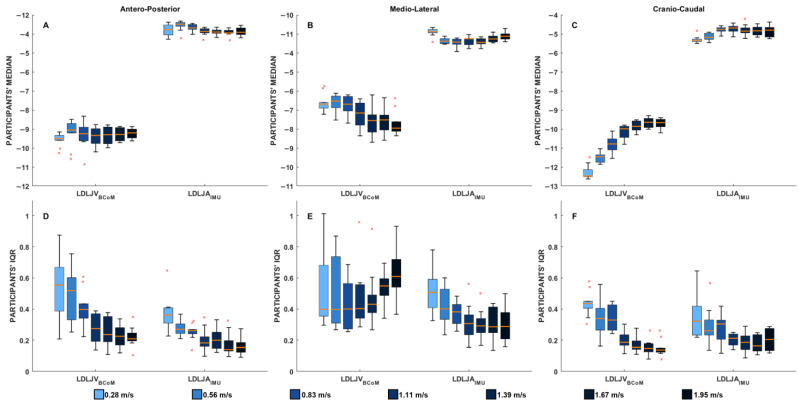
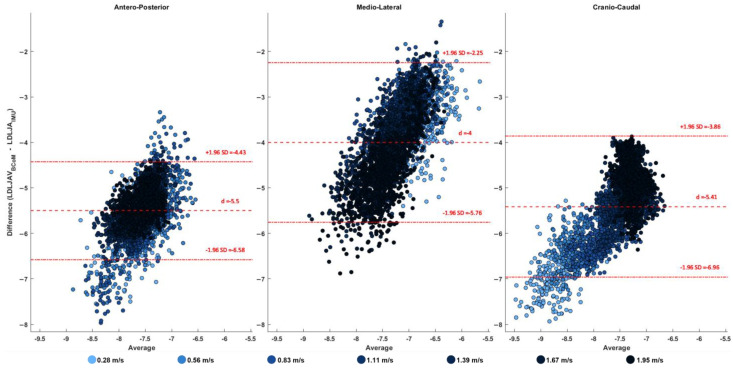
Movement smoothness is a critical metric for evaluating motor control and sensorimotor impairments, with increasing relevance in neurorehabilitation and everyday functional assessments. This study investigates the correlation between two smoothness metrics (Log Dimensionless Jerk): LDLJV, derived from body center of mass (BCoM) trajectories using a gold-standard stereophotogrammetric system, and LDLJA, calculated from acceleration data recorded via an inertial measurement unit (IMU) placed at the L1-L2 level. Ten healthy adults (six men and four women; height: 1.71 ± 0.08 m; body mass: 68.2 ± 10.2 kg; age: 34.5 ± 8.5 years) walked on a treadmill at seven different speeds, with stride-specific data analyzed to compute smoothness indices for three anatomical components (antero-posterior, medio-lateral, cranio-caudal). Concordance between the metrics was evaluated using Bland-Altman analysis, Spearman's correlation, and the mean absolute percentage error. The results revealed weak correlations and substantial biases across all components and speeds, reflecting inherent differences between IMU- and BCoM-derived data. Correcting biases improved alignment but did not eliminate discrepancies. The findings highlight that LDLJA captures only localized trunk accelerations, whereas BCoM-derived LDLJV approximates whole-body dynamics, making direct substitution infeasible. This study emphasizes the need for careful interpretation of IMU-based metrics and contributes to refining their application in real-world gait analyses.
期刊介绍:
Sensors (ISSN 1424-8220) provides an advanced forum for the science and technology of sensors and biosensors. It publishes reviews (including comprehensive reviews on the complete sensors products), regular research papers and short notes. Our aim is to encourage scientists to publish their experimental and theoretical results in as much detail as possible. There is no restriction on the length of the papers. The full experimental details must be provided so that the results can be reproduced.



 京公网安备 11010802042870号
京ICP备2023020795号-1
京公网安备 11010802042870号
京ICP备2023020795号-1

 分享
分享
 求助内容:
求助内容: 应助结果提醒方式:
 扫码关注我们
