{"title":"Closed-loop bowel obstruction caused by a right inguinal hernia containing the transverse colon: an unusual case report.","authors":"Abdulaziz Alnumay, Salman Batais, Alwateen Albalawi, Najd Alzaharani, Saleh Husam Aldeligan","doi":"10.1093/jscr/rjaf081","DOIUrl":null,"url":null,"abstract":"<p><p>Inguinal hernias are common, with a lifetime risk of 25% in men. Approximately 10% become incarcerated, risking complications like strangulation and bowel obstruction. Herniation of the transverse colon (TC) is rare, especially when causing a closed-loop obstruction. A 67-year-old male with poorly controlled type II diabetes and hypertension presented with a symptomatic right inguinoscrotal hernia, showing nausea, vomiting, and partial bowel obstruction. A computed tomography (CT) scan revealed a herniated TC causing a closed-loop obstruction. Emergency open hernia repair with a modified Shouldice technique and mesh was performed. Viable TC and omentum were reduced. The patient recovered without complications and was discharged on the fourth postoperative day. This case involved a rare TC herniation causing a closed-loop obstruction, confirmed by CT imaging. The open approach was selected due to the risk of ischemia and anticipated adhesions. A modified Shouldice repair with mesh reinforced the inguinal canal, reducing recurrence risk. The patient's postoperative course was uneventful. This case highlights the rarity of TC herniation causing closed-loop obstruction. CT scans were crucial for diagnosis, enabling prompt surgical intervention, which is key to preventing serious complications.</p>","PeriodicalId":47321,"journal":{"name":"Journal of Surgical Case Reports","volume":"2025 2","pages":"rjaf081"},"PeriodicalIF":0.5000,"publicationDate":"2025-02-25","publicationTypes":"Journal Article","fieldsOfStudy":null,"isOpenAccess":false,"openAccessPdf":"https://www.ncbi.nlm.nih.gov/pmc/articles/PMC11851467/pdf/","citationCount":"0","resultStr":null,"platform":"Semanticscholar","paperid":null,"PeriodicalName":"Journal of Surgical Case Reports","FirstCategoryId":"1085","ListUrlMain":"https://doi.org/10.1093/jscr/rjaf081","RegionNum":0,"RegionCategory":null,"ArticlePicture":[],"TitleCN":null,"AbstractTextCN":null,"PMCID":null,"EPubDate":"2025/2/1 0:00:00","PubModel":"eCollection","JCR":"Q4","JCRName":"SURGERY","Score":null,"Total":0}
引用次数: 0
Abstract
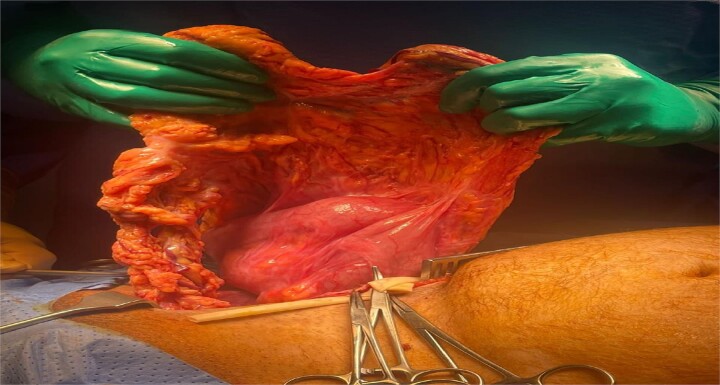
Inguinal hernias are common, with a lifetime risk of 25% in men. Approximately 10% become incarcerated, risking complications like strangulation and bowel obstruction. Herniation of the transverse colon (TC) is rare, especially when causing a closed-loop obstruction. A 67-year-old male with poorly controlled type II diabetes and hypertension presented with a symptomatic right inguinoscrotal hernia, showing nausea, vomiting, and partial bowel obstruction. A computed tomography (CT) scan revealed a herniated TC causing a closed-loop obstruction. Emergency open hernia repair with a modified Shouldice technique and mesh was performed. Viable TC and omentum were reduced. The patient recovered without complications and was discharged on the fourth postoperative day. This case involved a rare TC herniation causing a closed-loop obstruction, confirmed by CT imaging. The open approach was selected due to the risk of ischemia and anticipated adhesions. A modified Shouldice repair with mesh reinforced the inguinal canal, reducing recurrence risk. The patient's postoperative course was uneventful. This case highlights the rarity of TC herniation causing closed-loop obstruction. CT scans were crucial for diagnosis, enabling prompt surgical intervention, which is key to preventing serious complications.






 京公网安备 11010802042870号
京ICP备2023020795号-1
京公网安备 11010802042870号
京ICP备2023020795号-1

 分享
分享
 求助内容:
求助内容: 应助结果提醒方式:
 扫码关注我们
