Neli Korsun, Ivelina Trifonova, Diana Pavlova, Yordanka Uzunova, Ivan Ivanov, Daniel Ivanov, Petar Velikov, Silvia Voleva, Tatiana Tcherveniakova, Iva Christova
{"title":"Etiological Spectrum of Acute Respiratory Infections in Bulgaria During the 2023-2024 Season and Genetic Diversity of Circulating Influenza Viruses.","authors":"Neli Korsun, Ivelina Trifonova, Diana Pavlova, Yordanka Uzunova, Ivan Ivanov, Daniel Ivanov, Petar Velikov, Silvia Voleva, Tatiana Tcherveniakova, Iva Christova","doi":"10.3390/v17020270","DOIUrl":null,"url":null,"abstract":"<p><p>Influenza poses a serious threat to both individual and public health. This study aimed to investigate the virological and epidemiological characteristics of influenza infections and to explore the genetic diversity of the circulating influenza viruses. In total, 1886 nasopharyngeal specimens from patients with acute respiratory illnesses were tested against 13 respiratory viruses using a multiplex real-time PCR. Whole-genome sequencing, phylogenetic, and amino acid analyses of representative influenza strains were performed. At least one respiratory virus was detected in 869 (46.1%) patients; 87 (4.6%) were co-infected with two or three viruses. Influenza A(H1N1)pdm09 was the most prevalent virus (16.1%), followed by rhinoviruses (8.1%) and RSV (6.7%). Hemagglutinin (HA) genes of the 74 influenza A(H1N1)pdm09 viruses were categorized in subclades C.1.8, C.1.9, and C.1 within clade 5a.2a and D1, D.2, and D.3 within clade 5a.2a.1. The A(H3N2) viruses analyzed belonged to clade 2a.3a.1, subclades J.2 and J.1. The sequenced B/Victoria lineage viruses fell into clade V1A.3a.2, subclades C.5.6 and C.5.7. Amino acid substitutions in most viral proteins were identified compared with the vaccine strains, including in the HA antigenic sites. This study demonstrated the dominant distribution of the influenza A(H1N1)pdm09 virus among the respiratory viruses studied and the genetic diversity of the circulating influenza viruses.</p>","PeriodicalId":49328,"journal":{"name":"Viruses-Basel","volume":"17 2","pages":""},"PeriodicalIF":3.5000,"publicationDate":"2025-02-16","publicationTypes":"Journal Article","fieldsOfStudy":null,"isOpenAccess":false,"openAccessPdf":"https://www.ncbi.nlm.nih.gov/pmc/articles/PMC11860199/pdf/","citationCount":"0","resultStr":null,"platform":"Semanticscholar","paperid":null,"PeriodicalName":"Viruses-Basel","FirstCategoryId":"3","ListUrlMain":"https://doi.org/10.3390/v17020270","RegionNum":3,"RegionCategory":"医学","ArticlePicture":[],"TitleCN":null,"AbstractTextCN":null,"PMCID":null,"EPubDate":"","PubModel":"","JCR":"Q2","JCRName":"VIROLOGY","Score":null,"Total":0}
引用次数: 0
Abstract
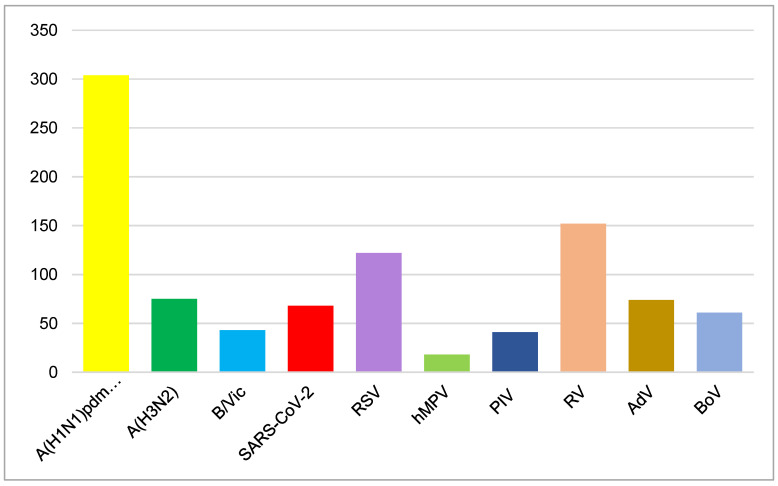
Influenza poses a serious threat to both individual and public health. This study aimed to investigate the virological and epidemiological characteristics of influenza infections and to explore the genetic diversity of the circulating influenza viruses. In total, 1886 nasopharyngeal specimens from patients with acute respiratory illnesses were tested against 13 respiratory viruses using a multiplex real-time PCR. Whole-genome sequencing, phylogenetic, and amino acid analyses of representative influenza strains were performed. At least one respiratory virus was detected in 869 (46.1%) patients; 87 (4.6%) were co-infected with two or three viruses. Influenza A(H1N1)pdm09 was the most prevalent virus (16.1%), followed by rhinoviruses (8.1%) and RSV (6.7%). Hemagglutinin (HA) genes of the 74 influenza A(H1N1)pdm09 viruses were categorized in subclades C.1.8, C.1.9, and C.1 within clade 5a.2a and D1, D.2, and D.3 within clade 5a.2a.1. The A(H3N2) viruses analyzed belonged to clade 2a.3a.1, subclades J.2 and J.1. The sequenced B/Victoria lineage viruses fell into clade V1A.3a.2, subclades C.5.6 and C.5.7. Amino acid substitutions in most viral proteins were identified compared with the vaccine strains, including in the HA antigenic sites. This study demonstrated the dominant distribution of the influenza A(H1N1)pdm09 virus among the respiratory viruses studied and the genetic diversity of the circulating influenza viruses.
期刊介绍:
Viruses (ISSN 1999-4915) is an open access journal which provides an advanced forum for studies of viruses. It publishes reviews, regular research papers, communications, conference reports and short notes. Our aim is to encourage scientists to publish their experimental and theoretical results in as much detail as possible. There is no restriction on the length of the papers. The full experimental details must be provided so that the results can be reproduced. We also encourage the publication of timely reviews and commentaries on topics of interest to the virology community and feature highlights from the virology literature in the ''News and Views'' section. Electronic files or software regarding the full details of the calculation and experimental procedure, if unable to be published in a normal way, can be deposited as supplementary material.






 京公网安备 11010802042870号
京ICP备2023020795号-1
京公网安备 11010802042870号
京ICP备2023020795号-1

 分享
分享
 求助内容:
求助内容: 应助结果提醒方式:
 扫码关注我们
