Theopista Lotto, Joanna Gallay, Martin Zuakulu, Beatrice Ternon, Laurent Arthur Decosterd, Alexandra V Kulinkina, Blaise Genton
{"title":"Population-Based Prevalence of Antibiotic Residuals in Low, Moderate and High Malaria Endemicity Areas in Tanzania.","authors":"Theopista Lotto, Joanna Gallay, Martin Zuakulu, Beatrice Ternon, Laurent Arthur Decosterd, Alexandra V Kulinkina, Blaise Genton","doi":"10.3390/antibiotics14020193","DOIUrl":null,"url":null,"abstract":"<p><strong>Background: </strong>Inappropriate antibiotic use drives antimicrobial resistance and remains a global concern. Evidence suggests antibiotic use may be higher among malaria-negative patients compared to malaria-positive ones, but uncertainty persists, particularly in regions with varying malaria prevalence. This study measured antibiotic residuals in three Tanzanian regions with varying malaria epidemiology and analyzed factors influencing their presence.</p><p><strong>Methods: </strong>A cross-sectional household survey was conducted in 2015, covering a population of 6000 individuals across three regions of Tanzania. Dried blood spot samples from a subset of participants were analyzed using broad-range tandem mass spectrometry to detect residual antibiotics. Risk factors associated with antibiotic presence, including household healthcare-seeking behaviors, malaria testing, and other relevant variables, were evaluated.</p><p><strong>Results: </strong>The overall prevalence of residual antibiotics in the study population was 14.4% (438/3036; 95% CI: 11.4-15.8%). Stratified by malaria transmission intensity, antibiotic prevalence was 17.2% (95% CI: 12.9-17.2%) in Mwanza (low), 14.6% (95% CI: 10.6-15.0%) in Mbeya (moderate), and 11.2% (95% CI: 7.9-11.6%) in Mtwara (high). Trimethoprim was the most frequently detected antibiotic (6.1%), followed by sulfamethoxazole (4.4%) and penicillin V (0.001%).</p><p><strong>Conclusions: </strong>Residual antibiotic prevalence did not directly correlate with malaria endemicity but was influenced by healthcare practices, including co-prescription of antibiotics and antimalarials. The higher antibiotic use in malaria-negative cases highlights the need for improved diagnostics to reduce unnecessary use and mitigate antimicrobial resistance in malaria-endemic areas.</p>","PeriodicalId":54246,"journal":{"name":"Antibiotics-Basel","volume":"14 2","pages":""},"PeriodicalIF":4.6000,"publicationDate":"2025-02-13","publicationTypes":"Journal Article","fieldsOfStudy":null,"isOpenAccess":false,"openAccessPdf":"https://www.ncbi.nlm.nih.gov/pmc/articles/PMC11851362/pdf/","citationCount":"0","resultStr":null,"platform":"Semanticscholar","paperid":null,"PeriodicalName":"Antibiotics-Basel","FirstCategoryId":"3","ListUrlMain":"https://doi.org/10.3390/antibiotics14020193","RegionNum":2,"RegionCategory":"医学","ArticlePicture":[],"TitleCN":null,"AbstractTextCN":null,"PMCID":null,"EPubDate":"","PubModel":"","JCR":"Q1","JCRName":"INFECTIOUS DISEASES","Score":null,"Total":0}
引用次数: 0
Abstract
Background: Inappropriate antibiotic use drives antimicrobial resistance and remains a global concern. Evidence suggests antibiotic use may be higher among malaria-negative patients compared to malaria-positive ones, but uncertainty persists, particularly in regions with varying malaria prevalence. This study measured antibiotic residuals in three Tanzanian regions with varying malaria epidemiology and analyzed factors influencing their presence.
Methods: A cross-sectional household survey was conducted in 2015, covering a population of 6000 individuals across three regions of Tanzania. Dried blood spot samples from a subset of participants were analyzed using broad-range tandem mass spectrometry to detect residual antibiotics. Risk factors associated with antibiotic presence, including household healthcare-seeking behaviors, malaria testing, and other relevant variables, were evaluated.
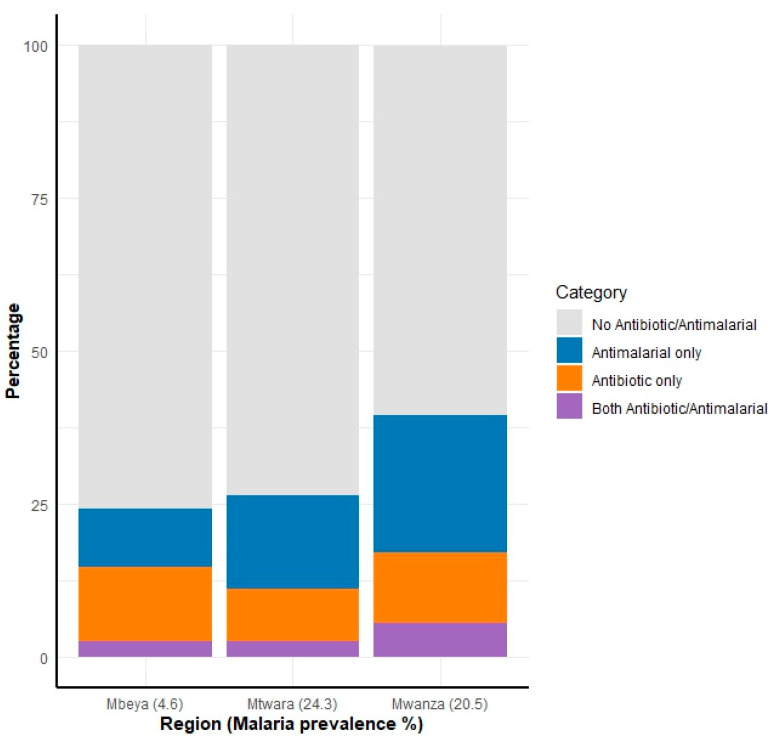
Results: The overall prevalence of residual antibiotics in the study population was 14.4% (438/3036; 95% CI: 11.4-15.8%). Stratified by malaria transmission intensity, antibiotic prevalence was 17.2% (95% CI: 12.9-17.2%) in Mwanza (low), 14.6% (95% CI: 10.6-15.0%) in Mbeya (moderate), and 11.2% (95% CI: 7.9-11.6%) in Mtwara (high). Trimethoprim was the most frequently detected antibiotic (6.1%), followed by sulfamethoxazole (4.4%) and penicillin V (0.001%).
Conclusions: Residual antibiotic prevalence did not directly correlate with malaria endemicity but was influenced by healthcare practices, including co-prescription of antibiotics and antimalarials. The higher antibiotic use in malaria-negative cases highlights the need for improved diagnostics to reduce unnecessary use and mitigate antimicrobial resistance in malaria-endemic areas.
Antibiotics-BaselPharmacology, Toxicology and Pharmaceutics-General Pharmacology, Toxicology and Pharmaceutics
CiteScore
7.30
自引率
14.60%
发文量
1547
审稿时长
11 weeks
期刊介绍:
Antibiotics (ISSN 2079-6382) is an open access, peer reviewed journal on all aspects of antibiotics. Antibiotics is a multi-disciplinary journal encompassing the general fields of biochemistry, chemistry, genetics, microbiology and pharmacology. Our aim is to encourage scientists to publish their experimental and theoretical results in as much detail as possible. Therefore, there is no restriction on the length of papers.





 京公网安备 11010802042870号
京ICP备2023020795号-1
京公网安备 11010802042870号
京ICP备2023020795号-1

 分享
分享
 求助内容:
求助内容: 应助结果提醒方式:
 扫码关注我们
