Adonay S Nunes, İlkay Yıldız Potter, Ram Kinker Mishra, Jose Casado, Nima Dana, Andrew Geronimo, Christopher G Tarolli, Ruth B Schneider, E Ray Dorsey, Jamie L Adams, Ashkan Vaziri
{"title":"Using wearable sensors and machine learning to assess upper limb function in Huntington's disease.","authors":"Adonay S Nunes, İlkay Yıldız Potter, Ram Kinker Mishra, Jose Casado, Nima Dana, Andrew Geronimo, Christopher G Tarolli, Ruth B Schneider, E Ray Dorsey, Jamie L Adams, Ashkan Vaziri","doi":"10.1038/s43856-025-00770-5","DOIUrl":null,"url":null,"abstract":"<p><strong>Background: </strong>Huntington's disease, a neurodegenerative disorder, impairs both upper and lower limb function, typically assessed in clinical settings. However, wearable sensors offer the opportunity to monitor real-world data that complements clinical assessments, providing a more comprehensive understanding of disease symptoms.</p><p><strong>Methods: </strong>In this study, we monitor upper limb function in individuals with Huntington's disease (HD, n = 16), prodromal HD (pHD, n = 7), and controls (CTR, n = 16) using a wrist-worn wearable sensor over a 7-day period. Goal-directed hand movements are detected through a deep learning model, and kinematic features of each movement are analyzed. The collected data is used to predict disease groups and clinical scores using statistical and machine learning models.</p><p><strong>Results: </strong>Here we show that significant differences in goal-directed movement features exist between the groups. Additionally, several of these features strongly correlate with clinical scores. Classification models accurately distinguish between HD, pHD, and CTR individuals, achieving a balanced accuracy of 67% and a recall of 0.72 for the HD group. Regression models effectively predict clinical scores.</p><p><strong>Conclusions: </strong>This study demonstrates the potential of wearable sensors and machine learning to monitor upper limb function in Huntington's disease, offering a tool for early detection, remote monitoring, and assessing treatment efficacy in clinical trials.</p>","PeriodicalId":72646,"journal":{"name":"Communications medicine","volume":"5 1","pages":"50"},"PeriodicalIF":5.4000,"publicationDate":"2025-02-25","publicationTypes":"Journal Article","fieldsOfStudy":null,"isOpenAccess":false,"openAccessPdf":"https://www.ncbi.nlm.nih.gov/pmc/articles/PMC11861259/pdf/","citationCount":"0","resultStr":null,"platform":"Semanticscholar","paperid":null,"PeriodicalName":"Communications medicine","FirstCategoryId":"1085","ListUrlMain":"https://doi.org/10.1038/s43856-025-00770-5","RegionNum":0,"RegionCategory":null,"ArticlePicture":[],"TitleCN":null,"AbstractTextCN":null,"PMCID":null,"EPubDate":"","PubModel":"","JCR":"Q1","JCRName":"MEDICINE, RESEARCH & EXPERIMENTAL","Score":null,"Total":0}
引用次数: 0
Abstract
Background: Huntington's disease, a neurodegenerative disorder, impairs both upper and lower limb function, typically assessed in clinical settings. However, wearable sensors offer the opportunity to monitor real-world data that complements clinical assessments, providing a more comprehensive understanding of disease symptoms.
Methods: In this study, we monitor upper limb function in individuals with Huntington's disease (HD, n = 16), prodromal HD (pHD, n = 7), and controls (CTR, n = 16) using a wrist-worn wearable sensor over a 7-day period. Goal-directed hand movements are detected through a deep learning model, and kinematic features of each movement are analyzed. The collected data is used to predict disease groups and clinical scores using statistical and machine learning models.
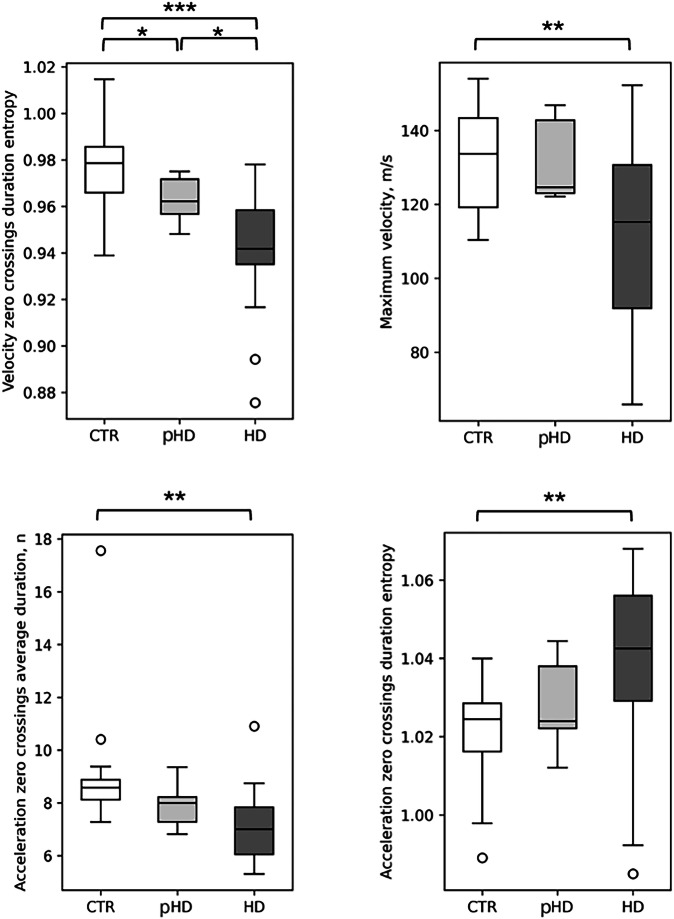
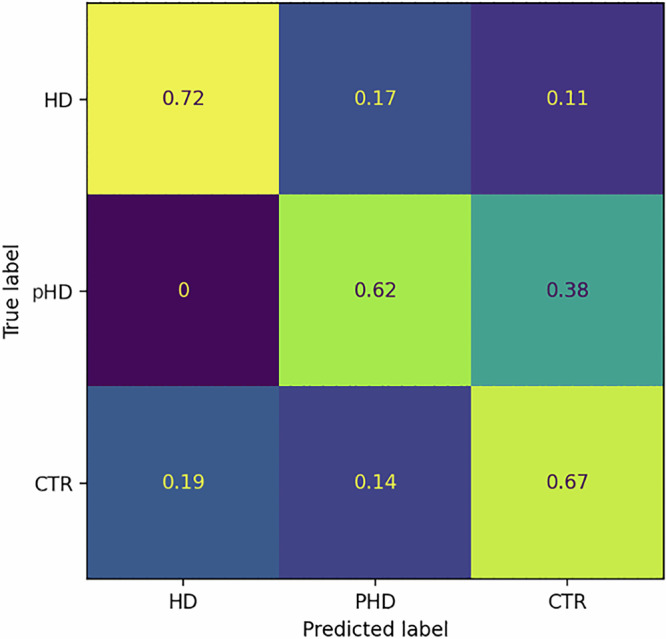
Results: Here we show that significant differences in goal-directed movement features exist between the groups. Additionally, several of these features strongly correlate with clinical scores. Classification models accurately distinguish between HD, pHD, and CTR individuals, achieving a balanced accuracy of 67% and a recall of 0.72 for the HD group. Regression models effectively predict clinical scores.
Conclusions: This study demonstrates the potential of wearable sensors and machine learning to monitor upper limb function in Huntington's disease, offering a tool for early detection, remote monitoring, and assessing treatment efficacy in clinical trials.
背景:亨廷顿舞蹈病是一种神经退行性疾病,损害上肢和下肢功能,通常在临床环境中进行评估。然而,可穿戴传感器提供了监测真实世界数据的机会,补充了临床评估,提供了对疾病症状更全面的了解。方法:在这项研究中,我们使用腕戴式可穿戴传感器监测亨廷顿舞蹈病(HD, n = 16)、前驱HD (pHD, n = 7)和对照组(CTR, n = 16)患者的上肢功能,为期7天。通过深度学习模型检测目标导向的手部运动,并分析每个运动的运动学特征。收集的数据用于使用统计和机器学习模型预测疾病组和临床评分。结果:本研究显示,两组之间在目标导向运动特征上存在显著差异。此外,其中一些特征与临床评分密切相关。分类模型准确地区分了HD、pHD和CTR个体,HD组的平衡准确率为67%,召回率为0.72。回归模型能有效预测临床评分。结论:本研究证明了可穿戴传感器和机器学习在监测亨廷顿病上肢功能方面的潜力,为临床试验中的早期检测、远程监测和评估治疗效果提供了一种工具。




 京公网安备 11010802042870号
京ICP备2023020795号-1
京公网安备 11010802042870号
京ICP备2023020795号-1

 分享
分享

 求助内容:
求助内容: 应助结果提醒方式:
 扫码关注我们
