{"title":"Skin-like quasi-solid-state electrolytes for spontaneous zinc-ion dehydration toward ultra-stable zinc–iodine batteries†","authors":"Shaochong Cao, Aiwen Zhang, Huayi Fang, Bingjian Feng, Yongshuai Liu, Pengshu Yi, Shan He, Zhouhong Ren, Longli Ma, Wenyi Lu, Mingxin Ye and Jianfeng Shen","doi":"10.1039/D4EE05527F","DOIUrl":null,"url":null,"abstract":"<p >Rechargeable aqueous zinc–iodine (Zn–I<small><sub>2</sub></small>) batteries are cost-effective alternative candidates for conventional metal-based batteries due to their sustainable fabrication and abundant resources. However, the issues of the shuttle effect of polyiodides and Zn anode side reactions need to be urgently addressed for their large-scale energy storage applications. Here, we propose a biologically inspired concept of a skin-like quasi-solid-state electrolyte (skin-QSSE), which features an asymmetric structure composed of covalent organic framework (COF) nanolayers and aramid fiber hydrogel layers. The electrostatic repulsion between the negatively charged nitrogen sites on the triazine COF skeleton and the polyiodide ensures efficient utilization of the iodine-activated material. Notably, DFT calculations revealed that ANF aramid fiber hydrogels induced a spontaneous dehydration process by lowering the desolvation energy barrier (−0.66 eV <em>vs.</em> 7.09 eV for the liquid electrolyte) of hydrated zinc ions (Zn(H<small><sub>2</sub></small>O)<small><sub>6</sub></small><small><sup>2+</sup></small>), which alleviates corrosion and dendrite formation at the Zn anode interface. Ultimately, the Zn–I<small><sub>2</sub></small> batteries with the skin-QSSE demonstrated ultra-stable cycling reversibility with an extremely low capacity decay rate of only 0.0018‰ over 45 000 cycles at 10C. This work presents novel insights from the standpoint of asymmetric electrolytes for coping with the anode and cathode interface issues in aqueous Zn batteries.</p>","PeriodicalId":72,"journal":{"name":"Energy & Environmental Science","volume":" 7","pages":" 3395-3406"},"PeriodicalIF":30.8000,"publicationDate":"2025-02-27","publicationTypes":"Journal Article","fieldsOfStudy":null,"isOpenAccess":false,"openAccessPdf":"https://pubs.rsc.org/en/content/articlepdf/2025/ee/d4ee05527f?page=search","citationCount":"0","resultStr":null,"platform":"Semanticscholar","paperid":null,"PeriodicalName":"Energy & Environmental Science","FirstCategoryId":"88","ListUrlMain":"https://pubs.rsc.org/en/content/articlelanding/2025/ee/d4ee05527f","RegionNum":1,"RegionCategory":"材料科学","ArticlePicture":[],"TitleCN":null,"AbstractTextCN":null,"PMCID":null,"EPubDate":"","PubModel":"","JCR":"Q1","JCRName":"CHEMISTRY, MULTIDISCIPLINARY","Score":null,"Total":0}
引用次数: 0
Abstract
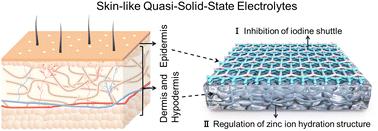
Rechargeable aqueous zinc–iodine (Zn–I2) batteries are cost-effective alternative candidates for conventional metal-based batteries due to their sustainable fabrication and abundant resources. However, the issues of the shuttle effect of polyiodides and Zn anode side reactions need to be urgently addressed for their large-scale energy storage applications. Here, we propose a biologically inspired concept of a skin-like quasi-solid-state electrolyte (skin-QSSE), which features an asymmetric structure composed of covalent organic framework (COF) nanolayers and aramid fiber hydrogel layers. The electrostatic repulsion between the negatively charged nitrogen sites on the triazine COF skeleton and the polyiodide ensures efficient utilization of the iodine-activated material. Notably, DFT calculations revealed that ANF aramid fiber hydrogels induced a spontaneous dehydration process by lowering the desolvation energy barrier (−0.66 eV vs. 7.09 eV for the liquid electrolyte) of hydrated zinc ions (Zn(H2O)62+), which alleviates corrosion and dendrite formation at the Zn anode interface. Ultimately, the Zn–I2 batteries with the skin-QSSE demonstrated ultra-stable cycling reversibility with an extremely low capacity decay rate of only 0.0018‰ over 45 000 cycles at 10C. This work presents novel insights from the standpoint of asymmetric electrolytes for coping with the anode and cathode interface issues in aqueous Zn batteries.
可充电水锌碘(Zn-I2)电池由于其制造和来源的可持续性,是传统金属基电池的经济有效的替代品。然而,在大规模储能应用中,多碘化物的穿梭效应和锌阳极副反应等问题亟待解决。在这里,我们提出了一种受生物学启发的皮肤类准固态电解质(skin-QSSE)概念,其特征是由共价有机框架(COF)纳米层和芳纶纤维水凝胶层组成的不对称结构。三嗪COF骨架上带负电荷的氮位点与多碘化物之间的静电斥力保证了碘活化材料的有效利用。值得注意的是,DFT计算表明,ANFs芳纶纤维水凝胶通过降低水合锌离子(Zn(H2O)62+)的脱溶能垒(-0.66 eV vs. 7.09 eV)诱导了自发脱水过程,从而减轻了Zn阳极界面的腐蚀和枝晶的形成。最终,具有皮肤qsse的Zn- i2电池表现出超稳定的循环可逆性,在10℃下超过45000次循环,容量衰减率极低,仅为0.0018‰。这项工作从不对称电解质的角度为解决水锌电池的阳极和阴极界面问题提供了新的见解。
期刊介绍:
Energy & Environmental Science, a peer-reviewed scientific journal, publishes original research and review articles covering interdisciplinary topics in the (bio)chemical and (bio)physical sciences, as well as chemical engineering disciplines. Published monthly by the Royal Society of Chemistry (RSC), a not-for-profit publisher, Energy & Environmental Science is recognized as a leading journal. It boasts an impressive impact factor of 8.500 as of 2009, ranking 8th among 140 journals in the category "Chemistry, Multidisciplinary," second among 71 journals in "Energy & Fuels," second among 128 journals in "Engineering, Chemical," and first among 181 scientific journals in "Environmental Sciences."
Energy & Environmental Science publishes various types of articles, including Research Papers (original scientific work), Review Articles, Perspectives, and Minireviews (feature review-type articles of broad interest), Communications (original scientific work of an urgent nature), Opinions (personal, often speculative viewpoints or hypotheses on current topics), and Analysis Articles (in-depth examination of energy-related issues).



 京公网安备 11010802042870号
京ICP备2023020795号-1
京公网安备 11010802042870号
京ICP备2023020795号-1

 分享
分享
 求助内容:
求助内容: 应助结果提醒方式:
 扫码关注我们
