Yang Lu, Gen Zhou, Zhuangzhuang Zhang, Chao Li, Qing Dong, Yinhai Su, Wen Chen
{"title":"Breaking the hemicellulose barrier for the preparation of high-performance porous carbon for supercapacitors and Zinc-Ion capacitors","authors":"Yang Lu, Gen Zhou, Zhuangzhuang Zhang, Chao Li, Qing Dong, Yinhai Su, Wen Chen","doi":"10.1016/j.cej.2025.161085","DOIUrl":null,"url":null,"abstract":"In recent years, biomass-based carbon supercapacitors and zinc-ion capacitors (ZICs) have garnered significant interest from researchers. Traditional methods for preparing porous carbon (PC) typically involve a carbonization-activation process. PC prepared through this method generally exhibits issues such as low specific surface area (SSA) and poor pore structure, which result from the inherently compact structure of the biomass. Therefore, this study proposes a novel preparation method, namely the hydrothermal modification-carbonization-activation process. This new process disrupts the cross-linked structure of the biomass, resulting in PC with a well-developed pore structure and a large SSA. Experimental results show that the unmodified samples have a low SSA, while the SSA of the PC produced from hydrothermal modification is significantly improved. The best-performing sample exhibited a high SSA of 2985.60 m<sup>2</sup>/g. In the three-electrode system with 6 M KOH, the sample achieved a specific capacitance of 339.8F/g at 0.5 A/g. In the organic electrolyte, its symmetrical supercapacitor achieved an energy density of 31.83 Wh/kg at 337.5 W/kg. Furthermore, it demonstrated good capacitance retention in both aqueous and organic electrolytes, with values of 98.0 % and 100 %, respectively. The assembled ZICs exhibited a high specific capacitance of 146.3 mAh/g at 0.1 A/g. Additionally, the experimental results indicate that the SSA of the pivotal factor determining the final SSA of the PC. This novel approach, which regulates the SSA of the PC by adjusting the SSA of the biochar, offers valuable insights for the future preparation of biomass-derived PC.","PeriodicalId":270,"journal":{"name":"Chemical Engineering Journal","volume":"31 1","pages":""},"PeriodicalIF":12.5000,"publicationDate":"2025-02-27","publicationTypes":"Journal Article","fieldsOfStudy":null,"isOpenAccess":false,"openAccessPdf":"","citationCount":"0","resultStr":null,"platform":"Semanticscholar","paperid":null,"PeriodicalName":"Chemical Engineering Journal","FirstCategoryId":"5","ListUrlMain":"https://doi.org/10.1016/j.cej.2025.161085","RegionNum":1,"RegionCategory":"工程技术","ArticlePicture":[],"TitleCN":null,"AbstractTextCN":null,"PMCID":null,"EPubDate":"","PubModel":"","JCR":"Q1","JCRName":"ENGINEERING, CHEMICAL","Score":null,"Total":0}
引用次数: 0
Abstract
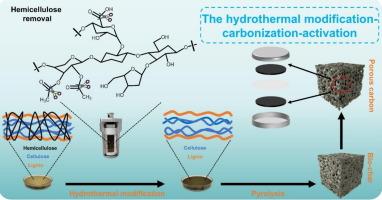
In recent years, biomass-based carbon supercapacitors and zinc-ion capacitors (ZICs) have garnered significant interest from researchers. Traditional methods for preparing porous carbon (PC) typically involve a carbonization-activation process. PC prepared through this method generally exhibits issues such as low specific surface area (SSA) and poor pore structure, which result from the inherently compact structure of the biomass. Therefore, this study proposes a novel preparation method, namely the hydrothermal modification-carbonization-activation process. This new process disrupts the cross-linked structure of the biomass, resulting in PC with a well-developed pore structure and a large SSA. Experimental results show that the unmodified samples have a low SSA, while the SSA of the PC produced from hydrothermal modification is significantly improved. The best-performing sample exhibited a high SSA of 2985.60 m2/g. In the three-electrode system with 6 M KOH, the sample achieved a specific capacitance of 339.8F/g at 0.5 A/g. In the organic electrolyte, its symmetrical supercapacitor achieved an energy density of 31.83 Wh/kg at 337.5 W/kg. Furthermore, it demonstrated good capacitance retention in both aqueous and organic electrolytes, with values of 98.0 % and 100 %, respectively. The assembled ZICs exhibited a high specific capacitance of 146.3 mAh/g at 0.1 A/g. Additionally, the experimental results indicate that the SSA of the pivotal factor determining the final SSA of the PC. This novel approach, which regulates the SSA of the PC by adjusting the SSA of the biochar, offers valuable insights for the future preparation of biomass-derived PC.
近年来,生物质碳超级电容器和锌离子电容器(ZICs)引起了研究人员的极大兴趣。制备多孔碳(PC)的传统方法通常涉及碳化活化过程。通过这种方法制备的PC通常表现出低比表面积(SSA)和孔隙结构差等问题,这是由生物质本身致密的结构造成的。因此,本研究提出了一种新的制备方法,即水热改性-碳化-活化工艺。这种新工艺破坏了生物质的交联结构,导致PC具有发育良好的孔隙结构和较大的SSA。实验结果表明,未经改性的样品的SSA较低,而水热改性后的PC的SSA明显提高。最佳样品的SSA为2985.60 m2/g。在6 M KOH的三电极体系中,样品在0.5 a /g下的比电容达到339.8F/g。在有机电解质中,其对称超级电容器在337.5 W/kg时实现了31.83 Wh/kg的能量密度。此外,它在水电解质和有机电解质中均表现出良好的电容保持率,分别为98.0 %和100% %。组装的zic在0.1 a /g下具有146.3 mAh/g的高比电容。此外,实验结果表明,SSA是决定PC最终SSA的关键因素。这种新方法通过调节生物炭的SSA来调节PC的SSA,为未来生物质衍生PC的制备提供了有价值的见解。
期刊介绍:
The Chemical Engineering Journal is an international research journal that invites contributions of original and novel fundamental research. It aims to provide an international platform for presenting original fundamental research, interpretative reviews, and discussions on new developments in chemical engineering. The journal welcomes papers that describe novel theory and its practical application, as well as those that demonstrate the transfer of techniques from other disciplines. It also welcomes reports on carefully conducted experimental work that is soundly interpreted. The main focus of the journal is on original and rigorous research results that have broad significance. The Catalysis section within the Chemical Engineering Journal focuses specifically on Experimental and Theoretical studies in the fields of heterogeneous catalysis, molecular catalysis, and biocatalysis. These studies have industrial impact on various sectors such as chemicals, energy, materials, foods, healthcare, and environmental protection.




 京公网安备 11010802042870号
京ICP备2023020795号-1
京公网安备 11010802042870号
京ICP备2023020795号-1

 分享
分享
 求助内容:
求助内容: 应助结果提醒方式:
 扫码关注我们
