Volatility spillover dynamics between fintech and traditional financial industries and their rich determinants: New evidence from Chinese listed institutions
{"title":"Volatility spillover dynamics between fintech and traditional financial industries and their rich determinants: New evidence from Chinese listed institutions","authors":"Chengcheng Liu , Meng Tian , Bai Huang","doi":"10.1016/j.irfa.2025.104034","DOIUrl":null,"url":null,"abstract":"<div><div>This study investigates the dynamics and determinants of volatility spillovers between Chinese financial technology (fintech) and traditional financial industries. We use stock prices of listed institutions and the elastic net vector autoregression (VAR) network approach to assess institution-, industry-, and system-level volatility spillovers in normal states between 2015 and 2023. Subsequently, we analyze 50 variables in terms of global environment, economic fundamentals, capital market, industry development, and other shocks and examine their impact on system- and industry-level volatility spillovers through variable selection and regression analysis. Furthermore, heterogeneous and asymmetric effects in extreme states are explored under a quantile-based framework. The empirical results show that (i) at the institutional level, volatility spillovers surge in the post-COVID-19 era, and large-cap institutions play vital roles in emitting volatility shocks. (ii) At the industry level, the fintech, securities, and diversified financial industries are net volatility transmitters, while the banking, insurance, and real estate industries are net receivers. Fundamental economic determinants prevail in explaining the net spillover index. (iii) At the system level, the total spillover index demonstrates a W-shape curve throughout the period. All determinants together explain over 85 % of the total spillover index. (iv) In extremely low and high volatility states, spillover effects are more obvious than in normal states. Industry development and capital market determinants fail to explain the respective total spillover indices. These findings offer valuable insights into how to foster effective risk management.</div></div>","PeriodicalId":48226,"journal":{"name":"International Review of Financial Analysis","volume":"101 ","pages":"Article 104034"},"PeriodicalIF":9.8000,"publicationDate":"2025-05-01","publicationTypes":"Journal Article","fieldsOfStudy":null,"isOpenAccess":false,"openAccessPdf":"","citationCount":"0","resultStr":null,"platform":"Semanticscholar","paperid":null,"PeriodicalName":"International Review of Financial Analysis","FirstCategoryId":"96","ListUrlMain":"https://www.sciencedirect.com/science/article/pii/S1057521925001218","RegionNum":1,"RegionCategory":"经济学","ArticlePicture":[],"TitleCN":null,"AbstractTextCN":null,"PMCID":null,"EPubDate":"2025/2/22 0:00:00","PubModel":"Epub","JCR":"Q1","JCRName":"BUSINESS, FINANCE","Score":null,"Total":0}
引用次数: 0
Abstract
This study investigates the dynamics and determinants of volatility spillovers between Chinese financial technology (fintech) and traditional financial industries. We use stock prices of listed institutions and the elastic net vector autoregression (VAR) network approach to assess institution-, industry-, and system-level volatility spillovers in normal states between 2015 and 2023. Subsequently, we analyze 50 variables in terms of global environment, economic fundamentals, capital market, industry development, and other shocks and examine their impact on system- and industry-level volatility spillovers through variable selection and regression analysis. Furthermore, heterogeneous and asymmetric effects in extreme states are explored under a quantile-based framework. The empirical results show that (i) at the institutional level, volatility spillovers surge in the post-COVID-19 era, and large-cap institutions play vital roles in emitting volatility shocks. (ii) At the industry level, the fintech, securities, and diversified financial industries are net volatility transmitters, while the banking, insurance, and real estate industries are net receivers. Fundamental economic determinants prevail in explaining the net spillover index. (iii) At the system level, the total spillover index demonstrates a W-shape curve throughout the period. All determinants together explain over 85 % of the total spillover index. (iv) In extremely low and high volatility states, spillover effects are more obvious than in normal states. Industry development and capital market determinants fail to explain the respective total spillover indices. These findings offer valuable insights into how to foster effective risk management.
期刊介绍:
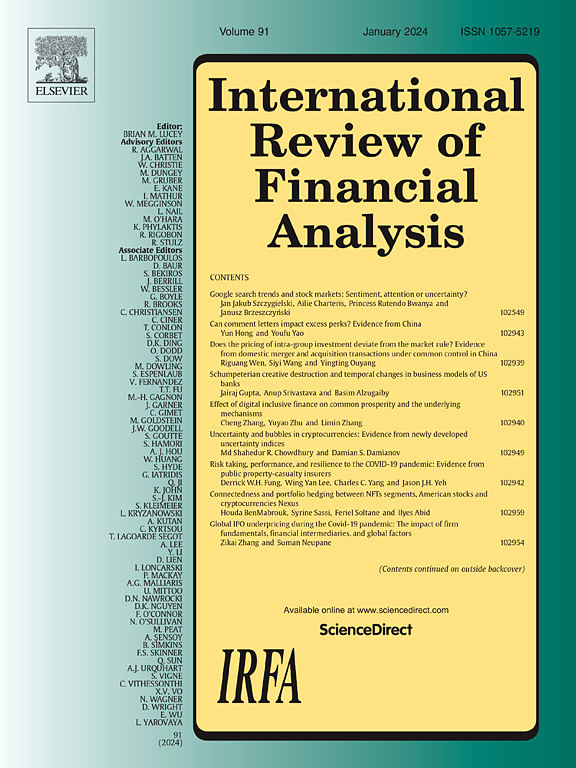
The International Review of Financial Analysis (IRFA) is an impartial refereed journal designed to serve as a platform for high-quality financial research. It welcomes a diverse range of financial research topics and maintains an unbiased selection process. While not limited to U.S.-centric subjects, IRFA, as its title suggests, is open to valuable research contributions from around the world.




 京公网安备 11010802042870号
京ICP备2023020795号-1
京公网安备 11010802042870号
京ICP备2023020795号-1

 分享
分享
 求助内容:
求助内容: 应助结果提醒方式:
 扫码关注我们
