Sikai Liu , Wei Sheng , Haikun Zheng , Shishun Pan , Yunpeng Wang , Maierzukejiang Bayizi
{"title":"Preparation and study of n-Tridecane@Silica low-temperature Nano-Encapsulated phase change microcapsules","authors":"Sikai Liu , Wei Sheng , Haikun Zheng , Shishun Pan , Yunpeng Wang , Maierzukejiang Bayizi","doi":"10.1016/j.enbuild.2025.115490","DOIUrl":null,"url":null,"abstract":"<div><div>Phase change cold storage technology and using nanoparticles to create superhydrophobic surfaces for frost suppression contribute to energy savings in cold chain transportation processes. A series of low-temperature nano-encapsulated phase change microcapsules with different core–shell ratios were prepared using in-situ polymerization method. The shell of the nano-capsules was silica derived from the hydrolysis of tetraethoxysilane (TEOS), while the core material was n-tridecane. The characterization results of Fourier transform infrared (FT-IR), X-ray diffraction (XRD), and Energy Dispersive Spectrometer (EDS) confirm the successful encapsulation of n-tridecane within the silica shell. The SEM image shows that the microcapsules are spherical and exhibit a nanometer-scale particle size. DSC testing shows that the phase change nano-capsules prepared with n-tridecane as the phase change material have two phase change peaks. When the core–shell ratio is 1:1, the latent heat of melting and freezing reaches 124.46 J·g<sup>−1</sup>, with an encapsulation efficiency of 69.79 %. TGA results demonstrate enhanced stability of phase change materials due to silica encapsulation. After 500 phase change cycles, the latent heat of the nano-capsules exhibits negligible changes, demonstrating robust thermal reliability. Low-temperature nano-encapsulated phase change microcapsules show promising potential in surface applications for cold chain logistics buildings, energy storage, and the preparation of superhydrophobic surfaces.</div></div>","PeriodicalId":11641,"journal":{"name":"Energy and Buildings","volume":"334 ","pages":"Article 115490"},"PeriodicalIF":7.1000,"publicationDate":"2025-02-18","publicationTypes":"Journal Article","fieldsOfStudy":null,"isOpenAccess":false,"openAccessPdf":"","citationCount":"0","resultStr":null,"platform":"Semanticscholar","paperid":null,"PeriodicalName":"Energy and Buildings","FirstCategoryId":"5","ListUrlMain":"https://www.sciencedirect.com/science/article/pii/S0378778825002208","RegionNum":2,"RegionCategory":"工程技术","ArticlePicture":[],"TitleCN":null,"AbstractTextCN":null,"PMCID":null,"EPubDate":"","PubModel":"","JCR":"Q1","JCRName":"CONSTRUCTION & BUILDING TECHNOLOGY","Score":null,"Total":0}
引用次数: 0
Abstract
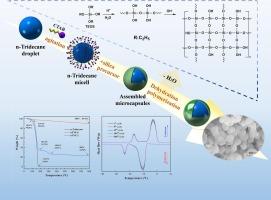
Phase change cold storage technology and using nanoparticles to create superhydrophobic surfaces for frost suppression contribute to energy savings in cold chain transportation processes. A series of low-temperature nano-encapsulated phase change microcapsules with different core–shell ratios were prepared using in-situ polymerization method. The shell of the nano-capsules was silica derived from the hydrolysis of tetraethoxysilane (TEOS), while the core material was n-tridecane. The characterization results of Fourier transform infrared (FT-IR), X-ray diffraction (XRD), and Energy Dispersive Spectrometer (EDS) confirm the successful encapsulation of n-tridecane within the silica shell. The SEM image shows that the microcapsules are spherical and exhibit a nanometer-scale particle size. DSC testing shows that the phase change nano-capsules prepared with n-tridecane as the phase change material have two phase change peaks. When the core–shell ratio is 1:1, the latent heat of melting and freezing reaches 124.46 J·g−1, with an encapsulation efficiency of 69.79 %. TGA results demonstrate enhanced stability of phase change materials due to silica encapsulation. After 500 phase change cycles, the latent heat of the nano-capsules exhibits negligible changes, demonstrating robust thermal reliability. Low-temperature nano-encapsulated phase change microcapsules show promising potential in surface applications for cold chain logistics buildings, energy storage, and the preparation of superhydrophobic surfaces.
期刊介绍:
An international journal devoted to investigations of energy use and efficiency in buildings
Energy and Buildings is an international journal publishing articles with explicit links to energy use in buildings. The aim is to present new research results, and new proven practice aimed at reducing the energy needs of a building and improving indoor environment quality.



 京公网安备 11010802042870号
京ICP备2023020795号-1
京公网安备 11010802042870号
京ICP备2023020795号-1

 分享
分享
 求助内容:
求助内容: 应助结果提醒方式:
 扫码关注我们
