Lu Tang , Siyu Chen , Ying Li , Donghong Wang , Zhiyong Chen , Yi Zuo , Sifan Zong , Jimei Xue , Zhijun Wang , Hanjun Wei
{"title":"Construction of TiO2 nanointerfaces in Yb2Si2O7 ceramics with adjustable electromagnetic wave absorption and high-temperature stability","authors":"Lu Tang , Siyu Chen , Ying Li , Donghong Wang , Zhiyong Chen , Yi Zuo , Sifan Zong , Jimei Xue , Zhijun Wang , Hanjun Wei","doi":"10.1016/j.ceramint.2024.12.298","DOIUrl":null,"url":null,"abstract":"<div><div>Due to the poor electromagnetic (EM) wave attenuation capability and relatively large bandgap of rare-earth silicate materials, their application as EM wave attenuation materials is adversely affected. In this work, TiO<sub>2</sub> was deposited onto the surface of porous Yb<sub>2</sub>Si<sub>2</sub>O<sub>7</sub> using a precipitation process followed by calcination. A transition from TiO<sub>2</sub> nanorods to nanowires resulted in a flower-like three-dimensional (3D) network structure, effectively modulating the dielectric and EM wave-absorbing properties. The TiO<sub>2</sub>/Yb<sub>2</sub>Si<sub>2</sub>O<sub>7</sub> ceramic (YT-3 sample) with a TiO<sub>2</sub> nanowire content of 20.1 wt% achieved a minimum reflection loss (RL<sub>min</sub>) of −21.1 dB at 2.3 mm and an effective absorption bandwidth (EAB) of 2.6 GHz at a thickness of 2.5 mm. Furthermore, the EAB fully covered the X-band at thickness ranging from 2.0 to 4.10 mm. The radar cross-section of the YT-3 sample significantly decreased by 21.5 dBm<sup>2</sup>. This improvement likely attributed to the 3D porous structure formed by the TiO<sub>2</sub> nanowires, which improved the impedance matching and electrical conductivity while increasing both homogeneous interfaces and heterointerfaces. This enhancement facilitated electron transfer and hopping, amplified polarization and conduction losses and promoted multiple EM wave reflections and scattering. Additionally, the weight variation of the YT-3 sample was <0.48 % in the range of 25–1400 °C, demonstrating excellent high-temperature stability. These results advances to the development of Yb<sub>2</sub>Si<sub>2</sub>O<sub>7</sub>-based wave-absorbing materials for achieving effective EM wave absorption in high-temperature environments.</div></div>","PeriodicalId":267,"journal":{"name":"Ceramics International","volume":"51 7","pages":"Pages 8690-8698"},"PeriodicalIF":5.6000,"publicationDate":"2025-03-01","publicationTypes":"Journal Article","fieldsOfStudy":null,"isOpenAccess":false,"openAccessPdf":"","citationCount":"0","resultStr":null,"platform":"Semanticscholar","paperid":null,"PeriodicalName":"Ceramics International","FirstCategoryId":"88","ListUrlMain":"https://www.sciencedirect.com/science/article/pii/S027288422405956X","RegionNum":2,"RegionCategory":"材料科学","ArticlePicture":[],"TitleCN":null,"AbstractTextCN":null,"PMCID":null,"EPubDate":"2024/12/18 0:00:00","PubModel":"Epub","JCR":"Q1","JCRName":"MATERIALS SCIENCE, CERAMICS","Score":null,"Total":0}
引用次数: 0
Abstract
Due to the poor electromagnetic (EM) wave attenuation capability and relatively large bandgap of rare-earth silicate materials, their application as EM wave attenuation materials is adversely affected. In this work, TiO2 was deposited onto the surface of porous Yb2Si2O7 using a precipitation process followed by calcination. A transition from TiO2 nanorods to nanowires resulted in a flower-like three-dimensional (3D) network structure, effectively modulating the dielectric and EM wave-absorbing properties. The TiO2/Yb2Si2O7 ceramic (YT-3 sample) with a TiO2 nanowire content of 20.1 wt% achieved a minimum reflection loss (RLmin) of −21.1 dB at 2.3 mm and an effective absorption bandwidth (EAB) of 2.6 GHz at a thickness of 2.5 mm. Furthermore, the EAB fully covered the X-band at thickness ranging from 2.0 to 4.10 mm. The radar cross-section of the YT-3 sample significantly decreased by 21.5 dBm2. This improvement likely attributed to the 3D porous structure formed by the TiO2 nanowires, which improved the impedance matching and electrical conductivity while increasing both homogeneous interfaces and heterointerfaces. This enhancement facilitated electron transfer and hopping, amplified polarization and conduction losses and promoted multiple EM wave reflections and scattering. Additionally, the weight variation of the YT-3 sample was <0.48 % in the range of 25–1400 °C, demonstrating excellent high-temperature stability. These results advances to the development of Yb2Si2O7-based wave-absorbing materials for achieving effective EM wave absorption in high-temperature environments.
期刊介绍:
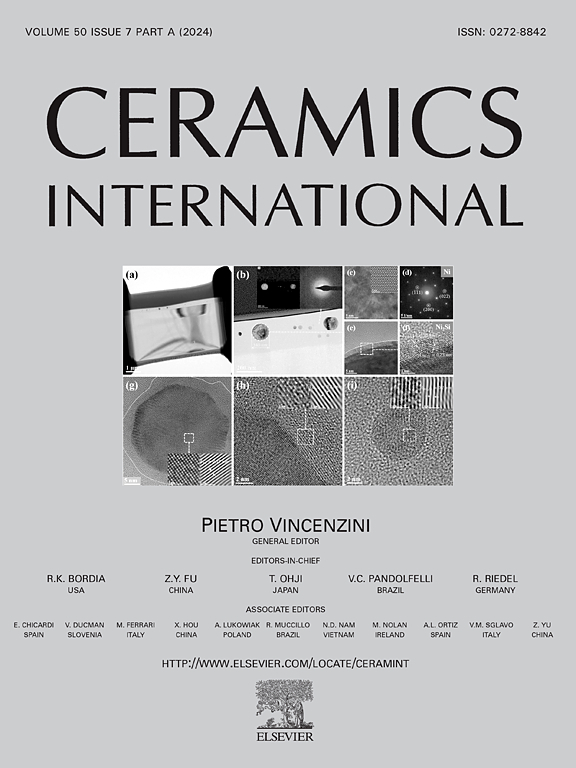
Ceramics International covers the science of advanced ceramic materials. The journal encourages contributions that demonstrate how an understanding of the basic chemical and physical phenomena may direct materials design and stimulate ideas for new or improved processing techniques, in order to obtain materials with desired structural features and properties.
Ceramics International covers oxide and non-oxide ceramics, functional glasses, glass ceramics, amorphous inorganic non-metallic materials (and their combinations with metal and organic materials), in the form of particulates, dense or porous bodies, thin/thick films and laminated, graded and composite structures. Process related topics such as ceramic-ceramic joints or joining ceramics with dissimilar materials, as well as surface finishing and conditioning are also covered. Besides traditional processing techniques, manufacturing routes of interest include innovative procedures benefiting from externally applied stresses, electromagnetic fields and energetic beams, as well as top-down and self-assembly nanotechnology approaches. In addition, the journal welcomes submissions on bio-inspired and bio-enabled materials designs, experimentally validated multi scale modelling and simulation for materials design, and the use of the most advanced chemical and physical characterization techniques of structure, properties and behaviour.
Technologically relevant low-dimensional systems are a particular focus of Ceramics International. These include 0, 1 and 2-D nanomaterials (also covering CNTs, graphene and related materials, and diamond-like carbons), their nanocomposites, as well as nano-hybrids and hierarchical multifunctional nanostructures that might integrate molecular, biological and electronic components.




 京公网安备 11010802042870号
京ICP备2023020795号-1
京公网安备 11010802042870号
京ICP备2023020795号-1

 分享
分享
 求助内容:
求助内容: 应助结果提醒方式:
 扫码关注我们
