{"title":"The physicochemical characterization of diesel-like fuels derived from plastic waste pyrolysis","authors":"Preecha Moonsin , Wuttichai Roschat , Sunti Phewphong , Sittichai Watthanalao , Phiriyakorn Chaona , Bunterm Maneerat , Supakorn Arthan , Aekkaphon Thammayod , Tappagorn Leelatam , Keyoon Duanguppama , Boonyawan Yoosuk , Pathompong Janetaisong , Vinich Promarak","doi":"10.1016/j.jtice.2025.106040","DOIUrl":null,"url":null,"abstract":"<div><h3>Background</h3><div>This research investigates liquid fuel derived from the pyrolysis of plastic waste as a renewable biofuel for diesel engines, particularly in agricultural machinery. The study addresses waste management challenges while exploring sustainable energy solutions.</div></div><div><h3>Methods</h3><div>Pyrolysis at 500 °C in a non-catalytic process produced over 63 ± 2 wt% liquid fuel. Activated carbon treatment enhanced fuel quality by removing particles, yielding activated carbon-treated waste plastic pyrolysis oil (P-WPPO) with a slightly reduced yield of 85 ± 3 wt%. Advanced techniques, including ¹H-NMR, ¹³C-NMR, FT-IR, and GC–MS, were employed for chemical analysis, while fuel properties were assessed against EN-14214 and ASTM-D6751 standards. Thermal degradation behavior was evaluated using TGA.</div></div><div><h3>Significant findings</h3><div>Both crude and treated P-WPPO contained approximately 99 % hydrocarbons, predominantly unsaturated compounds, with a heating value of 10,907 ± 67 kcal/kg, only 1.60 % lower than B10 diesel. Thermal decomposition occurred between 40 and 250 °C, completing at 550 °C. P-WPPO demonstrated excellent potential as a renewable and energy-dense diesel substitute. This research underscores the dual benefits of mitigating plastic waste pollution and producing sustainable fuels, advancing innovative waste-to-energy strategies.</div></div>","PeriodicalId":381,"journal":{"name":"Journal of the Taiwan Institute of Chemical Engineers","volume":"171 ","pages":"Article 106040"},"PeriodicalIF":6.3000,"publicationDate":"2025-06-01","publicationTypes":"Journal Article","fieldsOfStudy":null,"isOpenAccess":false,"openAccessPdf":"","citationCount":"0","resultStr":null,"platform":"Semanticscholar","paperid":null,"PeriodicalName":"Journal of the Taiwan Institute of Chemical Engineers","FirstCategoryId":"5","ListUrlMain":"https://www.sciencedirect.com/science/article/pii/S1876107025000938","RegionNum":3,"RegionCategory":"工程技术","ArticlePicture":[],"TitleCN":null,"AbstractTextCN":null,"PMCID":null,"EPubDate":"2025/2/28 0:00:00","PubModel":"Epub","JCR":"Q1","JCRName":"ENGINEERING, CHEMICAL","Score":null,"Total":0}
引用次数: 0
Abstract
Background
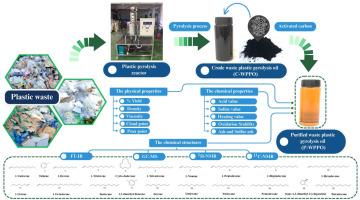
This research investigates liquid fuel derived from the pyrolysis of plastic waste as a renewable biofuel for diesel engines, particularly in agricultural machinery. The study addresses waste management challenges while exploring sustainable energy solutions.
Methods
Pyrolysis at 500 °C in a non-catalytic process produced over 63 ± 2 wt% liquid fuel. Activated carbon treatment enhanced fuel quality by removing particles, yielding activated carbon-treated waste plastic pyrolysis oil (P-WPPO) with a slightly reduced yield of 85 ± 3 wt%. Advanced techniques, including ¹H-NMR, ¹³C-NMR, FT-IR, and GC–MS, were employed for chemical analysis, while fuel properties were assessed against EN-14214 and ASTM-D6751 standards. Thermal degradation behavior was evaluated using TGA.
Significant findings
Both crude and treated P-WPPO contained approximately 99 % hydrocarbons, predominantly unsaturated compounds, with a heating value of 10,907 ± 67 kcal/kg, only 1.60 % lower than B10 diesel. Thermal decomposition occurred between 40 and 250 °C, completing at 550 °C. P-WPPO demonstrated excellent potential as a renewable and energy-dense diesel substitute. This research underscores the dual benefits of mitigating plastic waste pollution and producing sustainable fuels, advancing innovative waste-to-energy strategies.
期刊介绍:
Journal of the Taiwan Institute of Chemical Engineers (formerly known as Journal of the Chinese Institute of Chemical Engineers) publishes original works, from fundamental principles to practical applications, in the broad field of chemical engineering with special focus on three aspects: Chemical and Biomolecular Science and Technology, Energy and Environmental Science and Technology, and Materials Science and Technology. Authors should choose for their manuscript an appropriate aspect section and a few related classifications when submitting to the journal online.



 京公网安备 11010802042870号
京ICP备2023020795号-1
京公网安备 11010802042870号
京ICP备2023020795号-1

 分享
分享
 求助内容:
求助内容: 应助结果提醒方式:
 扫码关注我们
