Yanhua Cui , Yixuan Hong , Weilong Shi , Zengkai Wang
{"title":"An interfacial networked self-cleaning membrane based on 2D/2D C-g-C3N4/BiVO4 heterojunction for photocatalytic degradation of tetracycline","authors":"Yanhua Cui , Yixuan Hong , Weilong Shi , Zengkai Wang","doi":"10.1016/j.jtice.2025.106056","DOIUrl":null,"url":null,"abstract":"<div><h3>Background</h3><div>Photocatalytic membrane technology has attracted widespread concern in the field of water purification due to its high-efficiency and eco-friendly. However, the active sites of photocatalyst are easily embedding in the polymer membrane, consequently reducing degradation efficiency of photocatalytic membrane.</div></div><div><h3>Methods</h3><div>In this study, two-dimensional/two-dimensional regenerated silk fibroin-carbonized carbon modified graphite carbon nitride/bismuth vanadate heterojunction (2D/2D C-g-C<sub>3</sub>N<sub>4</sub>/BiVO<sub>4</sub>) with excellent photocatalytic performance was synthesized by electrostatic self-assembly method. Then C-g-C<sub>3</sub>N<sub>4</sub>/BiVO<sub>4</sub> heterojunction was selected as catalytic structural units, three-dimensional (3D) interfacial networked poly(vinylidene fluoride) membrane-supported C-g-C<sub>3</sub>N<sub>4</sub>/BiVO<sub>4</sub> heterojunction (C-g-C<sub>3</sub>N<sub>4</sub>/BiVO<sub>4</sub>/PVDF) was fabricated by electrospinning technique. The combination of C-g-C<sub>3</sub>N<sub>4</sub>/BiVO<sub>4</sub> heterojunction and interfacial networked PVDF membrane synergistically enhanced their permeability, antifouling and antibacterial performance.</div></div><div><h3>Significant findings</h3><div>The optimized C-g-C<sub>3</sub>N<sub>4</sub>/BiVO<sub>4</sub>/PVDF photocatalytic membrane had higher degradation TC efficiency (83.33 %) than other membrane samples, and the efficiency of bacterial inactivation of C-g-C<sub>3</sub>N<sub>4</sub>/BiVO<sub>4</sub>/PVDF could reach 99.00 %. The C-g-C<sub>3</sub>N<sub>4</sub>/BiVO<sub>4</sub>/PVDF exhibited tremendous enhancement in the permeability (13,488.2 L m<sup>−2</sup> h<sup>−1</sup>) and flux recovery efficiency (94.44 %). The free radical trapping tests and ESR spectra indicated that superoxide radical (·O<sub>2</sub><sup>⁻</sup>) was the dominant active species. In addition, the as-prepared C-g-C<sub>3</sub>N<sub>4</sub>/BiVO<sub>4</sub>/PVDF could easily recover and reuse, and photocatalytic activity basically remain unchanged, highlighting the potential application of membrane photocatalyst for the practical wastewater treatment.</div></div>","PeriodicalId":381,"journal":{"name":"Journal of the Taiwan Institute of Chemical Engineers","volume":"171 ","pages":"Article 106056"},"PeriodicalIF":6.3000,"publicationDate":"2025-06-01","publicationTypes":"Journal Article","fieldsOfStudy":null,"isOpenAccess":false,"openAccessPdf":"","citationCount":"0","resultStr":null,"platform":"Semanticscholar","paperid":null,"PeriodicalName":"Journal of the Taiwan Institute of Chemical Engineers","FirstCategoryId":"5","ListUrlMain":"https://www.sciencedirect.com/science/article/pii/S1876107025001099","RegionNum":3,"RegionCategory":"工程技术","ArticlePicture":[],"TitleCN":null,"AbstractTextCN":null,"PMCID":null,"EPubDate":"2025/2/27 0:00:00","PubModel":"Epub","JCR":"Q1","JCRName":"ENGINEERING, CHEMICAL","Score":null,"Total":0}
引用次数: 0
Abstract
Background
Photocatalytic membrane technology has attracted widespread concern in the field of water purification due to its high-efficiency and eco-friendly. However, the active sites of photocatalyst are easily embedding in the polymer membrane, consequently reducing degradation efficiency of photocatalytic membrane.
Methods
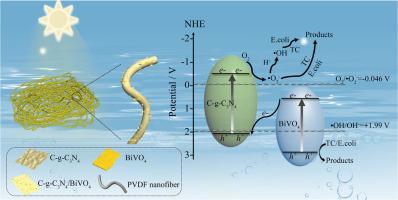
In this study, two-dimensional/two-dimensional regenerated silk fibroin-carbonized carbon modified graphite carbon nitride/bismuth vanadate heterojunction (2D/2D C-g-C3N4/BiVO4) with excellent photocatalytic performance was synthesized by electrostatic self-assembly method. Then C-g-C3N4/BiVO4 heterojunction was selected as catalytic structural units, three-dimensional (3D) interfacial networked poly(vinylidene fluoride) membrane-supported C-g-C3N4/BiVO4 heterojunction (C-g-C3N4/BiVO4/PVDF) was fabricated by electrospinning technique. The combination of C-g-C3N4/BiVO4 heterojunction and interfacial networked PVDF membrane synergistically enhanced their permeability, antifouling and antibacterial performance.
Significant findings
The optimized C-g-C3N4/BiVO4/PVDF photocatalytic membrane had higher degradation TC efficiency (83.33 %) than other membrane samples, and the efficiency of bacterial inactivation of C-g-C3N4/BiVO4/PVDF could reach 99.00 %. The C-g-C3N4/BiVO4/PVDF exhibited tremendous enhancement in the permeability (13,488.2 L m−2 h−1) and flux recovery efficiency (94.44 %). The free radical trapping tests and ESR spectra indicated that superoxide radical (·O2⁻) was the dominant active species. In addition, the as-prepared C-g-C3N4/BiVO4/PVDF could easily recover and reuse, and photocatalytic activity basically remain unchanged, highlighting the potential application of membrane photocatalyst for the practical wastewater treatment.
光催化膜技术以其高效、环保的特点在水净化领域受到广泛关注。然而,光催化剂的活性位点容易嵌入到聚合物膜中,从而降低了光催化膜的降解效率。方法采用静电自组装法合成具有优异光催化性能的二维/二维再生丝素-碳化碳改性石墨氮化碳/钒酸铋异质结(2D/2D C-g-C3N4/BiVO4)。然后选择C-g-C3N4/BiVO4异质结作为催化结构单元,采用静电纺丝技术制备了三维界面网状聚偏氟乙烯膜负载的C-g-C3N4/BiVO4异质结(C-g-C3N4/BiVO4/PVDF)。C-g-C3N4/BiVO4异质结与界面网络PVDF膜的结合,协同增强了其渗透性、防污性和抗菌性能。优化后的C-g-C3N4/BiVO4/PVDF光催化膜具有较高的降解TC效率(83.33%),对细菌的灭活效率可达99.00%。C-g-C3N4/BiVO4/PVDF在渗透率(13488.2 L m−2 h−1)和通量回收率(94.44%)方面均有显著提高。自由基捕获试验和ESR谱显示,超氧自由基(·O2毒血症)是主要的活性物质。此外,制备的C-g-C3N4/BiVO4/PVDF易于回收再利用,且光催化活性基本保持不变,突出了膜光催化剂在实际废水处理中的潜在应用。
期刊介绍:
Journal of the Taiwan Institute of Chemical Engineers (formerly known as Journal of the Chinese Institute of Chemical Engineers) publishes original works, from fundamental principles to practical applications, in the broad field of chemical engineering with special focus on three aspects: Chemical and Biomolecular Science and Technology, Energy and Environmental Science and Technology, and Materials Science and Technology. Authors should choose for their manuscript an appropriate aspect section and a few related classifications when submitting to the journal online.



 京公网安备 11010802042870号
京ICP备2023020795号-1
京公网安备 11010802042870号
京ICP备2023020795号-1

 分享
分享
 求助内容:
求助内容: 应助结果提醒方式:
 扫码关注我们
