The Influence of PEABr Passivation Concentration, Light Exposure, and Temperature on the Electrochemical Behavior and Charge Transfer Resistance in MAPbBr3 Single Crystals
{"title":"The Influence of PEABr Passivation Concentration, Light Exposure, and Temperature on the Electrochemical Behavior and Charge Transfer Resistance in MAPbBr3 Single Crystals","authors":"Tushar A. Limbani, A. Mahesh, Shivani R. Bharucha","doi":"10.1002/slct.202500273","DOIUrl":null,"url":null,"abstract":"<p>Methylammonium lead bromide (MAPbBr<sub>3</sub>) single crystals (SCs) showed promise for next-generation optoelectronic devices due to their exceptional charge transport properties and ease of fabrication. However, surface passivation, light exposure, and temperature significantly influenced their electrochemical behavior, charge transfer resistance, and overall device performance. This study investigated the effects of phenylethylammonium bromide (PEABr) passivation concentration, varying light conditions, and temperature on the electrochemical properties of MAPbBr<sub>3</sub> SCs. Results showed that increasing PEABr passivation concentration significantly enhanced charge transfer dynamics and reduced interfacial resistance. Passivation concentrations, particularly 20 mM and 50 mM, effectively reduced resistance and ion migration rates, enhanced charge carrier mobility, and minimized recombination losses. Charge transfer resistance exhibited a substantial dependence on passivation concentration and a moderate dependence on light type under various light exposures. The ion activation energy increased from 0.21 eV to 0.40 eV after passivation, indicating effective suppression of ion migration and improved electrochemical stability. Phase angle analysis from Bode plots further demonstrated enhanced charge transfer and capacitive behavior under all tested conditions with higher passivation concentrations. These findings highlighted the critical role of optimizing PEABr passivation concentration in reducing charge transfer resistance, enhancing charge carrier dynamics, and improving the electrochemical performance of MAPbBr<sub>3</sub> SCs.</p>","PeriodicalId":146,"journal":{"name":"ChemistrySelect","volume":"10 9","pages":""},"PeriodicalIF":2.0000,"publicationDate":"2025-02-27","publicationTypes":"Journal Article","fieldsOfStudy":null,"isOpenAccess":false,"openAccessPdf":"","citationCount":"0","resultStr":null,"platform":"Semanticscholar","paperid":null,"PeriodicalName":"ChemistrySelect","FirstCategoryId":"92","ListUrlMain":"https://chemistry-europe.onlinelibrary.wiley.com/doi/10.1002/slct.202500273","RegionNum":4,"RegionCategory":"化学","ArticlePicture":[],"TitleCN":null,"AbstractTextCN":null,"PMCID":null,"EPubDate":"","PubModel":"","JCR":"Q3","JCRName":"CHEMISTRY, MULTIDISCIPLINARY","Score":null,"Total":0}
引用次数: 0
Abstract
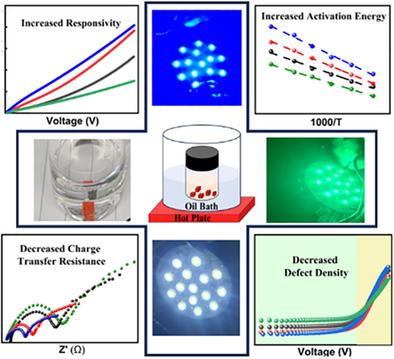
Methylammonium lead bromide (MAPbBr3) single crystals (SCs) showed promise for next-generation optoelectronic devices due to their exceptional charge transport properties and ease of fabrication. However, surface passivation, light exposure, and temperature significantly influenced their electrochemical behavior, charge transfer resistance, and overall device performance. This study investigated the effects of phenylethylammonium bromide (PEABr) passivation concentration, varying light conditions, and temperature on the electrochemical properties of MAPbBr3 SCs. Results showed that increasing PEABr passivation concentration significantly enhanced charge transfer dynamics and reduced interfacial resistance. Passivation concentrations, particularly 20 mM and 50 mM, effectively reduced resistance and ion migration rates, enhanced charge carrier mobility, and minimized recombination losses. Charge transfer resistance exhibited a substantial dependence on passivation concentration and a moderate dependence on light type under various light exposures. The ion activation energy increased from 0.21 eV to 0.40 eV after passivation, indicating effective suppression of ion migration and improved electrochemical stability. Phase angle analysis from Bode plots further demonstrated enhanced charge transfer and capacitive behavior under all tested conditions with higher passivation concentrations. These findings highlighted the critical role of optimizing PEABr passivation concentration in reducing charge transfer resistance, enhancing charge carrier dynamics, and improving the electrochemical performance of MAPbBr3 SCs.
期刊介绍:
ChemistrySelect is the latest journal from ChemPubSoc Europe and Wiley-VCH. It offers researchers a quality society-owned journal in which to publish their work in all areas of chemistry. Manuscripts are evaluated by active researchers to ensure they add meaningfully to the scientific literature, and those accepted are processed quickly to ensure rapid online publication.






 京公网安备 11010802042870号
京ICP备2023020795号-1
京公网安备 11010802042870号
京ICP备2023020795号-1

 分享
分享
 求助内容:
求助内容: 应助结果提醒方式:
 扫码关注我们
