{"title":"TCR catch bonds nonlinearly control CD8 cooperation to shape T cell specificity","authors":"Rui Qin, Yong Zhang, Jiawei Shi, Peng Wu, Chenyi An, Zhenhai Li, Nuo Liu, Ziyan Wan, Ting Hua, Xiaolong Li, Jizhong Lou, Weiwei Yin, Wei Chen","doi":"10.1038/s41422-025-01077-9","DOIUrl":null,"url":null,"abstract":"Naturally evolved T-cell receptors (TCRs) exhibit remarkably high specificity in discriminating non-self antigens from self-antigens under dynamic biomechanical modulation. In contrast, engineered high-affinity TCRs often lose this specificity, leading to cross-reactivity with self-antigens and off-target toxicity. The underlying mechanism for this difference remains unclear. Our study reveals that natural TCRs exploit mechanical force to form optimal catch bonds with their cognate antigens. This process relies on a mechanically flexible TCR–pMHC binding interface, which enables force-enhanced CD8 coreceptor binding to MHC-α1α2 domains through sequential conformational changes induced by force in both the MHC and CD8. Conversely, engineered high-affinity TCRs create rigid, tightly bound interfaces with cognate pMHCs of their parental TCRs. This rigidity prevents the force-induced conformational changes necessary for optimal catch-bond formation. Paradoxically, these high-affinity TCRs can form moderate catch bonds with non-stimulatory pMHCs of their parental TCRs, leading to off-target cross-reactivity and reduced specificity. We have also developed comprehensive force-dependent TCR–pMHC kinetics-function maps capable of distinguishing functional and non-functional TCR–pMHC pairs and identifying toxic, cross-reactive TCRs. These findings elucidate the mechano-chemical basis of the specificity of natural TCRs and highlight the critical role of CD8 in targeting cognate antigens. This work provides valuable insights for engineering TCRs with enhanced specificity and potency against non-self antigens, particularly for applications in cancer immunotherapy and infectious disease treatment, while minimizing the risk of self-antigen cross-reactivity.","PeriodicalId":9926,"journal":{"name":"Cell Research","volume":"35 4","pages":"265-283"},"PeriodicalIF":25.9000,"publicationDate":"2025-02-27","publicationTypes":"Journal Article","fieldsOfStudy":null,"isOpenAccess":false,"openAccessPdf":"https://www.nature.com/articles/s41422-025-01077-9.pdf","citationCount":"0","resultStr":null,"platform":"Semanticscholar","paperid":null,"PeriodicalName":"Cell Research","FirstCategoryId":"99","ListUrlMain":"https://www.nature.com/articles/s41422-025-01077-9","RegionNum":1,"RegionCategory":"生物学","ArticlePicture":[],"TitleCN":null,"AbstractTextCN":null,"PMCID":null,"EPubDate":"","PubModel":"","JCR":"Q1","JCRName":"CELL BIOLOGY","Score":null,"Total":0}
引用次数: 0
Abstract
Naturally evolved T-cell receptors (TCRs) exhibit remarkably high specificity in discriminating non-self antigens from self-antigens under dynamic biomechanical modulation. In contrast, engineered high-affinity TCRs often lose this specificity, leading to cross-reactivity with self-antigens and off-target toxicity. The underlying mechanism for this difference remains unclear. Our study reveals that natural TCRs exploit mechanical force to form optimal catch bonds with their cognate antigens. This process relies on a mechanically flexible TCR–pMHC binding interface, which enables force-enhanced CD8 coreceptor binding to MHC-α1α2 domains through sequential conformational changes induced by force in both the MHC and CD8. Conversely, engineered high-affinity TCRs create rigid, tightly bound interfaces with cognate pMHCs of their parental TCRs. This rigidity prevents the force-induced conformational changes necessary for optimal catch-bond formation. Paradoxically, these high-affinity TCRs can form moderate catch bonds with non-stimulatory pMHCs of their parental TCRs, leading to off-target cross-reactivity and reduced specificity. We have also developed comprehensive force-dependent TCR–pMHC kinetics-function maps capable of distinguishing functional and non-functional TCR–pMHC pairs and identifying toxic, cross-reactive TCRs. These findings elucidate the mechano-chemical basis of the specificity of natural TCRs and highlight the critical role of CD8 in targeting cognate antigens. This work provides valuable insights for engineering TCRs with enhanced specificity and potency against non-self antigens, particularly for applications in cancer immunotherapy and infectious disease treatment, while minimizing the risk of self-antigen cross-reactivity.
期刊介绍:
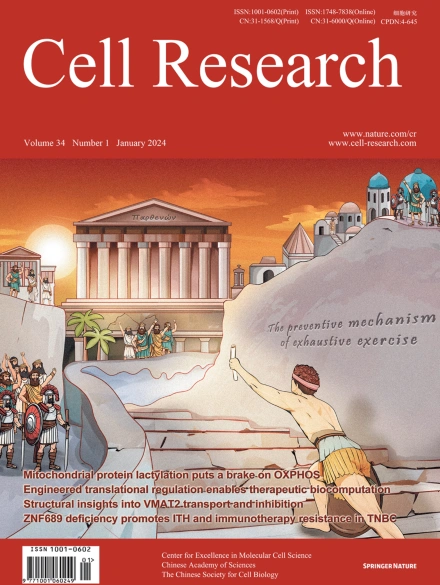
Cell Research (CR) is an international journal published by Springer Nature in partnership with the Center for Excellence in Molecular Cell Science, Chinese Academy of Sciences (CAS). It focuses on publishing original research articles and reviews in various areas of life sciences, particularly those related to molecular and cell biology. The journal covers a broad range of topics including cell growth, differentiation, and apoptosis; signal transduction; stem cell biology and development; chromatin, epigenetics, and transcription; RNA biology; structural and molecular biology; cancer biology and metabolism; immunity and molecular pathogenesis; molecular and cellular neuroscience; plant molecular and cell biology; and omics, system biology, and synthetic biology. CR is recognized as China's best international journal in life sciences and is part of Springer Nature's prestigious family of Molecular Cell Biology journals.




 京公网安备 11010802042870号
京ICP备2023020795号-1
京公网安备 11010802042870号
京ICP备2023020795号-1

 分享
分享
 求助内容:
求助内容: 应助结果提醒方式:
 扫码关注我们
