Eugenio Pettinato, Thomas M Steiner, Eric A Cassens, Thomas Geisberger, Christian Seitz, Simone König, Wolfgang Eisenreich, Ivan A Berg
{"title":"Propionate metabolism in <i>Desulfurella acetivorans</i>.","authors":"Eugenio Pettinato, Thomas M Steiner, Eric A Cassens, Thomas Geisberger, Christian Seitz, Simone König, Wolfgang Eisenreich, Ivan A Berg","doi":"10.3389/fmicb.2025.1545849","DOIUrl":null,"url":null,"abstract":"<p><p><i>Desulfurella acetivorans</i> is a strictly anaerobic sulfur-reducing deltaproteobacterium that can grow heterotrophically by oxidation of acetate or autotrophically with molecular hydrogen. Here we show that <i>D. acetivorans</i> possesses a putative operon encoding enzymes of the methylcitrate cycle of propionate oxidation and demonstrate that this bacterium is capable of propionate growth. However, activities of the methylcitrate cycle enzymes could not be detected in extracts of propionate-grown cells, and experiments with [U-<sup>13</sup>C<sub>3</sub>]propionate and comparative proteomic analysis of acetate- and propionate-grown cells suggested that the methylcitrate cycle is not active during propionate growth. Instead, propionyl-CoA assimilation proceeds via its carboxylation to methylmalonyl-CoA, which is further converted to succinyl-CoA. The latter is directed to the tricarboxylic acid (TCA) cycle, where it is converted to oxaloacetate and condenses with acetyl-CoA (produced by decarboxylation of another oxaloacetate molecule) to form citrate, which is oxidized in the TCA cycle. These results highlight the uncertainty of genomic predictions in the analysis of microbial metabolic pathways and the need for their experimental confirmation.</p>","PeriodicalId":12466,"journal":{"name":"Frontiers in Microbiology","volume":"16 ","pages":"1545849"},"PeriodicalIF":4.0000,"publicationDate":"2025-02-12","publicationTypes":"Journal Article","fieldsOfStudy":null,"isOpenAccess":false,"openAccessPdf":"https://www.ncbi.nlm.nih.gov/pmc/articles/PMC11861179/pdf/","citationCount":"0","resultStr":null,"platform":"Semanticscholar","paperid":null,"PeriodicalName":"Frontiers in Microbiology","FirstCategoryId":"99","ListUrlMain":"https://doi.org/10.3389/fmicb.2025.1545849","RegionNum":2,"RegionCategory":"生物学","ArticlePicture":[],"TitleCN":null,"AbstractTextCN":null,"PMCID":null,"EPubDate":"2025/1/1 0:00:00","PubModel":"eCollection","JCR":"Q2","JCRName":"MICROBIOLOGY","Score":null,"Total":0}
引用次数: 0
Abstract
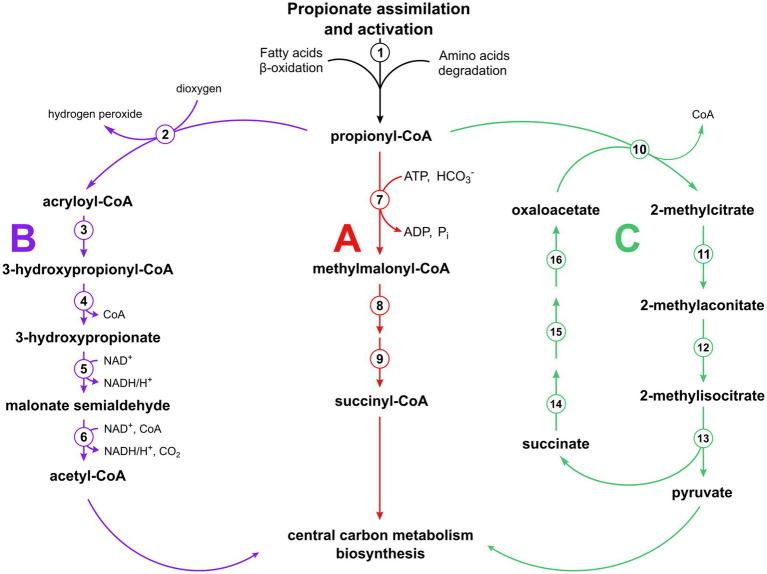
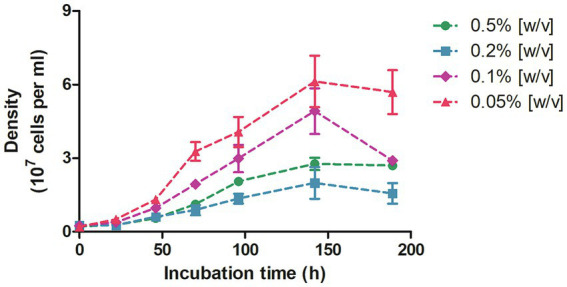
Desulfurella acetivorans is a strictly anaerobic sulfur-reducing deltaproteobacterium that can grow heterotrophically by oxidation of acetate or autotrophically with molecular hydrogen. Here we show that D. acetivorans possesses a putative operon encoding enzymes of the methylcitrate cycle of propionate oxidation and demonstrate that this bacterium is capable of propionate growth. However, activities of the methylcitrate cycle enzymes could not be detected in extracts of propionate-grown cells, and experiments with [U-13C3]propionate and comparative proteomic analysis of acetate- and propionate-grown cells suggested that the methylcitrate cycle is not active during propionate growth. Instead, propionyl-CoA assimilation proceeds via its carboxylation to methylmalonyl-CoA, which is further converted to succinyl-CoA. The latter is directed to the tricarboxylic acid (TCA) cycle, where it is converted to oxaloacetate and condenses with acetyl-CoA (produced by decarboxylation of another oxaloacetate molecule) to form citrate, which is oxidized in the TCA cycle. These results highlight the uncertainty of genomic predictions in the analysis of microbial metabolic pathways and the need for their experimental confirmation.
期刊介绍:
Frontiers in Microbiology is a leading journal in its field, publishing rigorously peer-reviewed research across the entire spectrum of microbiology. Field Chief Editor Martin G. Klotz at Washington State University is supported by an outstanding Editorial Board of international researchers. This multidisciplinary open-access journal is at the forefront of disseminating and communicating scientific knowledge and impactful discoveries to researchers, academics, clinicians and the public worldwide.




 京公网安备 11010802042870号
京ICP备2023020795号-1
京公网安备 11010802042870号
京ICP备2023020795号-1

 分享
分享
 求助内容:
求助内容: 应助结果提醒方式:
 扫码关注我们
