Jean Ikanga, Saranya Sundaram Patel, Megan Schwinne, Caterina Obenauf, Emmanuel Epenge, Guy Gikelekele, Nathan Tshengele, Immaculee Kavugho, Samuel Mampunza, Lelo Mananga, Charlotte E Teunissen, Julio C Rojas, Brandon Chan, Argentina Lario Lago, Joel H Kramer, Adam L Boxer, Andreas Jeromin, Emile Omba, Alvaro Alonso, Alden L Gross
{"title":"Exploring cognitive and neuroimaging profiles of dementia subtypes of individuals with dementia in the Democratic Republic of Congo.","authors":"Jean Ikanga, Saranya Sundaram Patel, Megan Schwinne, Caterina Obenauf, Emmanuel Epenge, Guy Gikelekele, Nathan Tshengele, Immaculee Kavugho, Samuel Mampunza, Lelo Mananga, Charlotte E Teunissen, Julio C Rojas, Brandon Chan, Argentina Lario Lago, Joel H Kramer, Adam L Boxer, Andreas Jeromin, Emile Omba, Alvaro Alonso, Alden L Gross","doi":"10.3389/fnagi.2025.1552348","DOIUrl":null,"url":null,"abstract":"<p><strong>Objective: </strong>The 2024 Alzheimer's Association (AA) research diagnostic criteria for Alzheimer's Disease (AD) considers fluid biomarkers, including promising blood-based biomarkers for detecting AD. This study aims to identify dementia subtypes and their cognitive and neuroimaging profiles in older adults with dementia in the Democratic Republic of Congo (DRC) using biomarkers and clinical data.</p><p><strong>Methods: </strong>Forty-five individuals with dementia over 65 years old were evaluated using the Community Screening Instrument for Dementia and the informant-based Alzheimer's Questionnaire. Core AD biomarkers (Aβ42/40 and p-tau181) and non-specific neurodegeneration biomarkers (NfL, GFAP) were measured in blood plasma. Neuroimaging structures were assessed using magnetic resonance imaging (MRI). Dementia subtypes were determined based on plasma biomarker pathology and vascular markers. Biomarker cutoff scores were identified to optimize sensitivity and specificity. Individuals were stratified into one of four dementia subtypes-AD only, non-AD vascular, non-AD other, or mixed - based on combinations of abnormalities in these markers.</p><p><strong>Results: </strong>Among the 45 individuals with dementia, mixed dementia had the highest prevalence (42.4%), followed by AD-only (24.4%), non-AD other dementia (22.2%), and non-AD vascular dementia subtypes (11.1%). Both cognitive and neuroimaging profiles aligned poorly with biomarker classifications in the full sample. Cognitive tests varied across dementia subtypes. The cognitive profile of the AD-only and mixed groups suggested relatively low cognitive performance, while the non-AD and other groups had the best scores on average.</p><p><strong>Conclusion: </strong>Consistent with studies in other settings, our preliminary findings suggest that neurodegenerative plasma biomarkers may help to identify dementia subtypes and provide insight into cognitive and neuroimaging profiles among older adults in the DRC.</p>","PeriodicalId":12450,"journal":{"name":"Frontiers in Aging Neuroscience","volume":"17 ","pages":"1552348"},"PeriodicalIF":4.5000,"publicationDate":"2025-02-12","publicationTypes":"Journal Article","fieldsOfStudy":null,"isOpenAccess":false,"openAccessPdf":"https://www.ncbi.nlm.nih.gov/pmc/articles/PMC11860979/pdf/","citationCount":"0","resultStr":null,"platform":"Semanticscholar","paperid":null,"PeriodicalName":"Frontiers in Aging Neuroscience","FirstCategoryId":"3","ListUrlMain":"https://doi.org/10.3389/fnagi.2025.1552348","RegionNum":2,"RegionCategory":"医学","ArticlePicture":[],"TitleCN":null,"AbstractTextCN":null,"PMCID":null,"EPubDate":"2025/1/1 0:00:00","PubModel":"eCollection","JCR":"Q2","JCRName":"GERIATRICS & GERONTOLOGY","Score":null,"Total":0}
引用次数: 0
Abstract
Objective: The 2024 Alzheimer's Association (AA) research diagnostic criteria for Alzheimer's Disease (AD) considers fluid biomarkers, including promising blood-based biomarkers for detecting AD. This study aims to identify dementia subtypes and their cognitive and neuroimaging profiles in older adults with dementia in the Democratic Republic of Congo (DRC) using biomarkers and clinical data.
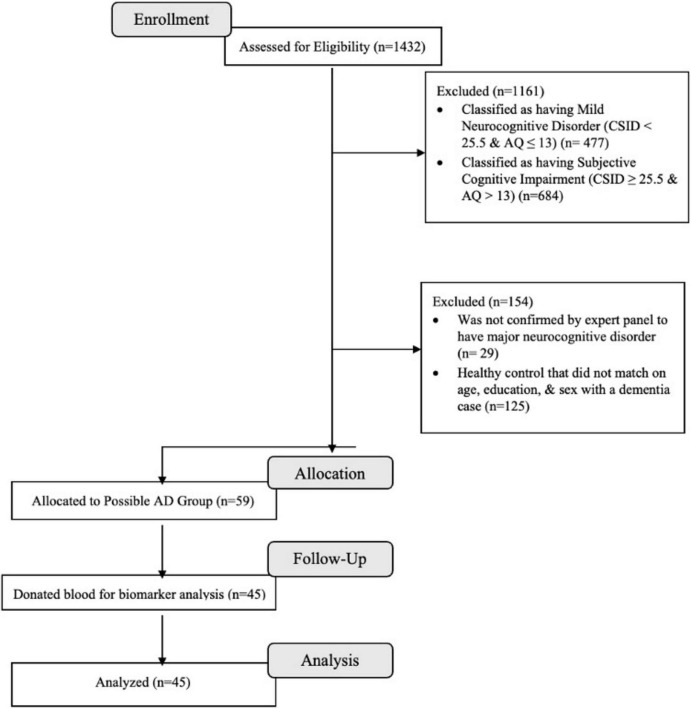
Methods: Forty-five individuals with dementia over 65 years old were evaluated using the Community Screening Instrument for Dementia and the informant-based Alzheimer's Questionnaire. Core AD biomarkers (Aβ42/40 and p-tau181) and non-specific neurodegeneration biomarkers (NfL, GFAP) were measured in blood plasma. Neuroimaging structures were assessed using magnetic resonance imaging (MRI). Dementia subtypes were determined based on plasma biomarker pathology and vascular markers. Biomarker cutoff scores were identified to optimize sensitivity and specificity. Individuals were stratified into one of four dementia subtypes-AD only, non-AD vascular, non-AD other, or mixed - based on combinations of abnormalities in these markers.
Results: Among the 45 individuals with dementia, mixed dementia had the highest prevalence (42.4%), followed by AD-only (24.4%), non-AD other dementia (22.2%), and non-AD vascular dementia subtypes (11.1%). Both cognitive and neuroimaging profiles aligned poorly with biomarker classifications in the full sample. Cognitive tests varied across dementia subtypes. The cognitive profile of the AD-only and mixed groups suggested relatively low cognitive performance, while the non-AD and other groups had the best scores on average.
Conclusion: Consistent with studies in other settings, our preliminary findings suggest that neurodegenerative plasma biomarkers may help to identify dementia subtypes and provide insight into cognitive and neuroimaging profiles among older adults in the DRC.
期刊介绍:
Frontiers in Aging Neuroscience is a leading journal in its field, publishing rigorously peer-reviewed research that advances our understanding of the mechanisms of Central Nervous System aging and age-related neural diseases. Specialty Chief Editor Thomas Wisniewski at the New York University School of Medicine is supported by an outstanding Editorial Board of international researchers. This multidisciplinary open-access journal is at the forefront of disseminating and communicating scientific knowledge and impactful discoveries to researchers, academics, clinicians and the public worldwide.



 京公网安备 11010802042870号
京ICP备2023020795号-1
京公网安备 11010802042870号
京ICP备2023020795号-1

 分享
分享
 求助内容:
求助内容: 应助结果提醒方式:
 扫码关注我们
