Hemant Borase, Chandrashekhar D Patil, Tibor Valyi-Nagy, Deepak Shukla
{"title":"HPSE-mediated proinflammatory signaling contributes to neurobehavioral deficits following intranasal HSV-1 infection.","authors":"Hemant Borase, Chandrashekhar D Patil, Tibor Valyi-Nagy, Deepak Shukla","doi":"10.1128/mbio.03765-24","DOIUrl":null,"url":null,"abstract":"<p><p>Herpes simplex virus-1 (HSV-1) is a neurotropic virus that can infect the brain, and an uncontrolled infection can lead to a range of diseases, including chronic nerve pain, encephalitis, and neurobehavioral abnormalities. These outcomes are often severe and have lasting consequences, highlighting the need to identify host factors that contribute to disease severity. In this study, we report that intranasal HSV-1 infection in murine model, which promotes viral dissemination into the brain, implicates the host protein heparanase (HPSE) as a key mediator of neuroinflammation. Specifically, we observed that the HPSE activity during HSV-1 infection in naïve animals promotes the upregulation of proinflammatory cytokines, enhances microglial activity in the brain, and contributes to cognitive impairment, anxiety, and motor coordination deficits. Such effects are significantly less detectable in heparanase deficient (<i>Hpse-/</i>-) mice. Additionally, we found that moderate activation of toll-like receptors (TLRs), particularly in <i>Hpse+/+</i> mice, may contribute to the activation of the inflammasome pathway. This, in turn, leads to the activation of caspase-1 (<i>Casp1</i>) and caspase-3 (<i>Casp3</i>), which may play a role in nerve function loss. Our findings position HPSE as a potential therapeutic target for mitigating virus-induced neuroinflammation and neurobehavioral defects.</p><p><strong>Importance: </strong>Herpes simplex virus-1 (HSV-1) infection in the brain can lead to severe and often permanent neurological consequences. Host factors influence disease outcomes in response to infection, and understanding these factors is crucial for developing effective therapies. This study identifies the host protein HPSE as a key mediator of neuroinflammation in response to HSV-1 infection. We demonstrate that the HPSE activity drives proinflammatory cytokine expression and microglial activation and promotes a signaling cascade involving toll-like receptors and caspase activation, potentially intensifying neuroinflammatory responses. These findings implicate HPSE as an important player in HSV-1 pathogenesis in the central nervous system and suggest that targeting HPSE could provide a novel therapeutic strategy to mitigate virus-induced neuroinflammation and neurobehavioral disturbance.</p>","PeriodicalId":18315,"journal":{"name":"mBio","volume":" ","pages":"e0376524"},"PeriodicalIF":4.7000,"publicationDate":"2025-04-09","publicationTypes":"Journal Article","fieldsOfStudy":null,"isOpenAccess":false,"openAccessPdf":"https://www.ncbi.nlm.nih.gov/pmc/articles/PMC11980599/pdf/","citationCount":"0","resultStr":null,"platform":"Semanticscholar","paperid":null,"PeriodicalName":"mBio","FirstCategoryId":"99","ListUrlMain":"https://doi.org/10.1128/mbio.03765-24","RegionNum":1,"RegionCategory":"生物学","ArticlePicture":[],"TitleCN":null,"AbstractTextCN":null,"PMCID":null,"EPubDate":"2025/2/27 0:00:00","PubModel":"Epub","JCR":"Q1","JCRName":"MICROBIOLOGY","Score":null,"Total":0}
引用次数: 0
Abstract
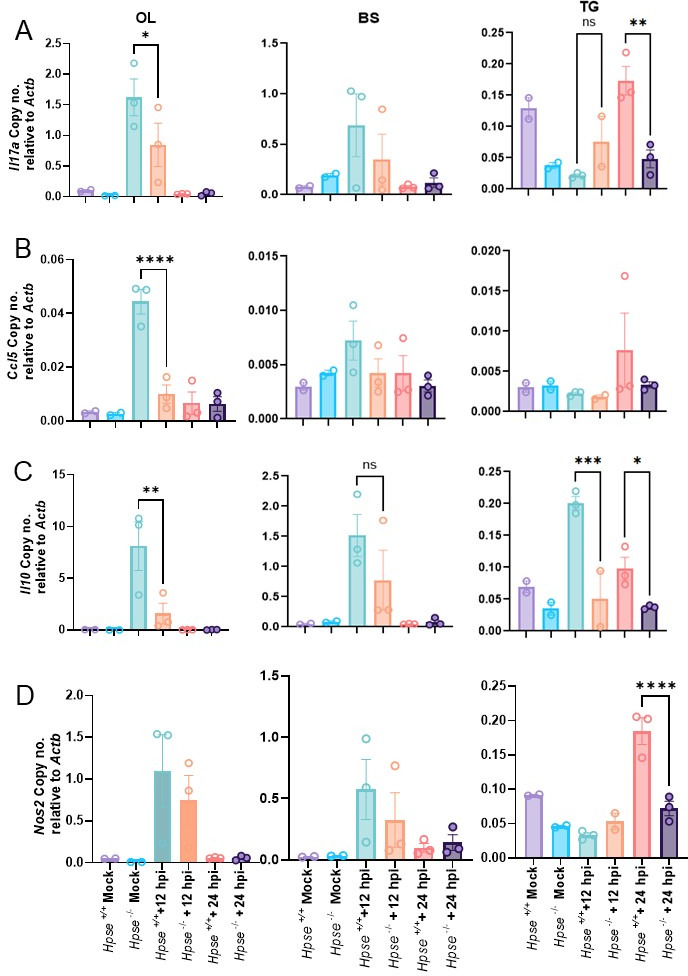
Herpes simplex virus-1 (HSV-1) is a neurotropic virus that can infect the brain, and an uncontrolled infection can lead to a range of diseases, including chronic nerve pain, encephalitis, and neurobehavioral abnormalities. These outcomes are often severe and have lasting consequences, highlighting the need to identify host factors that contribute to disease severity. In this study, we report that intranasal HSV-1 infection in murine model, which promotes viral dissemination into the brain, implicates the host protein heparanase (HPSE) as a key mediator of neuroinflammation. Specifically, we observed that the HPSE activity during HSV-1 infection in naïve animals promotes the upregulation of proinflammatory cytokines, enhances microglial activity in the brain, and contributes to cognitive impairment, anxiety, and motor coordination deficits. Such effects are significantly less detectable in heparanase deficient (Hpse-/-) mice. Additionally, we found that moderate activation of toll-like receptors (TLRs), particularly in Hpse+/+ mice, may contribute to the activation of the inflammasome pathway. This, in turn, leads to the activation of caspase-1 (Casp1) and caspase-3 (Casp3), which may play a role in nerve function loss. Our findings position HPSE as a potential therapeutic target for mitigating virus-induced neuroinflammation and neurobehavioral defects.
Importance: Herpes simplex virus-1 (HSV-1) infection in the brain can lead to severe and often permanent neurological consequences. Host factors influence disease outcomes in response to infection, and understanding these factors is crucial for developing effective therapies. This study identifies the host protein HPSE as a key mediator of neuroinflammation in response to HSV-1 infection. We demonstrate that the HPSE activity drives proinflammatory cytokine expression and microglial activation and promotes a signaling cascade involving toll-like receptors and caspase activation, potentially intensifying neuroinflammatory responses. These findings implicate HPSE as an important player in HSV-1 pathogenesis in the central nervous system and suggest that targeting HPSE could provide a novel therapeutic strategy to mitigate virus-induced neuroinflammation and neurobehavioral disturbance.
期刊介绍:
mBio® is ASM''s first broad-scope, online-only, open access journal. mBio offers streamlined review and publication of the best research in microbiology and allied fields.





 京公网安备 11010802042870号
京ICP备2023020795号-1
京公网安备 11010802042870号
京ICP备2023020795号-1

 分享
分享
 求助内容:
求助内容: 应助结果提醒方式:
 扫码关注我们
