{"title":"The global prevalence of antibiotic self-medication among the adult population: systematic review and meta-analysis.","authors":"Tigist Gashaw, Tesfaye Assebe Yadeta, Fitsum Weldegebreal, Lemma Demissie, Abera Jambo, Nega Assefa","doi":"10.1186/s13643-025-02783-6","DOIUrl":null,"url":null,"abstract":"<p><strong>Background: </strong>Antibiotic self-medication (ASM) is when a person takes antibiotics without a prescription or consulting a healthcare professional. These practices contribute to the misuse of medicines and antibiotic resistance which is a growing global health threat that can lead to longer hospital stays, higher healthcare costs, and increased mortality rates. Though various studies have been conducted on ASM in different countries, there has not yet been a systematic review that comprehensively assesses the problem in the entire globe. Hence, this systematic review and meta-analysis aimed to evaluate the global pooled prevalence of antibiotic self-medication and the reasons for its practice.</p><p><strong>Method: </strong>A systematic search of electronic registers and databases was conducted on PubMed, Medline, Embase, Scopus, Web of Science, Google Scholar, and gray literature including institutional repositories, and national health databases. It used carefully selected keywords and indexing terms in the past ten years. The Joanna Briggs Institute's critical checklist extracted relevant data after appraisal. Narrative analysis was used for descriptive data while Comprehensive Meta-Analysis (CMA) Software was used to analyze quantitative data. Statistics were used to look for heterogeneity, publication bias, and correlations. Sensitivity tests and sub-group analysis were employed to compare outcomes. A p-value < 0.05 was considered significant in all cases.</p><p><strong>Results: </strong>Seventy-one studies were included in this systematic review and meta-analysis. The total number of participants was 63,251 with sample sizes ranging from 110 to 15,526. In primary outcomes, ASM ranged from 0.65 to 92.2%. The pooled prevalence of ASM globally was 43.0% (95% CI: 38.0, 48.1%). A high degree of heterogeneity across studies was shown with I<sup>2</sup> = 99.2%, p < 0.001 assuming a random effect model. In subgroup analysis, the highest ASM pooled prevalence was 55.2% (95% CI: 47.2, 63.2) in sub-Saharan Africa followed by the Middle East, North Africa, and Greater Arabia at 48.3% (95% CI: 38.3, 58.4), Europe at 34.7% (95% CI:18.0, 56.4), and Asia at 25.8% (95% CI: 18.6, 34.6). Students have been identified as the major users of ASM at 62.1% (95% CI: 53.7, 69.7). The meta-regression showed a coefficient of 0.0365, -0.0117, and -0.0001 for a year of publication, recall time, and total sample size, respectively. Publication bias was demonstrated from the asymmetrical distribution of the funnel plot, and the Eggers regression p-value was greater than 0.05 (0.264). Moreover, knowledge of antibiotics (46.19% (95% CI: 27.99, 65.46)), previous successful experiences (39.13% (95% CI: 30.13, 48.93)), and perceiving illness as minor (38.10% (95% CI: 27.19, 50.37)) were the top three reasons pooled proportion for practicing ASM.</p><p><strong>Conclusion: </strong>ASM practice was higher among African and student users. The previous successful experience was the most frequent reason reported. Educational level, gender, and age were often mentioned as predictor factors. Hence, designing interventional approaches that consider the different burdens among the target population and tackle the reasons for the practices might benefit averting antimicrobial resistance.</p>","PeriodicalId":22162,"journal":{"name":"Systematic Reviews","volume":"14 1","pages":"49"},"PeriodicalIF":3.9000,"publicationDate":"2025-02-26","publicationTypes":"Journal Article","fieldsOfStudy":null,"isOpenAccess":false,"openAccessPdf":"https://www.ncbi.nlm.nih.gov/pmc/articles/PMC11863577/pdf/","citationCount":"0","resultStr":null,"platform":"Semanticscholar","paperid":null,"PeriodicalName":"Systematic Reviews","FirstCategoryId":"3","ListUrlMain":"https://doi.org/10.1186/s13643-025-02783-6","RegionNum":4,"RegionCategory":"医学","ArticlePicture":[],"TitleCN":null,"AbstractTextCN":null,"PMCID":null,"EPubDate":"","PubModel":"","JCR":"Q1","JCRName":"MEDICINE, GENERAL & INTERNAL","Score":null,"Total":0}
引用次数: 0
Abstract
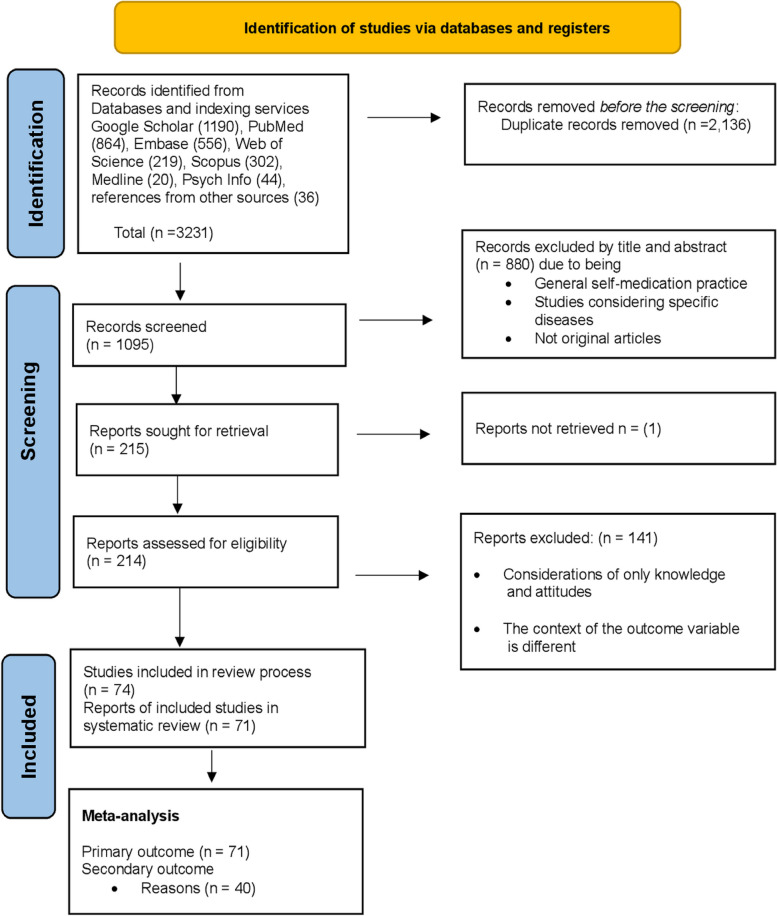
Background: Antibiotic self-medication (ASM) is when a person takes antibiotics without a prescription or consulting a healthcare professional. These practices contribute to the misuse of medicines and antibiotic resistance which is a growing global health threat that can lead to longer hospital stays, higher healthcare costs, and increased mortality rates. Though various studies have been conducted on ASM in different countries, there has not yet been a systematic review that comprehensively assesses the problem in the entire globe. Hence, this systematic review and meta-analysis aimed to evaluate the global pooled prevalence of antibiotic self-medication and the reasons for its practice.
Method: A systematic search of electronic registers and databases was conducted on PubMed, Medline, Embase, Scopus, Web of Science, Google Scholar, and gray literature including institutional repositories, and national health databases. It used carefully selected keywords and indexing terms in the past ten years. The Joanna Briggs Institute's critical checklist extracted relevant data after appraisal. Narrative analysis was used for descriptive data while Comprehensive Meta-Analysis (CMA) Software was used to analyze quantitative data. Statistics were used to look for heterogeneity, publication bias, and correlations. Sensitivity tests and sub-group analysis were employed to compare outcomes. A p-value < 0.05 was considered significant in all cases.
Results: Seventy-one studies were included in this systematic review and meta-analysis. The total number of participants was 63,251 with sample sizes ranging from 110 to 15,526. In primary outcomes, ASM ranged from 0.65 to 92.2%. The pooled prevalence of ASM globally was 43.0% (95% CI: 38.0, 48.1%). A high degree of heterogeneity across studies was shown with I2 = 99.2%, p < 0.001 assuming a random effect model. In subgroup analysis, the highest ASM pooled prevalence was 55.2% (95% CI: 47.2, 63.2) in sub-Saharan Africa followed by the Middle East, North Africa, and Greater Arabia at 48.3% (95% CI: 38.3, 58.4), Europe at 34.7% (95% CI:18.0, 56.4), and Asia at 25.8% (95% CI: 18.6, 34.6). Students have been identified as the major users of ASM at 62.1% (95% CI: 53.7, 69.7). The meta-regression showed a coefficient of 0.0365, -0.0117, and -0.0001 for a year of publication, recall time, and total sample size, respectively. Publication bias was demonstrated from the asymmetrical distribution of the funnel plot, and the Eggers regression p-value was greater than 0.05 (0.264). Moreover, knowledge of antibiotics (46.19% (95% CI: 27.99, 65.46)), previous successful experiences (39.13% (95% CI: 30.13, 48.93)), and perceiving illness as minor (38.10% (95% CI: 27.19, 50.37)) were the top three reasons pooled proportion for practicing ASM.
Conclusion: ASM practice was higher among African and student users. The previous successful experience was the most frequent reason reported. Educational level, gender, and age were often mentioned as predictor factors. Hence, designing interventional approaches that consider the different burdens among the target population and tackle the reasons for the practices might benefit averting antimicrobial resistance.
期刊介绍:
Systematic Reviews encompasses all aspects of the design, conduct and reporting of systematic reviews. The journal publishes high quality systematic review products including systematic review protocols, systematic reviews related to a very broad definition of health, rapid reviews, updates of already completed systematic reviews, and methods research related to the science of systematic reviews, such as decision modelling. At this time Systematic Reviews does not accept reviews of in vitro studies. The journal also aims to ensure that the results of all well-conducted systematic reviews are published, regardless of their outcome.





 京公网安备 11010802042870号
京ICP备2023020795号-1
京公网安备 11010802042870号
京ICP备2023020795号-1

 分享
分享
 求助内容:
求助内容: 应助结果提醒方式:
 扫码关注我们
