{"title":"<i>Barbastellacaspica</i> (Chiroptera, Vespertilionidae) in China: first record and complete mitochondrial genome.","authors":"Zhong-Yu Wang, Shamshidin Abduriyim","doi":"10.3897/zookeys.1228.137496","DOIUrl":null,"url":null,"abstract":"<p><p>The Caspian barbastelle, <i>Barbastellacaspica</i>, has spread widely in the Caspian region, Iran, and Central Asia; however, there is no evidence of its occurrence in China so far. During a field investigation, we collected a single specimen of <i>B.caspica</i> in China's Xinjiang Uyghur Autonomous Region. At the same time, we obtained the free-flight echolocation calls of the bat. It omitted signals with start frequency of 33.15 ± 1.43 kHz, end frequency of 29.82 ± 0.40 kHz, frequency of most energy 31.48 ± 0.40 kHz, duration of 2.43 ± 0.24 ms, and a pulse interval of 246.57 ± 9.48 ms, which are probably type-I sounds emitted through the mouth. We also sequenced its entire mitochondrial genome to elucidate the genomic structure and its evolutionary relationships with closely related <i>Barbastella</i>. The mitochondrial genome of <i>B.caspica</i> spans 16,933 bp, comprising 13 protein-encoding genes, 22 transfer RNA genes, two ribosomal RNA genes, and a displacement loop/control region. Consistent with previous bat mitogenome reports, the majority of mitochondrial genes are encoded on the heavy chain. A phylogenetic analysis based on 13 protein-coding genes revealed that <i>Rhogeessa</i>, <i>Plecotus</i>, and <i>B.caspica</i> formed a clade within Vespertilionidae. <i>Barbastellacaspica</i> was found to be a sister species to <i>B.beijingensis</i> and <i>B.leucomelas</i> in phylogenetic trees using the cytochrome <i>b</i> and <i>ND1</i> gene sequences. This is the first report of the mitogenome of a member of the genus <i>Barbastella</i>, as well as the first record of the distribution of <i>B.caspica</i> in China and first documentation of its echolocation calls.</p>","PeriodicalId":24051,"journal":{"name":"ZooKeys","volume":"1228 ","pages":"115-126"},"PeriodicalIF":1.3000,"publicationDate":"2025-02-18","publicationTypes":"Journal Article","fieldsOfStudy":null,"isOpenAccess":false,"openAccessPdf":"https://www.ncbi.nlm.nih.gov/pmc/articles/PMC11862895/pdf/","citationCount":"0","resultStr":null,"platform":"Semanticscholar","paperid":null,"PeriodicalName":"ZooKeys","FirstCategoryId":"99","ListUrlMain":"https://doi.org/10.3897/zookeys.1228.137496","RegionNum":3,"RegionCategory":"生物学","ArticlePicture":[],"TitleCN":null,"AbstractTextCN":null,"PMCID":null,"EPubDate":"2025/1/1 0:00:00","PubModel":"eCollection","JCR":"Q2","JCRName":"ZOOLOGY","Score":null,"Total":0}
引用次数: 0
Abstract
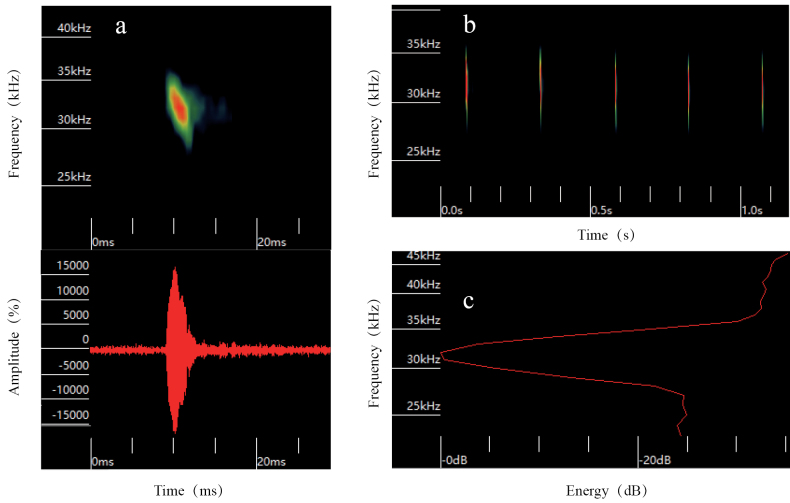
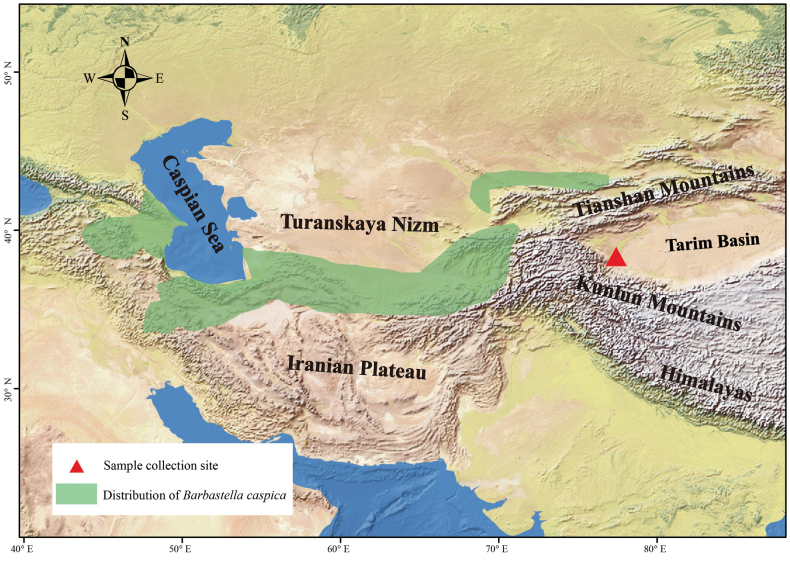
The Caspian barbastelle, Barbastellacaspica, has spread widely in the Caspian region, Iran, and Central Asia; however, there is no evidence of its occurrence in China so far. During a field investigation, we collected a single specimen of B.caspica in China's Xinjiang Uyghur Autonomous Region. At the same time, we obtained the free-flight echolocation calls of the bat. It omitted signals with start frequency of 33.15 ± 1.43 kHz, end frequency of 29.82 ± 0.40 kHz, frequency of most energy 31.48 ± 0.40 kHz, duration of 2.43 ± 0.24 ms, and a pulse interval of 246.57 ± 9.48 ms, which are probably type-I sounds emitted through the mouth. We also sequenced its entire mitochondrial genome to elucidate the genomic structure and its evolutionary relationships with closely related Barbastella. The mitochondrial genome of B.caspica spans 16,933 bp, comprising 13 protein-encoding genes, 22 transfer RNA genes, two ribosomal RNA genes, and a displacement loop/control region. Consistent with previous bat mitogenome reports, the majority of mitochondrial genes are encoded on the heavy chain. A phylogenetic analysis based on 13 protein-coding genes revealed that Rhogeessa, Plecotus, and B.caspica formed a clade within Vespertilionidae. Barbastellacaspica was found to be a sister species to B.beijingensis and B.leucomelas in phylogenetic trees using the cytochrome b and ND1 gene sequences. This is the first report of the mitogenome of a member of the genus Barbastella, as well as the first record of the distribution of B.caspica in China and first documentation of its echolocation calls.
期刊介绍:
ZooKeys is a peer-reviewed, open-access, online and print, rapidly produced journal launched to support free exchange of ideas and information in systematic zoology, phylogeny and biogeography.
All papers can be freely copied, downloaded, printed and distributed at no charge. Authors and readers are thus encouraged to post the pdf files of published papers on homepages or elsewhere to expedite distribution. There is no charge for color.





 京公网安备 11010802042870号
京ICP备2023020795号-1
京公网安备 11010802042870号
京ICP备2023020795号-1

 分享
分享
 求助内容:
求助内容: 应助结果提醒方式:
 扫码关注我们
