Muhammad Badarnee, Zhenfu Wen, Mira Z Hammoud, Paul Glimcher, Christopher K Cain, Mohammed R Milad
{"title":"Intersect between brain mechanisms of conditioned threat, active avoidance, and reward.","authors":"Muhammad Badarnee, Zhenfu Wen, Mira Z Hammoud, Paul Glimcher, Christopher K Cain, Mohammed R Milad","doi":"10.1038/s44271-025-00197-7","DOIUrl":null,"url":null,"abstract":"<p><p>Active avoidance is a core behavior for human coping, and its excess is common across psychiatric diseases. The decision to actively avoid a threat is influenced by cost and reward. Yet, threat, avoidance, and reward have been studied in silos. We discuss behavioral and brain circuits of active avoidance and the interactions with fear and threat. In addition, we present a neural toggle switch model enabling fear-to-anxiety transition and approaching reward vs. avoiding harm decision. To fully comprehend how threat, active avoidance, and reward intersect, it is paramount to develop one shared experimental approach across phenomena and behaviors, which will ultimately allow us to better understand human behavior and pathology.</p>","PeriodicalId":501698,"journal":{"name":"Communications Psychology","volume":"3 1","pages":"32"},"PeriodicalIF":0.0000,"publicationDate":"2025-02-26","publicationTypes":"Journal Article","fieldsOfStudy":null,"isOpenAccess":false,"openAccessPdf":"https://www.ncbi.nlm.nih.gov/pmc/articles/PMC11864974/pdf/","citationCount":"0","resultStr":null,"platform":"Semanticscholar","paperid":null,"PeriodicalName":"Communications Psychology","FirstCategoryId":"1085","ListUrlMain":"https://doi.org/10.1038/s44271-025-00197-7","RegionNum":0,"RegionCategory":null,"ArticlePicture":[],"TitleCN":null,"AbstractTextCN":null,"PMCID":null,"EPubDate":"","PubModel":"","JCR":"","JCRName":"","Score":null,"Total":0}
引用次数: 0
Abstract
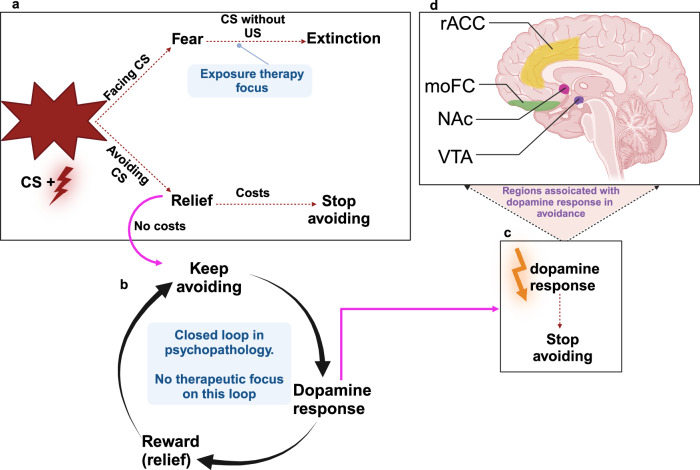
Active avoidance is a core behavior for human coping, and its excess is common across psychiatric diseases. The decision to actively avoid a threat is influenced by cost and reward. Yet, threat, avoidance, and reward have been studied in silos. We discuss behavioral and brain circuits of active avoidance and the interactions with fear and threat. In addition, we present a neural toggle switch model enabling fear-to-anxiety transition and approaching reward vs. avoiding harm decision. To fully comprehend how threat, active avoidance, and reward intersect, it is paramount to develop one shared experimental approach across phenomena and behaviors, which will ultimately allow us to better understand human behavior and pathology.






 京公网安备 11010802042870号
京ICP备2023020795号-1
京公网安备 11010802042870号
京ICP备2023020795号-1

 分享
分享

 求助内容:
求助内容: 应助结果提醒方式:
 扫码关注我们
