Choong Yeon Kim, Juhyun Lee, Eun Young Jeong, Yeji Jang, Heesoo Kim, Bohyung Choi, Donggi Han, Youngjun Oh, Jae-Woong Jeong
{"title":"Wireless Technologies for Wearable Electronics: A Review","authors":"Choong Yeon Kim, Juhyun Lee, Eun Young Jeong, Yeji Jang, Heesoo Kim, Bohyung Choi, Donggi Han, Youngjun Oh, Jae-Woong Jeong","doi":"10.1002/aelm.202400884","DOIUrl":null,"url":null,"abstract":"<p>Wireless technologies have profoundly transformed wearable electronics, advancing them from early, wired designs to untethered devices that seamlessly integrate into daily life. The adoption of wireless solutions has unlocked new possibilities, allowing for real-time remote monitoring, enhanced comfort, and greater versatility across diverse settings. These advancements expand the applications of wearable electronics from activity tracking and health monitoring to rehabilitation, human–machine interfaces, and immersive virtual and augmented reality. However, the shift to wireless wearable electronics introduces unique challenges. Unlike traditional tethered systems, wireless wearable electronics must carefully balance power efficiency, communication stability, and user convenience without relying on wired connections. This review examines the recent advancements and challenges in implementing wireless wearable electronics, with a focus on wireless communication and power solutions. It begins by discussing key design considerations for achieving reliable wireless functionality in wearable electronics. Subsequently, it explores wireless communication technologies, ranging from short-range protocols to long-range networks, as well as powering methods, including integrated power sources and energy harvesting technologies. Their diverse applications, particularly in healthcare and interactive systems, are also discussed. Finally, the review highlights major challenges and outlines potential future directions to drive the development of the next generation of wireless wearable electronics.</p>","PeriodicalId":110,"journal":{"name":"Advanced Electronic Materials","volume":"11 10","pages":""},"PeriodicalIF":5.3000,"publicationDate":"2025-02-26","publicationTypes":"Journal Article","fieldsOfStudy":null,"isOpenAccess":false,"openAccessPdf":"https://onlinelibrary.wiley.com/doi/epdf/10.1002/aelm.202400884","citationCount":"0","resultStr":null,"platform":"Semanticscholar","paperid":null,"PeriodicalName":"Advanced Electronic Materials","FirstCategoryId":"88","ListUrlMain":"https://advanced.onlinelibrary.wiley.com/doi/10.1002/aelm.202400884","RegionNum":2,"RegionCategory":"材料科学","ArticlePicture":[],"TitleCN":null,"AbstractTextCN":null,"PMCID":null,"EPubDate":"","PubModel":"","JCR":"Q2","JCRName":"MATERIALS SCIENCE, MULTIDISCIPLINARY","Score":null,"Total":0}
引用次数: 0
Abstract
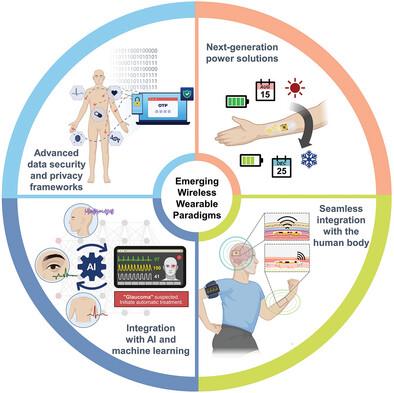
Wireless technologies have profoundly transformed wearable electronics, advancing them from early, wired designs to untethered devices that seamlessly integrate into daily life. The adoption of wireless solutions has unlocked new possibilities, allowing for real-time remote monitoring, enhanced comfort, and greater versatility across diverse settings. These advancements expand the applications of wearable electronics from activity tracking and health monitoring to rehabilitation, human–machine interfaces, and immersive virtual and augmented reality. However, the shift to wireless wearable electronics introduces unique challenges. Unlike traditional tethered systems, wireless wearable electronics must carefully balance power efficiency, communication stability, and user convenience without relying on wired connections. This review examines the recent advancements and challenges in implementing wireless wearable electronics, with a focus on wireless communication and power solutions. It begins by discussing key design considerations for achieving reliable wireless functionality in wearable electronics. Subsequently, it explores wireless communication technologies, ranging from short-range protocols to long-range networks, as well as powering methods, including integrated power sources and energy harvesting technologies. Their diverse applications, particularly in healthcare and interactive systems, are also discussed. Finally, the review highlights major challenges and outlines potential future directions to drive the development of the next generation of wireless wearable electronics.
期刊介绍:
Advanced Electronic Materials is an interdisciplinary forum for peer-reviewed, high-quality, high-impact research in the fields of materials science, physics, and engineering of electronic and magnetic materials. It includes research on physics and physical properties of electronic and magnetic materials, spintronics, electronics, device physics and engineering, micro- and nano-electromechanical systems, and organic electronics, in addition to fundamental research.







 京公网安备 11010802042870号
京ICP备2023020795号-1
京公网安备 11010802042870号
京ICP备2023020795号-1

 分享
分享
 求助内容:
求助内容: 应助结果提醒方式:
 扫码关注我们
