Han Chen , Tao Lin , Yuchen Wang , Feiyu Lu , Yiling Shi , Junding Yin
{"title":"Advanced oxidation process with hydrogen peroxide and sulfite for superfast degradation of micro-contaminants in drinking water","authors":"Han Chen , Tao Lin , Yuchen Wang , Feiyu Lu , Yiling Shi , Junding Yin","doi":"10.1016/j.jhazmat.2025.137790","DOIUrl":null,"url":null,"abstract":"<div><div>Sulfite (S(IV))-based advanced oxidation processes (AOPs) have recently gained attention as viable alternatives to peroxosulfate-based AOPs due to their low toxicity and cost-effectiveness. Hydrogen peroxide (H<sub>2</sub>O<sub>2</sub>) is widely recognized as an effective and environmentally friendly oxidant in drinking water treatment. This study introduces a novel H<sub>2</sub>O<sub>2</sub>/S(IV) AOP based on the observation of over-stoichiometric consumption of S(IV) by H<sub>2</sub>O<sub>2</sub>. This system generates a variety of reactive species (RSs), including sulfate radicals (SO<sub>4</sub><sup>•-</sup>), hydroxyl radicals (•OH), superoxide anion radicals (O<sub>2</sub><sup>•–</sup>), and singlet oxygen (<sup>1</sup>O<sub>2</sub>), to achieve rapid degradation of micro-contaminants in drinking water. With dosages of H<sub>2</sub>O<sub>2</sub> and S(IV) set at 0.1 mM and 1.0 mM, respectively, the H<sub>2</sub>O<sub>2</sub>/S(IV) system generated concentrations of SO<sub>4</sub><sup>•-</sup>, •OH, O<sub>2</sub><sup>•–</sup> and <sup>1</sup>O<sub>2</sub> at approximately 10<sup>−12</sup>, 10<sup>−12</sup>, 10<sup>−13</sup>, and 10<sup>−13</sup> M. This occurred even in complex water matrices containing bicarbonate (HCO<sub>3</sub><sup>-</sup>), chloride (Cl<sup>-</sup>), and humic acid (HA) across a pH range of 3.0–11.0. A kinetic model was developed to simulate RS generation and predict the pseudo-first-order degradation rate constants (<em>k</em>) for 15 micro-contaminants in the H<sub>2</sub>O<sub>2</sub>/S(IV) system. Theoretical calculations indicated that micro-contaminants with high E<sub>HOMO</sub> and low ΔE (i.e., E<sub>LUMO</sub> - E<sub>HOMO</sub>) are more susceptible to degradation. Compared to UV/H<sub>2</sub>O<sub>2</sub>, UV/S(IV), Fe<sup>2+</sup>/H<sub>2</sub>O<sub>2</sub>, and Fe<sup>3+</sup>/S(IV) systems, the H<sub>2</sub>O<sub>2</sub>/S(IV) system demonstrated faster degradation rates, with <em>k</em> values 1–2 orders of magnitude higher, towards micro-contaminants. Additionally, the H<sub>2</sub>O<sub>2</sub>/S(IV) system was more effective in controlling disinfection by-product formation during subsequent chlorination, highlighting the application potential of the H<sub>2</sub>O<sub>2</sub>/S(IV) system in drinking water treatment.</div></div>","PeriodicalId":361,"journal":{"name":"Journal of Hazardous Materials","volume":"490 ","pages":"Article 137790"},"PeriodicalIF":11.3000,"publicationDate":"2025-06-15","publicationTypes":"Journal Article","fieldsOfStudy":null,"isOpenAccess":false,"openAccessPdf":"","citationCount":"0","resultStr":null,"platform":"Semanticscholar","paperid":null,"PeriodicalName":"Journal of Hazardous Materials","FirstCategoryId":"93","ListUrlMain":"https://www.sciencedirect.com/science/article/pii/S0304389425007046","RegionNum":1,"RegionCategory":"环境科学与生态学","ArticlePicture":[],"TitleCN":null,"AbstractTextCN":null,"PMCID":null,"EPubDate":"2025/2/28 0:00:00","PubModel":"Epub","JCR":"Q1","JCRName":"ENGINEERING, ENVIRONMENTAL","Score":null,"Total":0}
引用次数: 0
Abstract
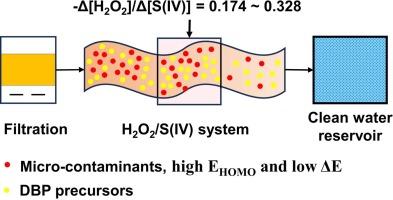
Sulfite (S(IV))-based advanced oxidation processes (AOPs) have recently gained attention as viable alternatives to peroxosulfate-based AOPs due to their low toxicity and cost-effectiveness. Hydrogen peroxide (H2O2) is widely recognized as an effective and environmentally friendly oxidant in drinking water treatment. This study introduces a novel H2O2/S(IV) AOP based on the observation of over-stoichiometric consumption of S(IV) by H2O2. This system generates a variety of reactive species (RSs), including sulfate radicals (SO4•-), hydroxyl radicals (•OH), superoxide anion radicals (O2•–), and singlet oxygen (1O2), to achieve rapid degradation of micro-contaminants in drinking water. With dosages of H2O2 and S(IV) set at 0.1 mM and 1.0 mM, respectively, the H2O2/S(IV) system generated concentrations of SO4•-, •OH, O2•– and 1O2 at approximately 10−12, 10−12, 10−13, and 10−13 M. This occurred even in complex water matrices containing bicarbonate (HCO3-), chloride (Cl-), and humic acid (HA) across a pH range of 3.0–11.0. A kinetic model was developed to simulate RS generation and predict the pseudo-first-order degradation rate constants (k) for 15 micro-contaminants in the H2O2/S(IV) system. Theoretical calculations indicated that micro-contaminants with high EHOMO and low ΔE (i.e., ELUMO - EHOMO) are more susceptible to degradation. Compared to UV/H2O2, UV/S(IV), Fe2+/H2O2, and Fe3+/S(IV) systems, the H2O2/S(IV) system demonstrated faster degradation rates, with k values 1–2 orders of magnitude higher, towards micro-contaminants. Additionally, the H2O2/S(IV) system was more effective in controlling disinfection by-product formation during subsequent chlorination, highlighting the application potential of the H2O2/S(IV) system in drinking water treatment.
期刊介绍:
The Journal of Hazardous Materials serves as a global platform for promoting cutting-edge research in the field of Environmental Science and Engineering. Our publication features a wide range of articles, including full-length research papers, review articles, and perspectives, with the aim of enhancing our understanding of the dangers and risks associated with various materials concerning public health and the environment. It is important to note that the term "environmental contaminants" refers specifically to substances that pose hazardous effects through contamination, while excluding those that do not have such impacts on the environment or human health. Moreover, we emphasize the distinction between wastes and hazardous materials in order to provide further clarity on the scope of the journal. We have a keen interest in exploring specific compounds and microbial agents that have adverse effects on the environment.



 京公网安备 11010802042870号
京ICP备2023020795号-1
京公网安备 11010802042870号
京ICP备2023020795号-1

 分享
分享
 求助内容:
求助内容: 应助结果提醒方式:
 扫码关注我们
