Junjun Xiong, Xuhui Ge, Dishui Pan, Yufeng Zhu, Yitong Zhou, Yu Gao, Haofan Wang, Xiaokun Wang, Yao Gu, Wu Ye, Honglin Teng, Xuhui Zhou, Zheng Wang, Wei Liu, Weihua Cai
{"title":"Metabolic reprogramming in astrocytes prevents neuronal death through a UCHL1/PFKFB3/H4K8la positive feedback loop","authors":"Junjun Xiong, Xuhui Ge, Dishui Pan, Yufeng Zhu, Yitong Zhou, Yu Gao, Haofan Wang, Xiaokun Wang, Yao Gu, Wu Ye, Honglin Teng, Xuhui Zhou, Zheng Wang, Wei Liu, Weihua Cai","doi":"10.1038/s41418-025-01467-x","DOIUrl":null,"url":null,"abstract":"Astrocytic metabolic reprogramming is an adaptation of metabolic patterns to meet increased energy demands, although the role after spinal cord injury (SCI) remains unclear. Analysis of single-cell RNA sequencing (scRNA-seq) data identified an increase in astrocytic glycolysis, while PFKFB3, a key regulator of glycolytic flux, was significantly upregulated following SCI. Loss of PFKFB3 in astrocytes prohibited neuronal energy supply and enhanced neuronal ferroptosis in vitro and expanded infiltration of CD68+ macrophages/microglia, exacerbated neuronal loss, and hindered functional recovery in vivo after SCI. Mechanistically, deubiquitinase UCHL1 plays a crucial role in stabilizing and enhancing PFKFB3 expression by cleaving K48-linked ubiquitin chains. Genetic deletion of Uchl1 inhibited locomotor recovery after SCI by suppression of PFKFB3-induced glycolytic reprogramming in astrocytes. Furthermore, the UCHL1/PFKFB3 axis increased lactate production, leading to enhanced histone lactylation and subsequent transcription of Uchl1 and several genes related to glycolysis, suggesting a glycolysis/H4K8la/UCHL1 positive feedback loop. These findings help to clarify the role of the UCHL1/PFKFB3/H4K8la loop in modulation of astrocytic metabolic reprogramming and reveal a potential target for treatment of SCI.","PeriodicalId":9731,"journal":{"name":"Cell Death and Differentiation","volume":"32 7","pages":"1214-1230"},"PeriodicalIF":13.6000,"publicationDate":"2025-02-27","publicationTypes":"Journal Article","fieldsOfStudy":null,"isOpenAccess":false,"openAccessPdf":"","citationCount":"0","resultStr":null,"platform":"Semanticscholar","paperid":null,"PeriodicalName":"Cell Death and Differentiation","FirstCategoryId":"99","ListUrlMain":"https://www.nature.com/articles/s41418-025-01467-x","RegionNum":1,"RegionCategory":"生物学","ArticlePicture":[],"TitleCN":null,"AbstractTextCN":null,"PMCID":null,"EPubDate":"","PubModel":"","JCR":"Q1","JCRName":"BIOCHEMISTRY & MOLECULAR BIOLOGY","Score":null,"Total":0}
引用次数: 0
Abstract
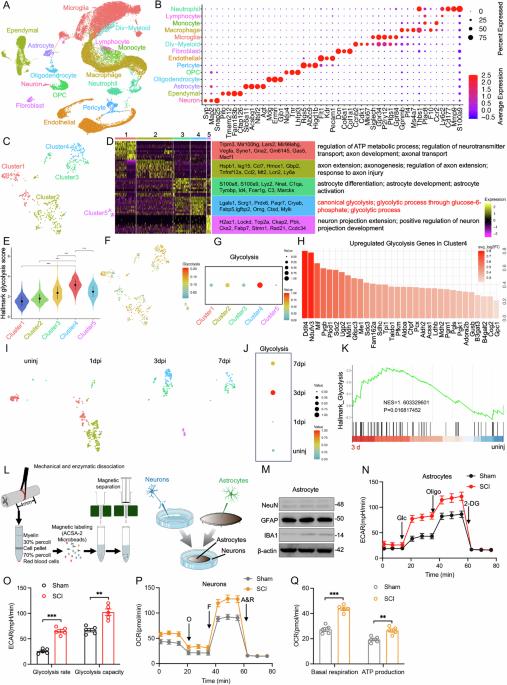
Astrocytic metabolic reprogramming is an adaptation of metabolic patterns to meet increased energy demands, although the role after spinal cord injury (SCI) remains unclear. Analysis of single-cell RNA sequencing (scRNA-seq) data identified an increase in astrocytic glycolysis, while PFKFB3, a key regulator of glycolytic flux, was significantly upregulated following SCI. Loss of PFKFB3 in astrocytes prohibited neuronal energy supply and enhanced neuronal ferroptosis in vitro and expanded infiltration of CD68+ macrophages/microglia, exacerbated neuronal loss, and hindered functional recovery in vivo after SCI. Mechanistically, deubiquitinase UCHL1 plays a crucial role in stabilizing and enhancing PFKFB3 expression by cleaving K48-linked ubiquitin chains. Genetic deletion of Uchl1 inhibited locomotor recovery after SCI by suppression of PFKFB3-induced glycolytic reprogramming in astrocytes. Furthermore, the UCHL1/PFKFB3 axis increased lactate production, leading to enhanced histone lactylation and subsequent transcription of Uchl1 and several genes related to glycolysis, suggesting a glycolysis/H4K8la/UCHL1 positive feedback loop. These findings help to clarify the role of the UCHL1/PFKFB3/H4K8la loop in modulation of astrocytic metabolic reprogramming and reveal a potential target for treatment of SCI.
期刊介绍:
Mission, vision and values of Cell Death & Differentiation:
To devote itself to scientific excellence in the field of cell biology, molecular biology, and biochemistry of cell death and disease.
To provide a unified forum for scientists and clinical researchers
It is committed to the rapid publication of high quality original papers relating to these subjects, together with topical, usually solicited, reviews, meeting reports, editorial correspondence and occasional commentaries on controversial and scientifically informative issues.




 京公网安备 11010802042870号
京ICP备2023020795号-1
京公网安备 11010802042870号
京ICP备2023020795号-1

 分享
分享
 求助内容:
求助内容: 应助结果提醒方式:
 扫码关注我们
