Adriana M. Mujal, Mark Owyong, Endi K. Santosa, John C. Sauter, Simon Grassmann, Anna-Marie Pedde, Philippa Meiser, Claire K. Wingert, Marine Pujol, Veit R. Buchholz, Colleen M. Lau, Jan P. Böttcher, Joseph C. Sun
{"title":"Splenic TNF-α signaling potentiates the innate-to-adaptive transition of antiviral NK cells","authors":"Adriana M. Mujal, Mark Owyong, Endi K. Santosa, John C. Sauter, Simon Grassmann, Anna-Marie Pedde, Philippa Meiser, Claire K. Wingert, Marine Pujol, Veit R. Buchholz, Colleen M. Lau, Jan P. Böttcher, Joseph C. Sun","doi":"10.1016/j.immuni.2025.02.012","DOIUrl":null,"url":null,"abstract":"Natural killer (NK) cells possess both innate and adaptive features. Here, we investigated NK cell activation across tissues during cytomegalovirus infection, which generates antigen-specific clonal expansion and long-lived memory responses. Longitudinal tracking and single-cell RNA sequencing of NK cells following infection revealed enhanced activation in the spleen, as well as early formation of a CD69<sup>lo</sup> precursor population that preferentially gave rise to adaptive NK cells. Splenic NK cells demonstrated heightened tumor necrosis factor alpha (TNF-α) signaling and increased expression of the receptor TNFR2, which coincided with elevated TNF-α production by splenic myeloid cells. TNFR2-deficient NK cells exhibited impaired interferon gamma (IFN-γ) production and expansion. TNFR2 signaling engaged two distinct nuclear factor κB (NF-κB) signaling arms—innate effector NK cell responses required canonical NF-κB signaling, whereas non-canonical NF-κB signaling enforced differentiation of CD69<sup>lo</sup> adaptive NK cell precursors. Thus, NK cell priming in the spleen during viral infection promotes an innate-to-adaptive transition, providing insight into avenues for generating adaptive NK cell immunity across diverse settings.","PeriodicalId":13269,"journal":{"name":"Immunity","volume":"28 1","pages":""},"PeriodicalIF":26.3000,"publicationDate":"2025-02-28","publicationTypes":"Journal Article","fieldsOfStudy":null,"isOpenAccess":false,"openAccessPdf":"","citationCount":"0","resultStr":null,"platform":"Semanticscholar","paperid":null,"PeriodicalName":"Immunity","FirstCategoryId":"3","ListUrlMain":"https://doi.org/10.1016/j.immuni.2025.02.012","RegionNum":1,"RegionCategory":"医学","ArticlePicture":[],"TitleCN":null,"AbstractTextCN":null,"PMCID":null,"EPubDate":"","PubModel":"","JCR":"Q1","JCRName":"IMMUNOLOGY","Score":null,"Total":0}
引用次数: 0
Abstract
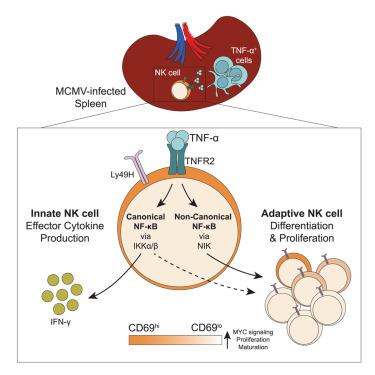
Natural killer (NK) cells possess both innate and adaptive features. Here, we investigated NK cell activation across tissues during cytomegalovirus infection, which generates antigen-specific clonal expansion and long-lived memory responses. Longitudinal tracking and single-cell RNA sequencing of NK cells following infection revealed enhanced activation in the spleen, as well as early formation of a CD69lo precursor population that preferentially gave rise to adaptive NK cells. Splenic NK cells demonstrated heightened tumor necrosis factor alpha (TNF-α) signaling and increased expression of the receptor TNFR2, which coincided with elevated TNF-α production by splenic myeloid cells. TNFR2-deficient NK cells exhibited impaired interferon gamma (IFN-γ) production and expansion. TNFR2 signaling engaged two distinct nuclear factor κB (NF-κB) signaling arms—innate effector NK cell responses required canonical NF-κB signaling, whereas non-canonical NF-κB signaling enforced differentiation of CD69lo adaptive NK cell precursors. Thus, NK cell priming in the spleen during viral infection promotes an innate-to-adaptive transition, providing insight into avenues for generating adaptive NK cell immunity across diverse settings.
期刊介绍:
Immunity is a publication that focuses on publishing significant advancements in research related to immunology. We encourage the submission of studies that offer groundbreaking immunological discoveries, whether at the molecular, cellular, or whole organism level. Topics of interest encompass a wide range, such as cancer, infectious diseases, neuroimmunology, autoimmune diseases, allergies, mucosal immunity, metabolic diseases, and homeostasis.



 京公网安备 11010802042870号
京ICP备2023020795号-1
京公网安备 11010802042870号
京ICP备2023020795号-1

 分享
分享
 求助内容:
求助内容: 应助结果提醒方式:
 扫码关注我们
