Virginia Echavarri-Bravo, Isolde Marsland, Mai-Britt V. Jensen, Caroline Kirk, Louise E. Horsfall
{"title":"Characterization and Reuse of Lithium-ion Battery Cathode Material Recovered Through a Bacterial Process","authors":"Virginia Echavarri-Bravo, Isolde Marsland, Mai-Britt V. Jensen, Caroline Kirk, Louise E. Horsfall","doi":"10.1002/aenm.202405901","DOIUrl":null,"url":null,"abstract":"<p>Recycling lithium-ion batteries (LIBs) is imperative for securing the future demand for raw materials required for the electrification of economies worldwide. The technical challenges of recycling at a large scale involve minimizing the value loss of materials, addressing the complexity of standardization, and reducing environmental impacts. This research aims to support the development of more sustainable LIB recycling methods by utilizing bacterial biological reactions to recover manganese from spent LIBs, aligned with the principles of green chemistry. The present study describes an optimized bioseparation method to recover manganese from spent LIBs (lithium manganese oxide - LMO/ lithium nickel manganese cobalt oxide - NMC) as manganese carbonate (MnCO<sub>3</sub>) with a uniform, spherical morphology, using an engineered strain of <i>S. oneidensis</i> MR-1. Calcination of this bio-precipitate facilitated the transformation of the biorecovered manganese species into a sodium-manganese-phosphate “fillowite-type” phase (Na<sub>8.71</sub>Mn<sub>22</sub>(PO<sub>4</sub>)<sub>18</sub>)–a previously reported electrode material. Preliminary electrochemistry measurements revealed both faradaic and capacitive behavior, as well as exhibiting excellent material stability over 40 cycles. The calcination therefore demonstrates a simple electrode synthesis method from the biorecovered manganese and highlights a potential advantage over chemically synthesized alternatives.</p>","PeriodicalId":111,"journal":{"name":"Advanced Energy Materials","volume":"15 46","pages":""},"PeriodicalIF":26.0000,"publicationDate":"2025-02-28","publicationTypes":"Journal Article","fieldsOfStudy":null,"isOpenAccess":false,"openAccessPdf":"https://advanced.onlinelibrary.wiley.com/doi/epdf/10.1002/aenm.202405901","citationCount":"0","resultStr":null,"platform":"Semanticscholar","paperid":null,"PeriodicalName":"Advanced Energy Materials","FirstCategoryId":"88","ListUrlMain":"https://advanced.onlinelibrary.wiley.com/doi/10.1002/aenm.202405901","RegionNum":1,"RegionCategory":"材料科学","ArticlePicture":[],"TitleCN":null,"AbstractTextCN":null,"PMCID":null,"EPubDate":"","PubModel":"","JCR":"Q1","JCRName":"CHEMISTRY, PHYSICAL","Score":null,"Total":0}
引用次数: 0
Abstract
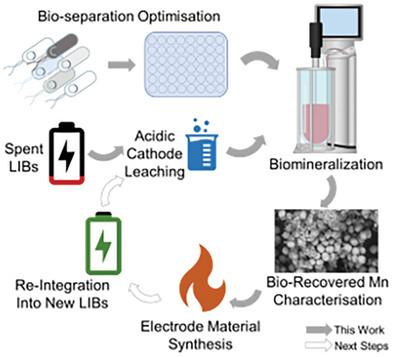
Recycling lithium-ion batteries (LIBs) is imperative for securing the future demand for raw materials required for the electrification of economies worldwide. The technical challenges of recycling at a large scale involve minimizing the value loss of materials, addressing the complexity of standardization, and reducing environmental impacts. This research aims to support the development of more sustainable LIB recycling methods by utilizing bacterial biological reactions to recover manganese from spent LIBs, aligned with the principles of green chemistry. The present study describes an optimized bioseparation method to recover manganese from spent LIBs (lithium manganese oxide - LMO/ lithium nickel manganese cobalt oxide - NMC) as manganese carbonate (MnCO3) with a uniform, spherical morphology, using an engineered strain of S. oneidensis MR-1. Calcination of this bio-precipitate facilitated the transformation of the biorecovered manganese species into a sodium-manganese-phosphate “fillowite-type” phase (Na8.71Mn22(PO4)18)–a previously reported electrode material. Preliminary electrochemistry measurements revealed both faradaic and capacitive behavior, as well as exhibiting excellent material stability over 40 cycles. The calcination therefore demonstrates a simple electrode synthesis method from the biorecovered manganese and highlights a potential advantage over chemically synthesized alternatives.
期刊介绍:
Established in 2011, Advanced Energy Materials is an international, interdisciplinary, English-language journal that focuses on materials used in energy harvesting, conversion, and storage. It is regarded as a top-quality journal alongside Advanced Materials, Advanced Functional Materials, and Small.
With a 2022 Impact Factor of 27.8, Advanced Energy Materials is considered a prime source for the best energy-related research. The journal covers a wide range of topics in energy-related research, including organic and inorganic photovoltaics, batteries and supercapacitors, fuel cells, hydrogen generation and storage, thermoelectrics, water splitting and photocatalysis, solar fuels and thermosolar power, magnetocalorics, and piezoelectronics.
The readership of Advanced Energy Materials includes materials scientists, chemists, physicists, and engineers in both academia and industry. The journal is indexed in various databases and collections, such as Advanced Technologies & Aerospace Database, FIZ Karlsruhe, INSPEC (IET), Science Citation Index Expanded, Technology Collection, and Web of Science, among others.





 京公网安备 11010802042870号
京ICP备2023020795号-1
京公网安备 11010802042870号
京ICP备2023020795号-1

 分享
分享
 求助内容:
求助内容: 应助结果提醒方式:
 扫码关注我们
