Xabier Rodríguez-Martínez, Constantin Tormann, Marta Sanz-Lleó, Bernhard Dörling, Martí Gibert-Roca, Albert Harillo-Baños, Alfonsina Abat Amelenan Torimtubun, Enrique Pascual-San-José, José P. Jurado, Laura López-Mir, Martijn Kemerink, Mariano Campoy-Quiles
{"title":"What Makes Thickness-Tolerant Organic Solar Cells?","authors":"Xabier Rodríguez-Martínez, Constantin Tormann, Marta Sanz-Lleó, Bernhard Dörling, Martí Gibert-Roca, Albert Harillo-Baños, Alfonsina Abat Amelenan Torimtubun, Enrique Pascual-San-José, José P. Jurado, Laura López-Mir, Martijn Kemerink, Mariano Campoy-Quiles","doi":"10.1002/aenm.202405735","DOIUrl":null,"url":null,"abstract":"<p>Relatively thick-film organic photovoltaics (OPVs) are desirable to spark commercialization through mass-printing methods. Thickness-resilient donor:acceptor blends are, however, scarce and not fully understood. The interplay between electronic, optical, and microstructural properties of the photoactive layer (PAL) generates a multi-parametric space where rationalization is far from trivial. In this work, high-throughput experimentation, simulations, and machine learning (ML) methods are leveraged to provide material and device insights toward thickness-resilient OPVs. From a database of 720 inverted devices and 20 different donor:acceptor blends, two main blend families are identified in terms of their resilience against increased PAL thickness (>200 nm). These are archetypically represented by PBDB-T:ITIC (thickness-sensitive) and PTQ10:Y6 (thickness-resilient). Kinetic Monte Carlo (kMC) simulations elucidate that the blend morphology alone, either in the form of an effective medium or energy cascade, can explain the experimental short-circuit current density and open-circuit voltage trends without tweaking the recombination parameters (cf. drift-diffusion, DD). High fill factors (FFs) in thick-film devices cannot, however, be reproduced by the kMC or DD simulations. ML models show that complementary absorbing donors and acceptors (shifted absorption onsets) mixed in balanced weight ratios provide a favorable hole back-transfer efficiency to increase the FF in thick-film devices.</p>","PeriodicalId":111,"journal":{"name":"Advanced Energy Materials","volume":"16 3","pages":""},"PeriodicalIF":26.0000,"publicationDate":"2025-02-28","publicationTypes":"Journal Article","fieldsOfStudy":null,"isOpenAccess":false,"openAccessPdf":"","citationCount":"0","resultStr":null,"platform":"Semanticscholar","paperid":null,"PeriodicalName":"Advanced Energy Materials","FirstCategoryId":"88","ListUrlMain":"https://advanced.onlinelibrary.wiley.com/doi/10.1002/aenm.202405735","RegionNum":1,"RegionCategory":"材料科学","ArticlePicture":[],"TitleCN":null,"AbstractTextCN":null,"PMCID":null,"EPubDate":"","PubModel":"","JCR":"Q1","JCRName":"CHEMISTRY, PHYSICAL","Score":null,"Total":0}
引用次数: 0
Abstract
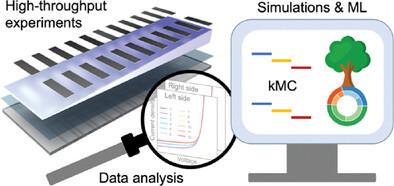
Relatively thick-film organic photovoltaics (OPVs) are desirable to spark commercialization through mass-printing methods. Thickness-resilient donor:acceptor blends are, however, scarce and not fully understood. The interplay between electronic, optical, and microstructural properties of the photoactive layer (PAL) generates a multi-parametric space where rationalization is far from trivial. In this work, high-throughput experimentation, simulations, and machine learning (ML) methods are leveraged to provide material and device insights toward thickness-resilient OPVs. From a database of 720 inverted devices and 20 different donor:acceptor blends, two main blend families are identified in terms of their resilience against increased PAL thickness (>200 nm). These are archetypically represented by PBDB-T:ITIC (thickness-sensitive) and PTQ10:Y6 (thickness-resilient). Kinetic Monte Carlo (kMC) simulations elucidate that the blend morphology alone, either in the form of an effective medium or energy cascade, can explain the experimental short-circuit current density and open-circuit voltage trends without tweaking the recombination parameters (cf. drift-diffusion, DD). High fill factors (FFs) in thick-film devices cannot, however, be reproduced by the kMC or DD simulations. ML models show that complementary absorbing donors and acceptors (shifted absorption onsets) mixed in balanced weight ratios provide a favorable hole back-transfer efficiency to increase the FF in thick-film devices.
期刊介绍:
Established in 2011, Advanced Energy Materials is an international, interdisciplinary, English-language journal that focuses on materials used in energy harvesting, conversion, and storage. It is regarded as a top-quality journal alongside Advanced Materials, Advanced Functional Materials, and Small.
With a 2022 Impact Factor of 27.8, Advanced Energy Materials is considered a prime source for the best energy-related research. The journal covers a wide range of topics in energy-related research, including organic and inorganic photovoltaics, batteries and supercapacitors, fuel cells, hydrogen generation and storage, thermoelectrics, water splitting and photocatalysis, solar fuels and thermosolar power, magnetocalorics, and piezoelectronics.
The readership of Advanced Energy Materials includes materials scientists, chemists, physicists, and engineers in both academia and industry. The journal is indexed in various databases and collections, such as Advanced Technologies & Aerospace Database, FIZ Karlsruhe, INSPEC (IET), Science Citation Index Expanded, Technology Collection, and Web of Science, among others.



 京公网安备 11010802042870号
京ICP备2023020795号-1
京公网安备 11010802042870号
京ICP备2023020795号-1

 分享
分享
 求助内容:
求助内容: 应助结果提醒方式:
 扫码关注我们
