Jason S. Terreblanche, Tongjun Luo, Louis F. J. Piper, Wesley M. Dose
{"title":"Degradation Pathways in Lithium-Ion Batteries with Ethylene Carbonate-Free Electrolytes","authors":"Jason S. Terreblanche, Tongjun Luo, Louis F. J. Piper, Wesley M. Dose","doi":"10.1002/aenm.202404427","DOIUrl":null,"url":null,"abstract":"<p>The development of stable electrolyte solutions is critical for improving the lifetime and performance of lithium-ion batteries (LIBs). Electrolyte instability is a prominent issue with many next-generation electrode materials, such as Ni-rich cathodes, with recent reports identifying ethylene carbonate (EC) as a bad actor at the cathode surface. Herein, electrochemical methods, operando pressure measurements, and post-mortem X-ray and solution NMR studies are combined to investigate electrolyte and interfacial degradation phenomena in Ni-rich LiNi<sub>0.8</sub>Mn<sub>0.1</sub>Co<sub>0.1</sub>O<sub>2</sub> (NMC811)/graphite full cells with EC-containing and EC-free electrolytes. One key finding is that the mechanism for improved performance in EC-free electrolyte–1.5 <span>M</span> LiPF<sub>6</sub> in ethyl methyl carbonate (EMC) with 10 wt.% fluoroethylene carbonate (FEC)–arises from improved stability at both electrode-electrolyte interfaces. The EC-free electrolyte is found to suppress lattice oxygen release and reduce surface layer formation at NMC, leading to improved ion transport into the cathode particles, suppressed electrolyte solvent oxidation reactions, less formation and crossover of species that disrupt the graphite solid electrolyte interphase (SEI), and ultimately improved capacity retention. These insights are helpful in understanding and mitigating degradation in LIBs with Ni-rich cathodes.</p>","PeriodicalId":111,"journal":{"name":"Advanced Energy Materials","volume":"15 22","pages":""},"PeriodicalIF":26.0000,"publicationDate":"2025-02-28","publicationTypes":"Journal Article","fieldsOfStudy":null,"isOpenAccess":false,"openAccessPdf":"https://onlinelibrary.wiley.com/doi/epdf/10.1002/aenm.202404427","citationCount":"0","resultStr":null,"platform":"Semanticscholar","paperid":null,"PeriodicalName":"Advanced Energy Materials","FirstCategoryId":"88","ListUrlMain":"https://advanced.onlinelibrary.wiley.com/doi/10.1002/aenm.202404427","RegionNum":1,"RegionCategory":"材料科学","ArticlePicture":[],"TitleCN":null,"AbstractTextCN":null,"PMCID":null,"EPubDate":"","PubModel":"","JCR":"Q1","JCRName":"CHEMISTRY, PHYSICAL","Score":null,"Total":0}
引用次数: 0
Abstract
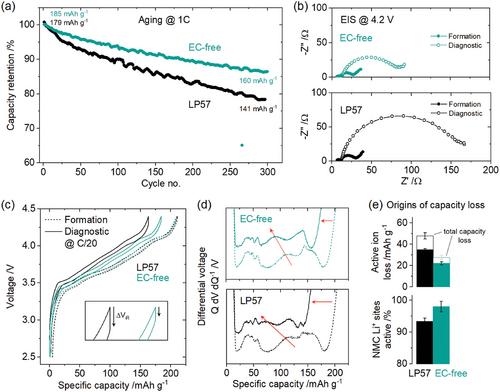
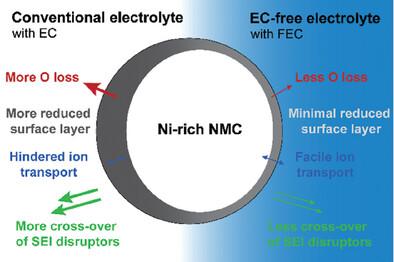
The development of stable electrolyte solutions is critical for improving the lifetime and performance of lithium-ion batteries (LIBs). Electrolyte instability is a prominent issue with many next-generation electrode materials, such as Ni-rich cathodes, with recent reports identifying ethylene carbonate (EC) as a bad actor at the cathode surface. Herein, electrochemical methods, operando pressure measurements, and post-mortem X-ray and solution NMR studies are combined to investigate electrolyte and interfacial degradation phenomena in Ni-rich LiNi0.8Mn0.1Co0.1O2 (NMC811)/graphite full cells with EC-containing and EC-free electrolytes. One key finding is that the mechanism for improved performance in EC-free electrolyte–1.5 M LiPF6 in ethyl methyl carbonate (EMC) with 10 wt.% fluoroethylene carbonate (FEC)–arises from improved stability at both electrode-electrolyte interfaces. The EC-free electrolyte is found to suppress lattice oxygen release and reduce surface layer formation at NMC, leading to improved ion transport into the cathode particles, suppressed electrolyte solvent oxidation reactions, less formation and crossover of species that disrupt the graphite solid electrolyte interphase (SEI), and ultimately improved capacity retention. These insights are helpful in understanding and mitigating degradation in LIBs with Ni-rich cathodes.
期刊介绍:
Established in 2011, Advanced Energy Materials is an international, interdisciplinary, English-language journal that focuses on materials used in energy harvesting, conversion, and storage. It is regarded as a top-quality journal alongside Advanced Materials, Advanced Functional Materials, and Small.
With a 2022 Impact Factor of 27.8, Advanced Energy Materials is considered a prime source for the best energy-related research. The journal covers a wide range of topics in energy-related research, including organic and inorganic photovoltaics, batteries and supercapacitors, fuel cells, hydrogen generation and storage, thermoelectrics, water splitting and photocatalysis, solar fuels and thermosolar power, magnetocalorics, and piezoelectronics.
The readership of Advanced Energy Materials includes materials scientists, chemists, physicists, and engineers in both academia and industry. The journal is indexed in various databases and collections, such as Advanced Technologies & Aerospace Database, FIZ Karlsruhe, INSPEC (IET), Science Citation Index Expanded, Technology Collection, and Web of Science, among others.






 京公网安备 11010802042870号
京ICP备2023020795号-1
京公网安备 11010802042870号
京ICP备2023020795号-1

 分享
分享
 求助内容:
求助内容: 应助结果提醒方式:
 扫码关注我们
