Exploring the potential of Fourier transform-infrared spectroscopy of urine for non-invasive monitoring of inflammation associated with a kidney transplant†
Elie Sarkees, Vincent Vuiblet, Fayek Taha and Olivier Piot
{"title":"Exploring the potential of Fourier transform-infrared spectroscopy of urine for non-invasive monitoring of inflammation associated with a kidney transplant†","authors":"Elie Sarkees, Vincent Vuiblet, Fayek Taha and Olivier Piot","doi":"10.1039/D4AN01459F","DOIUrl":null,"url":null,"abstract":"<p >The global rise of end-stage renal disease is leading to an increase in kidney transplants. Graft survival is dependent on the occurrence of inflammation which can lead to cases of rejection. Traditional laboratory analyses often lack accuracy, and graft biopsies – the current gold standard – are considered invasive and risky. This highlights an unmet need for innovative diagnostic and monitoring methods of graft rejection and inflammation. This study explores the potential of Fourier-transform infrared spectroscopy of fresh urine for diagnosing kidney transplant inflammation. Urine samples were collected from kidney transplant patients who were under regular surveillance. An unsupervised method of spectral data analysis, especially Uniform Manifold Approximation and Projection (UMAP), was initially employed. However, it was unable to reveal a clear distinction between control and pathological conditions. Subsequently, two machine learning models – SVM and gradient boosting – were employed to categorise participants into pathologic or control groups, achieving a diagnostic accuracy of 77.78%. This study also evaluated other factors that could affect model performance, including urine biochemical composition, type of inflammation, and patient's medication history. The inherent variability of urine, attributed to factors such as diet and medications, poses challenges to identifying robust spectroscopic markers. Nevertheless, mid-infrared spectroscopy offers a promising, non-invasive approach for diagnosing kidney transplant disorders. Further research is essential to provide more advanced prediction models and meet the criteria for potential clinical deployment.</p>","PeriodicalId":63,"journal":{"name":"Analyst","volume":" 7","pages":" 1427-1435"},"PeriodicalIF":3.3000,"publicationDate":"2025-02-27","publicationTypes":"Journal Article","fieldsOfStudy":null,"isOpenAccess":false,"openAccessPdf":"","citationCount":"0","resultStr":null,"platform":"Semanticscholar","paperid":null,"PeriodicalName":"Analyst","FirstCategoryId":"92","ListUrlMain":"https://pubs.rsc.org/en/content/articlelanding/2025/an/d4an01459f","RegionNum":3,"RegionCategory":"化学","ArticlePicture":[],"TitleCN":null,"AbstractTextCN":null,"PMCID":null,"EPubDate":"","PubModel":"","JCR":"Q2","JCRName":"CHEMISTRY, ANALYTICAL","Score":null,"Total":0}
引用次数: 0
Abstract
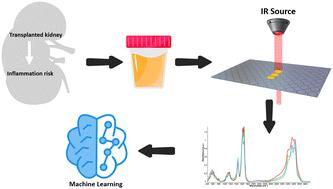
The global rise of end-stage renal disease is leading to an increase in kidney transplants. Graft survival is dependent on the occurrence of inflammation which can lead to cases of rejection. Traditional laboratory analyses often lack accuracy, and graft biopsies – the current gold standard – are considered invasive and risky. This highlights an unmet need for innovative diagnostic and monitoring methods of graft rejection and inflammation. This study explores the potential of Fourier-transform infrared spectroscopy of fresh urine for diagnosing kidney transplant inflammation. Urine samples were collected from kidney transplant patients who were under regular surveillance. An unsupervised method of spectral data analysis, especially Uniform Manifold Approximation and Projection (UMAP), was initially employed. However, it was unable to reveal a clear distinction between control and pathological conditions. Subsequently, two machine learning models – SVM and gradient boosting – were employed to categorise participants into pathologic or control groups, achieving a diagnostic accuracy of 77.78%. This study also evaluated other factors that could affect model performance, including urine biochemical composition, type of inflammation, and patient's medication history. The inherent variability of urine, attributed to factors such as diet and medications, poses challenges to identifying robust spectroscopic markers. Nevertheless, mid-infrared spectroscopy offers a promising, non-invasive approach for diagnosing kidney transplant disorders. Further research is essential to provide more advanced prediction models and meet the criteria for potential clinical deployment.



 京公网安备 11010802042870号
京ICP备2023020795号-1
京公网安备 11010802042870号
京ICP备2023020795号-1

 分享
分享
 求助内容:
求助内容: 应助结果提醒方式:
 扫码关注我们
