Strong Metal-Support Interaction to Invert Hydrogen Evolution Overpotential of Cu Coating for High-Coulombic-Efficiency Stable Zn Anode in Aqueous Zn-Ion Batteries
Sheng Chen, Kefeng Ouyang, Youfa Liu, Hongyu Qin, Mangwei Cui, Ao Liu, Yihan Wang, Kun Zhang, Yan Huang
{"title":"Strong Metal-Support Interaction to Invert Hydrogen Evolution Overpotential of Cu Coating for High-Coulombic-Efficiency Stable Zn Anode in Aqueous Zn-Ion Batteries","authors":"Sheng Chen, Kefeng Ouyang, Youfa Liu, Hongyu Qin, Mangwei Cui, Ao Liu, Yihan Wang, Kun Zhang, Yan Huang","doi":"10.1002/adma.202417775","DOIUrl":null,"url":null,"abstract":"<p>Cu exhibits strong zincophilic properties but suffers from a much lower hydrogen evolution reaction (HER) overpotential compared to Zn, which significantly undermines the coulombic efficiency and stability of the Zn anode. Consequently, Cu is regarded as an unsuitable coating for Zn anode protection. In this work, the HER overpotential of Cu versus Zn is inverted through strong metal-support interaction (SMSI) to modify the electronic structure of Cu. This interaction facilitates electron transfer, enriching positive charge and slowing down the adsorption kinetics of H<sup>+</sup> on the Cu surface. As a result, at very low current densities of 0.2 and 2 mA cm⁻<sup>2</sup>, the Cu-coated-Zn||Cu cell achieves exceptionally high coulombic efficiencies of 99.11% and 99.91% over 2500 and 1600 h of cycling (100% depth of discharge (DOD)), which remarkably surpasses the performance of Zn anode protective coatings all reported. Moreover, a 1 Ah soft-packed full battery is not bulged and retains 94.7% of its initial capacity after 150 cycles. This study overturns the conventional concept by leveraging SMSI to tune the electronic structure, reverses the HER overpotential, and expands the range of viable metals for anode protection in aqueous metal batteries.</p>","PeriodicalId":114,"journal":{"name":"Advanced Materials","volume":"37 15","pages":""},"PeriodicalIF":26.8000,"publicationDate":"2025-02-28","publicationTypes":"Journal Article","fieldsOfStudy":null,"isOpenAccess":false,"openAccessPdf":"","citationCount":"0","resultStr":null,"platform":"Semanticscholar","paperid":null,"PeriodicalName":"Advanced Materials","FirstCategoryId":"88","ListUrlMain":"https://advanced.onlinelibrary.wiley.com/doi/10.1002/adma.202417775","RegionNum":1,"RegionCategory":"材料科学","ArticlePicture":[],"TitleCN":null,"AbstractTextCN":null,"PMCID":null,"EPubDate":"","PubModel":"","JCR":"Q1","JCRName":"CHEMISTRY, MULTIDISCIPLINARY","Score":null,"Total":0}
引用次数: 0
Abstract
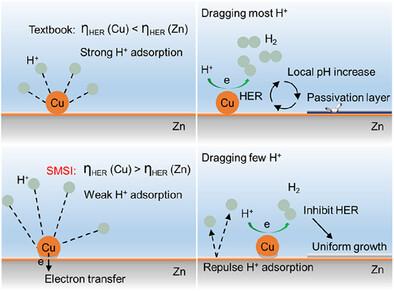
Cu exhibits strong zincophilic properties but suffers from a much lower hydrogen evolution reaction (HER) overpotential compared to Zn, which significantly undermines the coulombic efficiency and stability of the Zn anode. Consequently, Cu is regarded as an unsuitable coating for Zn anode protection. In this work, the HER overpotential of Cu versus Zn is inverted through strong metal-support interaction (SMSI) to modify the electronic structure of Cu. This interaction facilitates electron transfer, enriching positive charge and slowing down the adsorption kinetics of H+ on the Cu surface. As a result, at very low current densities of 0.2 and 2 mA cm⁻2, the Cu-coated-Zn||Cu cell achieves exceptionally high coulombic efficiencies of 99.11% and 99.91% over 2500 and 1600 h of cycling (100% depth of discharge (DOD)), which remarkably surpasses the performance of Zn anode protective coatings all reported. Moreover, a 1 Ah soft-packed full battery is not bulged and retains 94.7% of its initial capacity after 150 cycles. This study overturns the conventional concept by leveraging SMSI to tune the electronic structure, reverses the HER overpotential, and expands the range of viable metals for anode protection in aqueous metal batteries.
Cu具有较强的亲锌性,但其析氢反应过电位远低于Zn,严重影响了Zn阳极的库仑效率和稳定性。因此,铜被认为是不适合锌阳极保护的涂层。在这项工作中,通过强金属支撑相互作用(SMSI)来改变Cu的电子结构,反转Cu对Zn的HER过电位。这种相互作用促进了电子转移,富集了正电荷,减缓了H+在Cu表面的吸附动力学。结果,在0.2和2 mA cm⁻2的极低电流密度下,Cu- Zn||Cu电池在循环2500和1600小时(100%放电深度(DOD))内获得了99.11%和99.91%的超高库仑效率,显著超过了所有报道的Zn阳极保护涂层的性能。此外,1 Ah的软包装电池不会膨胀,在150次循环后仍保持其初始容量的94.7%。这项研究通过利用SMSI来调整电子结构,逆转HER过电位,推翻了传统的概念,并扩大了水金属电池阳极保护的可行金属范围。
期刊介绍:
Advanced Materials, one of the world's most prestigious journals and the foundation of the Advanced portfolio, is the home of choice for best-in-class materials science for more than 30 years. Following this fast-growing and interdisciplinary field, we are considering and publishing the most important discoveries on any and all materials from materials scientists, chemists, physicists, engineers as well as health and life scientists and bringing you the latest results and trends in modern materials-related research every week.







 京公网安备 11010802042870号
京ICP备2023020795号-1
京公网安备 11010802042870号
京ICP备2023020795号-1

 分享
分享
 求助内容:
求助内容: 应助结果提醒方式:
 扫码关注我们
