Heng Zhang, Aderinsola Oduntan, Zengqing Zhuo, Steven S. C. Chuang, Jinghua Guo, Jin Zhong Zhang
{"title":"New Insights into Nonthermal Plasma-Assisted Poly(vinyl alcohol) Depolymerization Catalyzed by TiO2","authors":"Heng Zhang, Aderinsola Oduntan, Zengqing Zhuo, Steven S. C. Chuang, Jinghua Guo, Jin Zhong Zhang","doi":"10.1021/acs.jpcc.4c07876","DOIUrl":null,"url":null,"abstract":"In this study, we investigated the solid residual poly(vinyl alcohol) (PVA) and TiO<sub>2</sub> after nonthermal air, CO<sub>2</sub>, and N<sub>2</sub> plasma depolymerization in the absence and presence of TiO<sub>2</sub>. Scanning electron microscopy studies showed the absence of highly viscous tar and carbonaceous residues on the surfaces of PVA and TiO<sub>2</sub>. In the absence of TiO<sub>2</sub>, PVA particles exhibited micron-sized holes on their surfaces, whereas in the presence of TiO<sub>2</sub>, the surface roughness of PVA particles was observed at the submicron scale. These observations suggest that TiO<sub>2</sub> facilitates the even distribution of nonthermal plasma at a submicron scale, leading to a more uniform depolymerization of PVA surfaces. Raman, Fourier transform infrared spectroscopy, and X-ray absorption spectroscopy showed that (i) the surface of residual PVA contains mainly ketone functional groups and less C–H bonds than the pristine PVA and (ii) further confirmed the absence of highly viscous tar and carbonaceous residues on both used TiO<sub>2</sub> and residual PVA. The nuclear magnetic resonance and mass spectroscopy suggested that the PVA is growing back to poly polyvinyl acetate by the esterification reaction, and the ethers are produced by the acetal reaction between PVA and aldehyde. The transmission electron microscopy and X-ray diffraction analysis indicated no major crystal structural change of the TiO<sub>2</sub> catalyst after the plasma reactions. This study demonstrates that nonthermal plasma-assisted depolymerization is a viable alternative to thermal depolymerization, offering the unique advantage of converting polymer wastes into gaseous small organic molecules without generating recalcitrant viscous tar and carbonaceous residues on the surfaces of the polymer and TiO<sub>2</sub> catalysts.","PeriodicalId":61,"journal":{"name":"The Journal of Physical Chemistry C","volume":"193 1","pages":""},"PeriodicalIF":3.2000,"publicationDate":"2025-02-28","publicationTypes":"Journal Article","fieldsOfStudy":null,"isOpenAccess":false,"openAccessPdf":"","citationCount":"0","resultStr":null,"platform":"Semanticscholar","paperid":null,"PeriodicalName":"The Journal of Physical Chemistry C","FirstCategoryId":"1","ListUrlMain":"https://doi.org/10.1021/acs.jpcc.4c07876","RegionNum":3,"RegionCategory":"化学","ArticlePicture":[],"TitleCN":null,"AbstractTextCN":null,"PMCID":null,"EPubDate":"","PubModel":"","JCR":"Q2","JCRName":"CHEMISTRY, PHYSICAL","Score":null,"Total":0}
引用次数: 0
Abstract
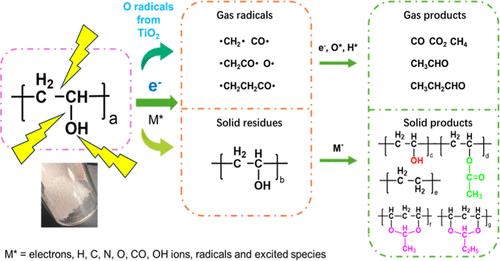
In this study, we investigated the solid residual poly(vinyl alcohol) (PVA) and TiO2 after nonthermal air, CO2, and N2 plasma depolymerization in the absence and presence of TiO2. Scanning electron microscopy studies showed the absence of highly viscous tar and carbonaceous residues on the surfaces of PVA and TiO2. In the absence of TiO2, PVA particles exhibited micron-sized holes on their surfaces, whereas in the presence of TiO2, the surface roughness of PVA particles was observed at the submicron scale. These observations suggest that TiO2 facilitates the even distribution of nonthermal plasma at a submicron scale, leading to a more uniform depolymerization of PVA surfaces. Raman, Fourier transform infrared spectroscopy, and X-ray absorption spectroscopy showed that (i) the surface of residual PVA contains mainly ketone functional groups and less C–H bonds than the pristine PVA and (ii) further confirmed the absence of highly viscous tar and carbonaceous residues on both used TiO2 and residual PVA. The nuclear magnetic resonance and mass spectroscopy suggested that the PVA is growing back to poly polyvinyl acetate by the esterification reaction, and the ethers are produced by the acetal reaction between PVA and aldehyde. The transmission electron microscopy and X-ray diffraction analysis indicated no major crystal structural change of the TiO2 catalyst after the plasma reactions. This study demonstrates that nonthermal plasma-assisted depolymerization is a viable alternative to thermal depolymerization, offering the unique advantage of converting polymer wastes into gaseous small organic molecules without generating recalcitrant viscous tar and carbonaceous residues on the surfaces of the polymer and TiO2 catalysts.
期刊介绍:
The Journal of Physical Chemistry A/B/C is devoted to reporting new and original experimental and theoretical basic research of interest to physical chemists, biophysical chemists, and chemical physicists.



 京公网安备 11010802042870号
京ICP备2023020795号-1
京公网安备 11010802042870号
京ICP备2023020795号-1

 分享
分享
 求助内容:
求助内容: 应助结果提醒方式:
 扫码关注我们
